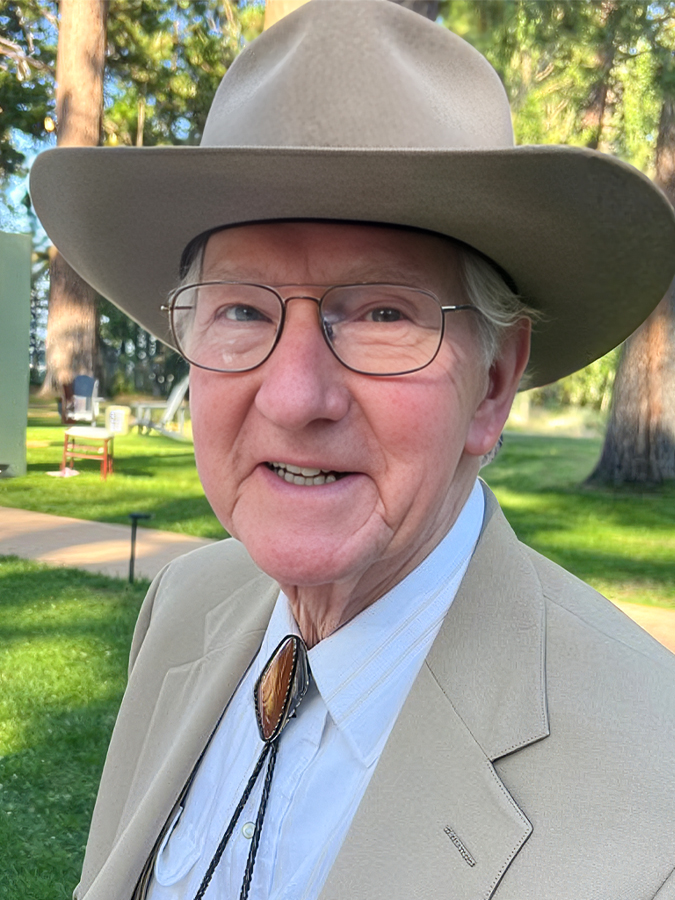

SANTA FE, NM, April 22, 2026 /24-7PressRelease/ -- Richard L. Blake has been selected for inclusion in Marquis Who's Who. As in all Marquis Who's Who biographical volumes, individuals profiled are selected on the basis of current reference value. Factors such as position, noteworthy accomplishments, visibility, and prominence in a field are all taken into account during the selection process.
Pioneering achievements and a steadfast commitment to scientific advancement mark Dr. Blake's distinguished career in physics and astronomy. After retiring from Los Alamos National Laboratory in 1999, he entered active retirement, dedicating his time to Ravens Roost Relics, where he has pursued personal interests and hobbies. His retirement followed a prolific tenure at Los Alamos National Laboratory from 1974 to 1994, during which he carried out numerous physics experiments with X-rays, conducted a program of rocket astronomy, developed diagnostic experiments in the national security program, and played a central role in utilizing synchrotron beam lines (facilities that accelerate electrons to nearly the speed of light, producing finely tuned X-ray beams with applications spanning medicine and numerous scientific fields) to support the national security program, various physics experiments, and calibration of the Chandra X-Ray Observatory. Dr. Blake utilized three beam lines across two rings at Brookhaven National Laboratory, a beam line at Cornell University, and a lower energy beam line at The Advanced Light Source at Lawrence Berkeley Laboratory. During his final years at Los Alamos, Dr. Blake formed a significant collaboration with the Harvard-Smithsonian Center for Astrophysics to calibrate the Chandra X-ray Observatory sponsored by NASA. Over a decade, he and collaborators meticulously used his equipment on these beam lines to calibrate the observatory's mirrors and focal-plane instruments, achieving an unprecedented accuracy of 1%. This accomplishment allowed NASA to leverage existing facilities rather than develop new ones, streamlining the calibration process and contributing directly to the success of the Chandra mission following its launch in 1999.
Earlier in his career, Dr. Blake was Assistant Professor in the University of Chicago's astronomy department from 1968 to 1974. There, he initiated an X-ray astronomy program that began with university support and later secured grants from the National Science Foundation, the Air Force and NASA.
Dr. Blake's professional journey began with his service as an astronomer at the Naval Research Laboratory from 1959 to 1963, following his undergraduate studies at Rensselaer Polytechnic Institute. As a young naval officer assigned through the Navy ROTC scholarship program, he worked under Dr. Herbert Friedman, a pioneer in rocket astronomy. During his active duty with the United States Navy, Dr. Blake developed a camera capable of capturing X-ray photographs of the Sun and later created a spectrograph to measure its X-ray spectrum—both requiring rocket-based experiments above Earth's atmosphere due to X-rays' inability to penetrate it. These early projects laid critical groundwork for future advancements in X-ray photography and spectroscopy of cosmic sources.
After completing his military service, Dr. Blake returned to graduate school and spent five years conducting research for his doctoral thesis at the University of Colorado Boulder. He constructed a large laboratory dedicated to replicating solar spectra measured in X-rays and completed his PhD in astrophysics in 1968.
Throughout his career Dr. Blake served as a consultant on X-ray physics and astrophysics and later provided synchrotron expertise to several companies and individuals. It was late in his career as noted earlier when he collaborated with the Harvard-Smithsonian Center for Astrophysics. In addition to his primary research roles, he made contributions to national security programs during his time at Los Alamos National Laboratory.
Dr. Blake's professional affiliations reflect his broad engagement with both scientific and archaeological communities. He is a member of the American Physical Society, the American Astronomical Society, the American Geographical Union and the Archaeological Institute of America. He has served as a board member of Friends of Archaeology at the Office of Archaeological Studies in New Mexico and, for 10 years, on the board of the Southwest Association on Indian Affairs. Additionally, he is involved with the Santa Fe Archaeological Society.
His academic background includes a Bachelor's degree from Rensselaer Polytechnic Institute in Troy, New York, earned in 1959, followed by a Doctor of Philosophy in astrophysics from the University of Colorado Boulder in 1968. Dr. Blake credits his success to curiosity and tenacity. He notes that his early ambition to become a physicist guided him into roles as physicist, astronomer and astrophysicist throughout his career.
Dr. Blake's achievements have been recognized through numerous awards and honors: he is a grant recipient from the National Science Foundation, Air Force and NASA; has received recognition from Sigma Xi; and was honored with several participation awards from Los Alamos National Laboratory.
Beyond his scientific pursuits, Dr. Blake is civically engaged as a contributor to Doctors Without Borders and PBS. He has also remained actively involved with organizations dedicated to archaeology and cultural preservation.
Born in Berkeley Springs, WV Dr. Blake enjoys archaeology, collecting cars, traveling globally for archaeological digs and photography. He is devoted to family life with four stepchildren and plans to continue restoring cars while deepening his involvement in archaeology and family affairs.
Dr. Blake's legacy is defined by pioneering contributions to X-ray astronomy—most notably integrating X-ray photography into astrophysics and guiding calibration efforts for rocket and space observatories—alongside decades of service advancing science through research, mentorship and civic engagement.
# # #