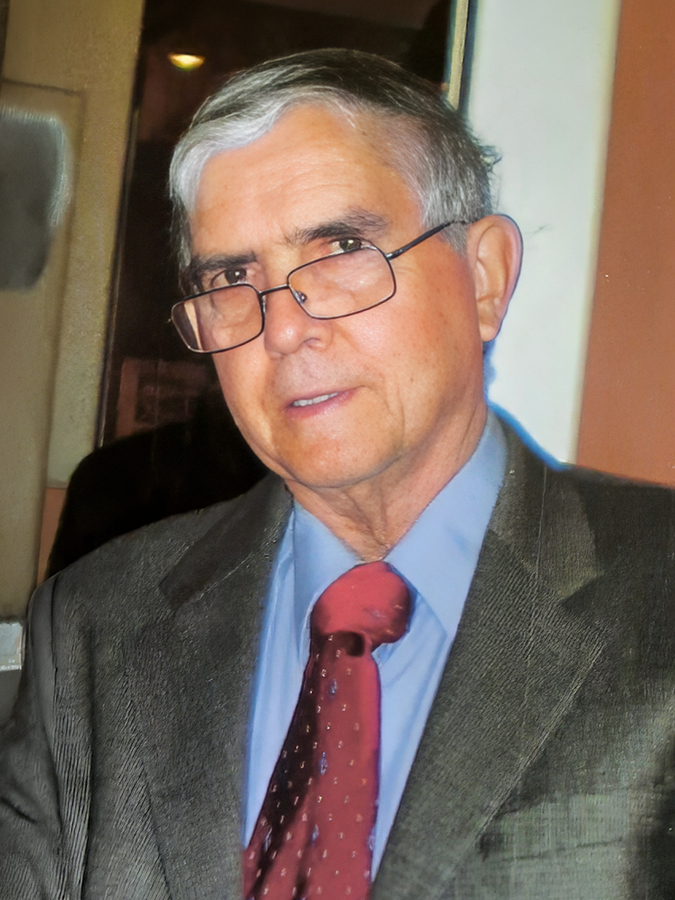

GEORGETOWN, TX, June 26, 2026 /24-7PressRelease/ -- David John McAdoo has been included in Marquis Who's Who. As in all Marquis Who's Who biographical volumes, individuals profiled are selected on the basis of current reference value. Factors such as position, noteworthy accomplishments, visibility, and prominence in a field are all taken into account during the selection process.
Dr. McAdoo's distinguished career in chemistry (esp. ions) and neuroscience research is marked by a series of significant appointments and achievements that reflect his expertise and dedication to advancing scientific knowledge. Prior to his passing, his most recent and prominent role was as a professor emeritus and neuroscience researcher at the University of Texas Medical Branch in Galveston, where he focused on spinal cord research.
The David McAdoo's Laboratory in Neuroscience at the University of Texas Medical Branch, Galveston, TX, was created where ideas were exchanged, with vigor and passion and sometimes at an uncomfortalbe volume. Dr. McAdoo believed that an intellectually permissive environment, where ideas could be exchanged, contributed to some of the most significant findings in neuroscience. Dr. McAdoo was at UTMB from 1973 to 2008.
During his tenure, Dr. McAdoo taught medical students, trained postdoctoral fellows and mentored high school students during summer programs. His research contributions in neurosciences are widely recognized, with more than 250 published papers in professional journals. He also lectured internationally in cities such as Barcelona, Paris, London and Bologna, as well as in various locations in Japan, further establishing his reputation as a leader in his field. His respect and use of the spectrometer was obvious.
Before his long-standing service at the University of Texas Medical Branch, Dr. McAdoo held a position at the Jet Propulsion Laboratory in Pasadena, California. Initially hired to work on life-detection research on Mars, he was frequently called upon to repair the laboratory's room-sized computer systems, which broke down frequently, because of his technical expertise. This was in the late 60s and as a chemist, not a lot of data was available for analysis. This role provided him with valuable interdisciplinary experience and introduced him to colleagues whose research interests would later influence his career trajectory.
At Johns Hopkins University, Dr. McAdoo completed a postdoctoral position, where he deepened his understanding of advanced scientific methodologies and contributed to ongoing research initiatives. Before this appointment, he spent one year with Union Carbide in White Plains, New York, gaining experience in industrial chemistry.
Dr. McAdoo's early professional journey began with the United States Food and Drug Administration in Philadelphia, Pennsylvania, where he worked for one year developing methods to increase protein content in military rations during the Vietnam War. This innovative work demonstrated his commitment to practical applications of chemistry for societal benefit.
Dr. McAdoo served in the United States Army. Rather than being deployed to combat zones, he was assigned to military research roles in Neddick, MA due to his scientific background. It was during this period that he met his mentor, Dr. Fred W. McLafferty, and first encountered a mass spectrometer, an experience that shifted his focus from medicine to research. After Dr. McAdoo's post doc at John Hopkins University, Dr. McLafferty invited Dr. McAdoo to join him at Purdue and then Cornell. The two chemists found a molecule together before Dr McAdoo went west.
Throughout his career, Dr. McAdoo was recognized for his academic rigor and impact on the field. Notably, Dr. McLafferty honored him by stating that Dr. McAdoo had produced the longest and best thesis of any student he had mentored at Cornell University, a testament to Dr. McAdoo's scholarly excellence.
Beyond his professional titles, Dr. McAdoo's affiliations included membership in the American Chemical Society and service on major grant review committees responsible for evaluating applicants for funding from institutions such as the National Institutes of Health and the Department of Veterans Affairs. He regularly traveled to Washington, D.C., for committee meetings that shaped national research priorities.
Dr. McAdoo's educational foundation began with a Bachelor of Science in Chemistry from Lafayette College on scholarship in 1963, where he quickly became known as the star of his chemistry class. He pursued coursework at Purdue University before following Dr. McLafferty to Cornell University, where he earned a Doctor of Philosophy in 1971. David, the oldest of four siblings, lost his father at the age of 11. The intellectual curiosity that defined his youth, fostered by growing up in Frog Hollow, PA, continued throughout his academic pursuits and professional life.
Beyond academia, Dr. McAdoo's civic engagement extended into environmental stewardship and community service. He co-founded the Georgetown Chapter of the Texas Master Naturalist program after relocating to Georgetown following Hurricane Ike and retirement from the University of Texas Medical Branch. He was also active with the Galveston Bay Area Chapter of Texas Master Naturalist. was also recognized for many years in the Texas Speleological Association where he was leader of his grotto. They caved from within Mexico to Pennsylvania. As a youth, his curiosity led him to many Woodland Indian sites of his humble home in "Frogs" Hollow, a natural place near Washington, PA where he was born. As an adult, he continued to pick up artifacts while hiking in Texas. He volunteered at an archaeological dig in Florence, Texas (The Gault Site, with preclovis artifacts), an interest rooted in childhood experiences discovering Native American artifacts of the Woodland Indians.
Quoting his first wife of 30 years, Martha Hervey (also a chemist): "Dave has taken me to the depth of the earth and to the heights of mountains." Due to her illness. yet wanting children, they adopted two in 1979 (Cathy) and in 1981 (Matthew). He took to parenthood with gusto.
Dr. McAdoo married his high school sweetheart Gail Wetzel in 1997: they were the first to be married in a Frank Lloyd Wright house in southcentral PA. They thoroughly enjoyed Galveston until Hurricane Ike in 2008. Georgetown TX offered a different environment to explore. They became students in the Life Long Learning program, and co-founded (with ten others) the Williamson County Chapter of the Texas Master Naturalist, an organization they had both enjoyed in Galveston. And they travelled (Machu Pichu, Galapagos, the Amazon, Eqypt, Spain, Japan.....) until Lewy Body Dementia grabbed the accomplished scientist in 2019.
Dr. McAdoo enjoyed spelunking, rappelling, birdwatching, parenthood, music and travel — pursuits that reflected both his adventurous spirit and enduring curiosity about the world around him. He held deep, principled convictions, strongly believing in democracy and advocating for the separation of church and state.
Some of his pivotal work at UTMB:
1. He was one of the first to describe glycine and L-glutamic acid as neruotransmitters of importance in the central nervous system of metazoans.
2. He described and characterized many biogenic amines as critical neurotransmitters.
3. He was one of the first to conclusively show bidirectional axonal transport of substances.
4. In the mid 1980s, he collaborated with Linda Sorkin, Judy Steinman and Bill Willis to develop the first real time sampling technique in which the microenvironment of the spinal cord could be sampled by using microdialysis tubing that was carefully painted, so that only a mm or two was open for sampling extracellular concentrations of constituents in the spinal cord.
5. Using these techniques, he was the first to describe that excitatory amino acids increased by 37 fold after spinal cord injury. These levels are clearly toxic to cells and led to the new widely accepted understanding of the pathophysiology of "excitotoxicity" after central nervous system injury.
6. He was one of the first to demonstrate the role of free radicals in cellular toxicity in the pathophysiology of spinal cord injury.
7. After describing various compounds that rose to toxic levels after spinal cord injury, he then publiihed an impressive series of manuscripts on various blockers that attenuate the cytotoxicity and preserve neural cells that were at risk of dying. Relatives of these blockers are or have been in clinical phase 1 trials.
8. Because of his precision and care in measurements, he was sought after as a collaborative colleague to measure substances released by transplanted stem cells.
9 Because of his expertise in spinal cord injury and precision of chemical measurements he was sought after as a collaborative colleague to study the pathophysiology and prevention of pain after spinal cord injury. His project is a pivotal project in a 7.5 m Program Project Grant.
10. He has fostered the careers of several junior investigators that have gone on to leadership positions in academia, industry and medicine.
11. His productivity continued to be impressive with 5 publications in early 2006. He continued to remain productive in terms of grantsmanship and manuscript production, beyond retirement in 2008.
12. In the area of leadership, he has served as Chair of several key departmental and university committees, and served on Study Section and NIH, which attests to his recognition and reputation internationally.
In summary his scientific contributions have made important and critical insights in the understanding of how the central nervous system works.
# # #