 +1 888-880-9539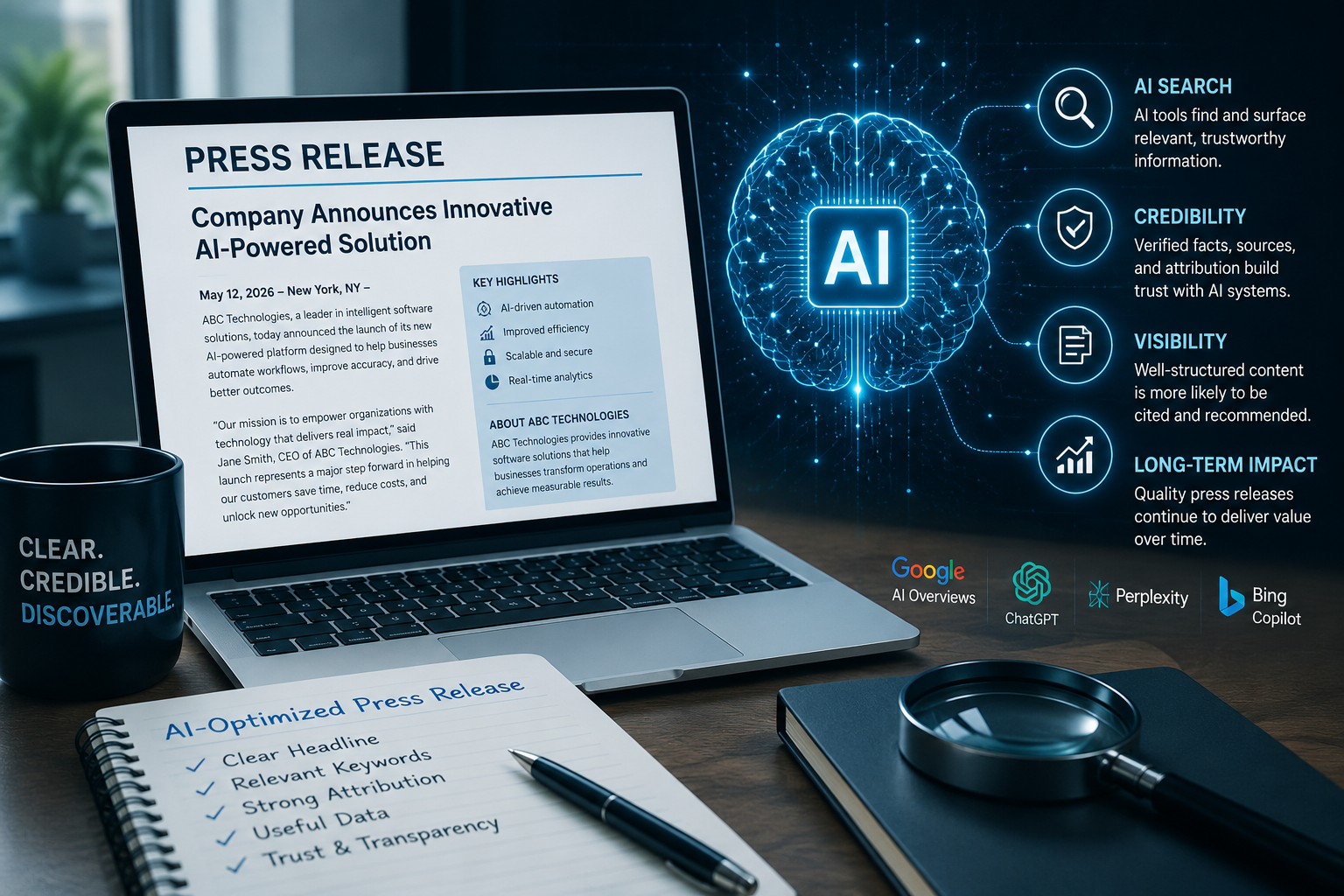
For years, many businesses approached press releases primarily as promotional announcements. The goal was often visibility, backlinks, or simply getting a company name distributed across the web. But as AI-powered search engines and answer engines continue reshaping how information is discovered online, the role of the press release is quietly evolving into something far more important: a trusted source document.
In 2026, platforms like Google AI Overviews, ChatGPT, Perplexity, Bing Copilot, and other AI-driven systems are increasingly prioritizing content that appears factual, structured, attributable, and verifiable. That shift is creating a major opportunity for organizations that understand how to write press releases for both human readers and AI interpretation.
One of the biggest misconceptions businesses still make is assuming that AI search rewards sensational headlines or exaggerated marketing language. In reality, AI systems are becoming increasingly cautious about credibility signals. A press release that clearly explains who is making the announcement, what specifically is happening, why it matters, and where supporting information can be verified often performs far better than content filled with vague promotional claims.
This does not mean press releases should become dry or robotic. Strong storytelling still matters. However, clarity is now becoming one of the most valuable SEO assets a company can have.
When AI systems scan a press release, they are often attempting to answer very specific questions. What company made the announcement? Is there a named executive attached to the statement? Is the information time-sensitive? Does the release contain useful context, data, statistics, locations, or supporting details? Is the content written in a way that appears trustworthy and understandable?
Press releases that answer those questions naturally tend to have greater long-term discoverability.
One trend becoming increasingly visible is the growing importance of attribution. Press releases that include executive quotes, named experts, research references, partnerships, and identifiable organizations provide stronger trust signals to AI systems. Anonymous or overly generic statements often carry less weight because they provide little context for verification.
For example, compare these two approaches:
“Our revolutionary platform is transforming the future of healthcare.”
Versus:
“According to CEO Jane Smith, the platform reduced patient on-boarding time by 42% during a six-month pilot program across three clinics.”
The second statement gives AI systems something tangible to interpret and potentially cite. It includes attribution, measurable information, and contextual specificity. Those details matter more than ever.
Another major shift involves how AI systems evaluate structure. Historically, many press releases relied on keyword stuffing or repetitive phrasing designed primarily for older search engine algorithms. Modern AI systems are moving away from that approach. Instead, they reward natural language, semantic relevance, and logical organization.
This means companies should focus less on repeating keywords excessively and more on writing clearly around a topic. A well-written press release about cybersecurity, for example, may naturally mention ransomware protection, threat detection, network security, compliance, incident response, and data privacy without awkward repetition. AI systems are increasingly capable of understanding those relationships contextually.
Formatting also plays a surprisingly important role. Press releases that use strong headlines, clear subheadings, readable paragraphs, and organized information are easier for AI systems to interpret. Dense walls of text with little structure may reduce readability for both humans and machine analysis.
In addition, supporting media is becoming increasingly valuable. Images, executive photos, charts, info-graphics, videos, and downloadable resources can strengthen engagement signals while helping AI systems better understand the content surrounding a release. Google itself has repeatedly emphasized the importance of helpful, people-first content that demonstrates expertise and value.
Companies should also think beyond immediate distribution and consider the long-term shelf (or search) life of a press release. A well-structured release may continue appearing in AI-generated answers months or even years after publication if the topic remains relevant. Evergreen educational angles often outperform purely promotional announcements over time.
For instance, a release discussing broader industry challenges, regulatory changes, emerging technologies, or consumer trends may have more lasting AI visibility than a simple “company announces new product” story with little contextual depth.
This is particularly important because AI search increasingly blends multiple sources together when generating responses. Press releases that provide useful facts, definitions, timelines, or expert commentary may be included in those synthesized answers, even if the original release was not widely covered by traditional media.
That creates an entirely new layer of opportunity for businesses willing to approach press releases strategically.
Another overlooked factor is consistency. Organizations that publish credible, informative releases regularly may gradually strengthen their overall digital authority. AI systems appear to favor entities that consistently publish coherent information across time, especially when that information aligns with external references, company websites, executive profiles, and third-party mentions.
In many ways, press releases are becoming part of a broader digital trust ecosystem.
This does not mean every press release will suddenly go viral or appear inside AI-generated search answers. But it does mean that businesses now have an opportunity to create content that serves both immediate distribution goals and long-term discoverability.
The companies benefiting most from AI-driven search visibility are often not the loudest. They are the clearest.
As AI continues reshaping online discovery, the future of press release writing may rely less on hype and more on credibility, clarity, structure, and usefulness. Businesses that understand this shift early may find that a thoughtfully written press release becomes far more than a temporary announcement. It becomes a durable digital asset that helps establish authority, trust, and discoverability across the evolving landscape of AI-powered search.