 +1 888-880-9539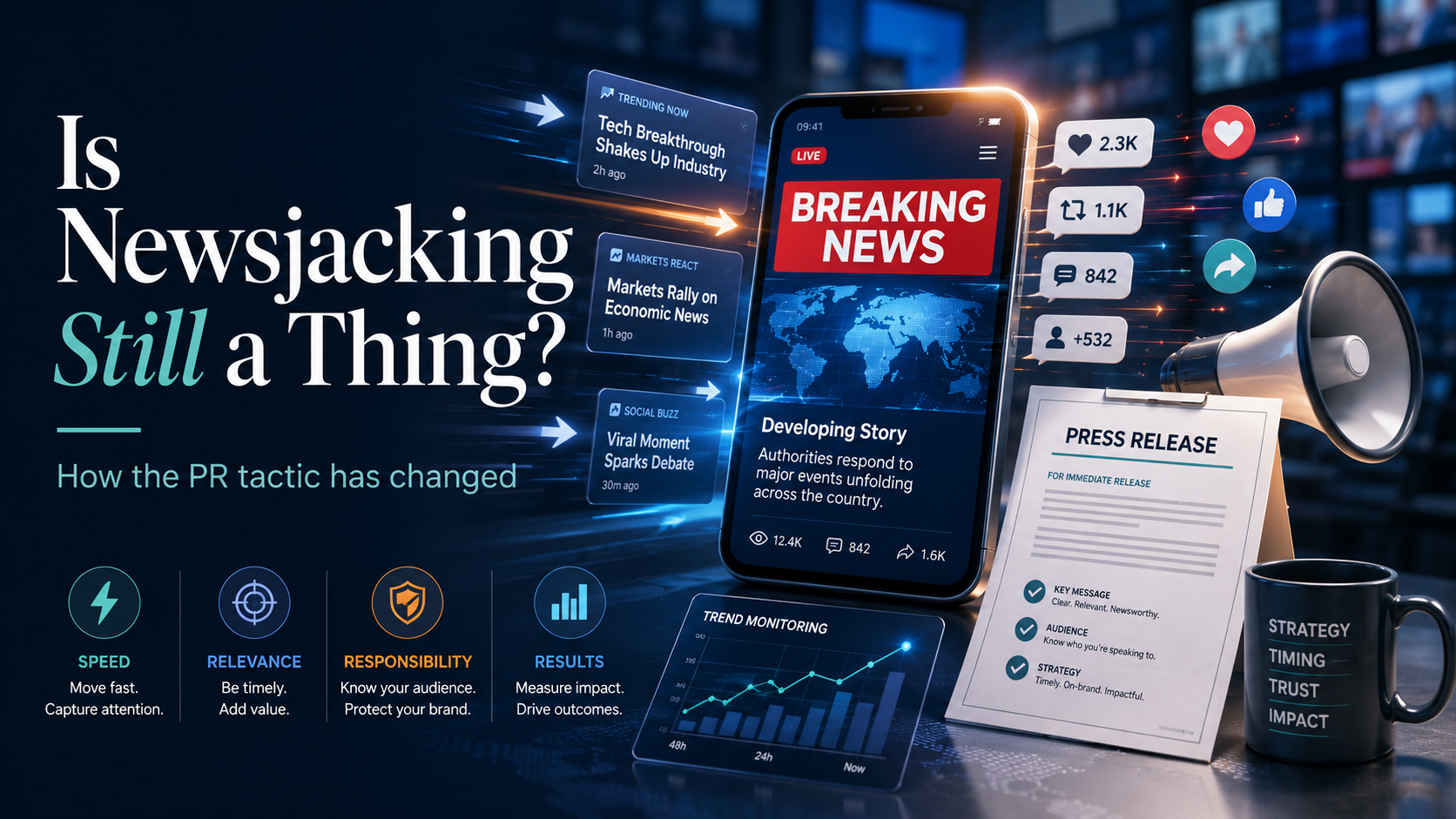
Newsjacking has been around long enough that some marketers now wonder whether it is still relevant or belongs to an earlier era of social media marketing. The short answer is yes, newsjacking is still a thing. Brands, agencies, entrepreneurs, and public relations teams still use current events to create timely content, pitch media, write press releases, and join public conversations. What has changed is how it is done, the speed at which it happens, and the level of caution required before linking a brand to a trending topic.
In a previous 24-7 Press Release Newswire article, “Newsjacking in 2025: A Clever Press Release Strategy or a Controversial Practice?”, we explored how newsjacking had shifted from a clever visibility tactic into something that requires far more care and judgment. The article noted that newsjacking can still help a press release or campaign feel timely, but only when the connection is authentic and appropriate. That point has become even more important over the last year or two. News cycles are faster, audiences are more skeptical, and brands have less room for error when they try to align with current events.
Traditionally, newsjacking meant taking a breaking news story or trending topic and quickly adding a brand’s angle to it.
In the early days of social media, this often meant a fast tweet, a clever headline, or a campaign that responded to a major cultural moment. The goal was simple: join the conversation while people were already paying attention. If you were successful, it could make your brand appear timely, relevant, and creative. If done poorly, it could feel forced, opportunistic, or insensitive.
Fast forward to mid-2026, and the basic idea has not disappeared. Companies still monitor the news for opportunities. PR teams still look for ways to connect client announcements to larger industry trends. Businesses still use timely hooks in press releases, blog posts, email campaigns, and LinkedIn updates. However, modern newsjacking is less about jumping on any trend and more about choosing the right trend. A weak or forced connection is easier than ever for audiences to recognize and criticize. A company that tries to insert itself into a conversation where it lacks credibility can quickly appear to be chasing attention rather than adding value.
One of the biggest changes is that newsjacking has become more strategic and less spontaneous. In the past, the most famous examples often came from quick reactions to unexpected events. Today, many successful newsjacking efforts are planned around predictable moments, such as major sporting events, holidays, award shows, seasonal changes, government announcements, economic reports, product trends, or industry developments. Instead of waiting for a random breaking news moment, businesses can prepare flexible messaging in advance and respond when the timing is right.
This matters for press releases because a timely angle can still make a release more interesting. A company announcing a new cybersecurity service, for example, may be more relevant if the announcement ties into a broader rise in cyber threats or new security regulations. A real estate company discussing affordability may connect its announcement to current housing market conditions. A health technology company may reference wider conversations about access to care, aging populations, or digital health tools. In each case, the news hook helps explain why the announcement matters now.
However, the key is that the company must have a legitimate reason to participate in the conversation. This is where modern newsjacking differs from the older, more opportunistic version. Today, the strongest examples are not simply “our brand noticed this trending topic.” They are closer to “our organization has expertise, data, a service, a solution, or a useful perspective that helps people understand this issue.” That is a much stronger foundation for a press release, media pitch, or content campaign.
The Public Relations Society of America has also noted that PR professionals operate in a fast-changing environment shaped by technology, politics, and shifting public expectations. That context is important. Newsjacking now occurs in an environment where artificial intelligence plays a role. AI can help teams monitor trends, draft content, and analyze public conversations faster than ever before. At the same time, AI-generated content has made audiences more cautious about generic or low-effort messaging. Speed alone is no longer enough. In fact, being too fast without thinking carefully can create more risk than reward.
Over the last year or two, another major change has been the rise of AI search and answer engines. Traditional search behaviour is changing, and many people now discover information through AI summaries, social platforms, newsletters, podcasts, and short-form video rather than only through search engine results. This means newsjacking is no longer just about getting a timely article indexed on Google or hoping a journalist picks up a story. It is also about creating clear, useful, well-structured content that is understandable across different platforms and formats.
This gives press releases a continued role. A well-written press release can establish the facts, provide a timely angle, and give journalists, customers, and search systems a clear source of information. But the release must be specific. Generic statements tied to broad trends are less effective. A better approach is to include concrete details, quotes from credible spokespeople, relevant data, and a clear explanation of why the announcement connects to the current moment.
The ethical side of newsjacking has also become more important. What was once an opportunity should now be avoided; we are talking about topics such as tragedies, disasters, violence, political conflict, and sensitive social issues. Newsjacking on these subjects can pose serious reputational risk if a company appears to be using them for promotional purposes. Even if the intent is not harmful, the perception can be damaging. Modern audiences are quick to question motive. Before using a news hook, companies should ask whether they are helping the conversation or simply borrowing attention from it. As a press release service at 24-7PressRelease, we have seen folks take this angle and sometimes cringe or, in extreme cases, deny a press release.
We are not saying that brands should avoid all serious topics. Some organizations have genuine expertise or a meaningful role to play in difficult conversations. A nonprofit responding to a disaster, a medical organization sharing public health information, or a cybersecurity company warning businesses about a new threat may have a valid reason to speak. The difference is contribution. If the message provides useful information, support, resources, or expert context, it is far more likely to be received as responsible communication.
So, do people still do newsjacking? Absolutely. But the best practitioners are doing it more carefully. They are using it as part of a broader content and PR strategy rather than a quick trick for attention. They are focusing on relevance, brand fit, timing, and usefulness. They are also recognizing that the modern public has a sharper eye for authenticity. Audiences can tell when a brand is trying too hard to force itself into a moment.
For businesses considering a newsjacking angle in a press release, the best test is simple: would this announcement still matter if the trending topic disappeared tomorrow? If the answer is no, the angle may be too weak. But if the news hook helps explain the timing, urgency, or importance of the announcement, it may strengthen the release. A timely angle should support the story, not replace it.
Newsjacking is still alive, but it has matured. The older version was often about speed and cleverness. The newer version is about relevance, judgment, and trust. When done thoughtfully, it can still help companies connect their message to what people are already discussing. When done carelessly, it can quickly damage credibility. The opportunity remains, but the standard is higher.
For press releases in particular, the most effective approach is not to chase every headline. It is to identify the current events, industry shifts, or cultural conversations where a company has something meaningful to add. In that sense, newsjacking has not gone away. It has simply become more responsible, more selective, and more closely tied to the quality of the message itself.
Find more helpful tips in our press release writing tips Knowledge Base page.
By: Michael Iwasaki
Michael Iwasaki is a managing partner at 24-7 Press Release Newswire and has been with the company since 2004. He writes about press release strategy, editorial best practices, and how businesses can create clearer, more credible, and more newsworthy announcements.