 +1 888-880-9539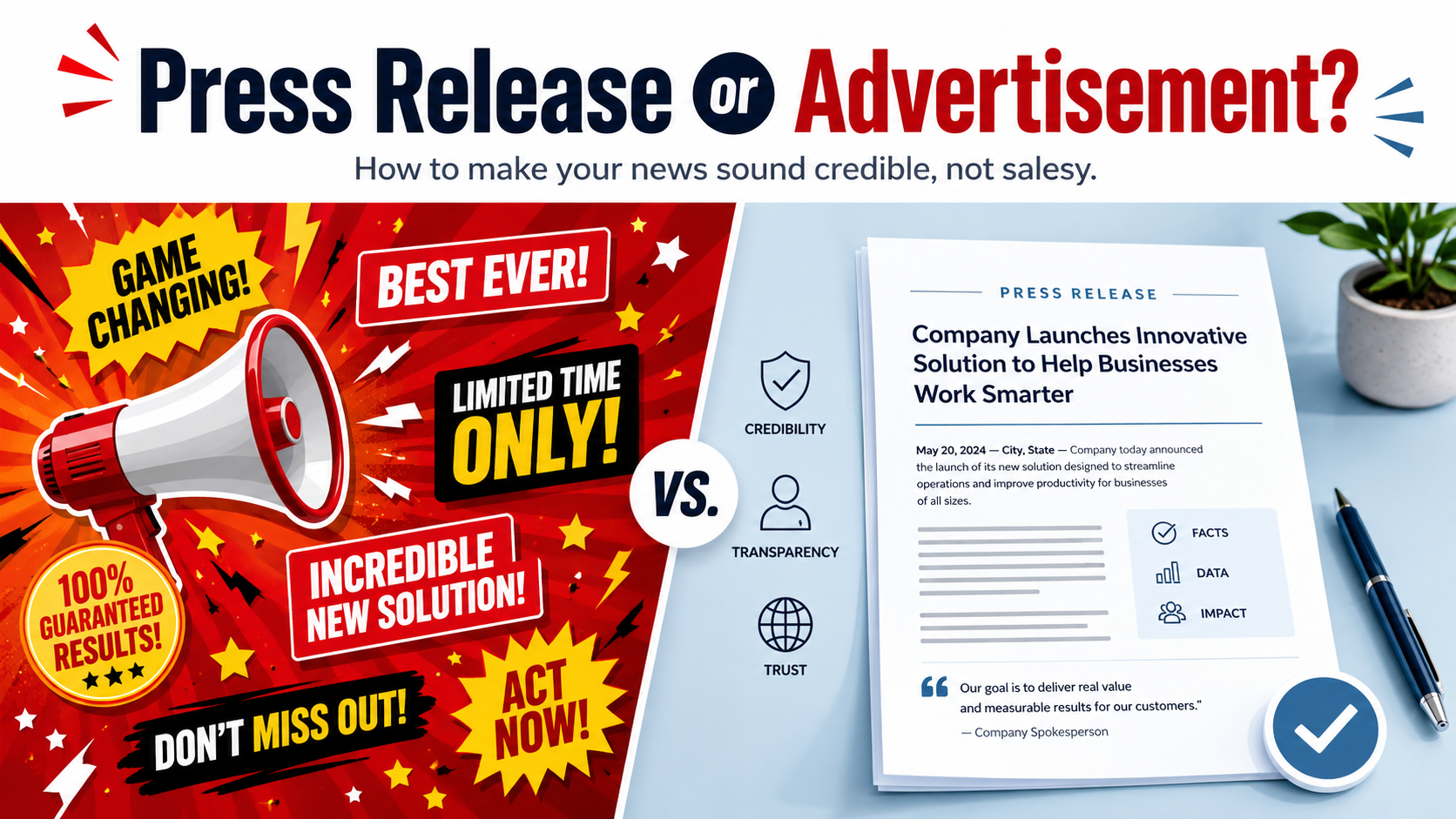
That may sound obvious, but it is one of the most common issues we see when reviewing press release submissions. In our experience, roughly 20% of press releases submitted to 24-7 Press Release Newswire read too much like an advertisement, sales pitch, or promotional brochure rather than a clear news announcement.
That does not mean the company has nothing valuable to say. In many cases, there is a real announcement buried inside the draft. A business may be launching a new product, expanding into a new market, hiring a key executive, opening a location, publishing research, hosting an event, or reaching a milestone.
The problem is often the way the story is presented.
Instead of leading with the news, the release leads with hype. Instead of explaining what happened, it tries to persuade. Instead of giving journalists, readers, search engines, and AI-powered discovery tools clear facts to understand, writers try to push claims like "best," "revolutionary," "game-changing," "industry-leading," or "unmatched."
Those words may sound exciting to the company writing the press release, but they usually make the content less credible, doing more harm than good. A stronger press release does not need to shout. It needs to inform.
Why Salesy Press Releases Usually Underperform
Businesses often write press releases like advertisements because they are excited about what they offer. That is understandable. When you are close to your own company, product, or service, it is natural to want to explain why people should care. That said, a press release has a different job from an ad.
An advertisement is designed to sell directly. It can use emotional language, repeated calls to action, promotional claims, and persuasive messaging. A press release is designed to communicate news. It should explain what happened, why it matters, who is involved, and where readers can learn more. When a press release sounds too advertorial, it can create several problems.
First, it may be less appealing to journalists or editors. Media professionals are usually looking for information they can evaluate quickly. They want the facts, not a sales pitch. If the headline and opening paragraph sound like marketing copy, they may move on before they find the actual news.
Second, it can weaken reader trust. Readers are more likely to take a release seriously when the claims are specific, supported, and clearly presented. A release that makes big promises without evidence may feel exaggerated.
Lastly, it may make the release harder to understand, which could cause it to appear in search or AI-driven discovery.
When a press release is written clearly, with specific information, useful to the media, and supported by verifiable claims, it provides journalists, search engines and AI tools with cleaner information to interpret. But when the release is primarily promotional, there is less substance for those systems to identify, summarize, or connect to relevant questions.
This does not mean a press release cannot support marketing goals. It absolutely can. But it does that best when it starts with real news, not an advertisement disguised as news.
The Difference Between News and Advertising
One of the easiest ways to improve a press release is to ask a simple question:
What actually happened?
If the answer is unclear, the release may be too promotional. For example, this sounds like advertising:
"XYZ Company is proud to offer the most innovative and reliable resolution for businesses looking to transform their success and dominate their industry."
This sounds more like news:
"XYZ Company has launched a new scheduling platform for small businesses, designed to help service providers manage appointments, reminders, and customer follow-ups from one dashboard."
The second version is stronger because it gives the reader something concrete. It tells us what happened. A company launched a platform. It explains who it is for. It identifies what the platform does. It does not require the reader to accept a vague claim like "most innovative."
Here is another example.
Advertorial version:
"DEF Wellness is changing the health industry with a revolutionary new program that delivers unmatched results for clients everywhere."
News-style version:
"DEF Wellness has introduced a 12-week virtual coaching program for remote employees. The program includes weekly nutrition sessions, habit tracking, and group accountability meetings."
This version is stronger because it tells the reader what the company has actually accomplished. It provides specific details rather than relying on a broad claim like "revolutionary" or "unmatched." If the program has results to back it up, those can be added later through data, testimonials, study findings, professional credentials, or other proof points. Common Signs a Press Release Sounds Too Much Like an Advertisement
After looking at tens of thousands of press releases over the years, we start to recognize certain patterns. Below are five of the most common issues.
1. Rather than announcing news, the headline makes a claim.
When we see a headline like "XYZ Company Is the Best Choice for Homeowners," it sounds way too promotional. A headline like "XYZ Company Opens New Home Renovation Showroom in Dallas" gives readers the facts without overpromotion.
A good headline should usually identify a specific announcement: a launch, expansion, appointment, partnership, award, event, study, milestone, acquisition, funding round, or major update.
2. The opening paragraph does not say what happened
The first paragraph should quickly answer the basic questions: who, what, when, where, and why it matters. If the opening paragraph is mostly adjectives, slogans, or background about how great the company is, the release may lose the reader.
3. The release uses too many unsupported claims.
Using words like "best," "leading," "top," "premier," "unmatched," and "world-class" may not always be wrong, but they should be supported by evidence. If a company says it is "award-winning," make sure to name the award. If it says it is "fast-growing," include evidence, including any statistics. If it says it is "industry-leading," explain based on what measure.
Unsupported claims make a release feel less credible.
4. The quote sounds like a slogan
Quotes are often one of the weakest parts of a press release. A quote should add context, perspective, or explanation. It should not simply repeat the company's marketing message and should come from a top individual within the organization or Company
A weak quote might say:
"We are thrilled to offer the best service in the industry and help customers achieve amazing results."
A stronger quote might say:
"Many of our customers told us they needed a simpler way to manage bookings without adding another complicated software tool," said Jane Smith, founder of XYZ Company. "This launch is our response to that feedback."
The second quote explains the reason behind the announcement. It gives the reader more context.
5. The call to action takes over the release
A press release can include a website link or contact information. That is normal. But if the release repeatedly tells readers to "buy now," "sign up today," "claim your offer," or "act before it is too late," it absolutely sounds like an advertisement.
A press release should inform first. The call to action should be secondary.
How to Turn a Salesy Press Release Into a Newsworthy Announcement
If your draft sounds too promotional, you do not always need to start over. Often, you can improve it by changing the structure and language.
Start by identifying the real news. What has changed? What is new? What is timely? What would a reader not have known before?
Then rewrite the opening around that fact.
For example, instead of starting with:
"DEF Consulting is proud to be the most trusted partner for companies seeking growth, success, and long-term transformation."
Start with:
"DEF Consulting has opened a new office in Austin, Texas, to support growing demand from technology and manufacturing clients in the region."
The second version gives the reader real news. The company can still explain its services later, but the release begins with news.
Next, replace broad claims with proof points.
Instead of:
"Our platform saves businesses time and improves productivity."
Look to changing to something like:
" According to the company, folks who have tried our new platform, using features like appointment management, customer service inquiries, and follow-up messages from a single dashboard, have saved them a lot of time and frustration."
The goal is not to remove all positive language. The goal is to make the positive language specific and supportable.
Last but not least, ensure your press release has enough context. For example, explain why the announcement matters now. Is the news connected to customer demand, market growth, a company milestone, a new regulation, or a seasonal trend? Adding context helps readers understand why the announcement is relevant.
A Simple Test Before You Publish
Before submitting a press release, read the headline and first paragraph and ask:
Would this still make sense if I removed the company's self-description?
If the answer is no, the release may be relying too heavily on promotion.
Next, you need to ask:
- What happened?
- Who does this currently affect or in the future?
- Why is it newsworthy right now?
- What are the supporting facts?
- Is the quote adding real context?
- Can the claims be verified?
- Would a journalist, customer, or AI-powered search system be able to understand the announcement quickly?
If the release answers those questions clearly, it is much more likely to read like news.
Press Releases Can Promote a Business Without Sounding Promotional
One of the biggest misconceptions about press releases is that they must sound promotional to help a company. In reality, the opposite is often true.
A clear, factual, news-style release can do more for credibility than a release packed with exaggerated claims. It gives journalists something easier to evaluate. It gives readers something easier to trust. It gives search engines and AI systems cleaner information to understand. And it gives the company a stronger professional presentation.
The best press releases are not boring. They are focused. They give the reader a reason to care without forcing the message.
If your company has real news, you do not need to bury it under hype. Lead with the announcement. Support it with facts. Use quotes to explain why it matters. Keep the sales pitch out of the lead.
A press release can still help promote your business, product, service, or event. But it works best when it earns attention by sounding credible, not when it demands attention by sounding like an ad.
At 24-7 Press Release Newswire, one of the most common issues we see is that businesses often have a real story to tell, but the first draft sounds too advertorial. The good news is that this is fixable.
Start with the news. Add context. Support your claims. Write for people first.
That is how a press release becomes more than promotion. It becomes useful information.
By: Michael Iwasaki
Michael Iwasaki is a managing partner at 24-7 Press Release Newswire and has been with the company since 2004. He writes about press release strategy, editorial best practices, and how businesses can create clearer, more credible, and more newsworthy announcements.