 +1 888-880-9539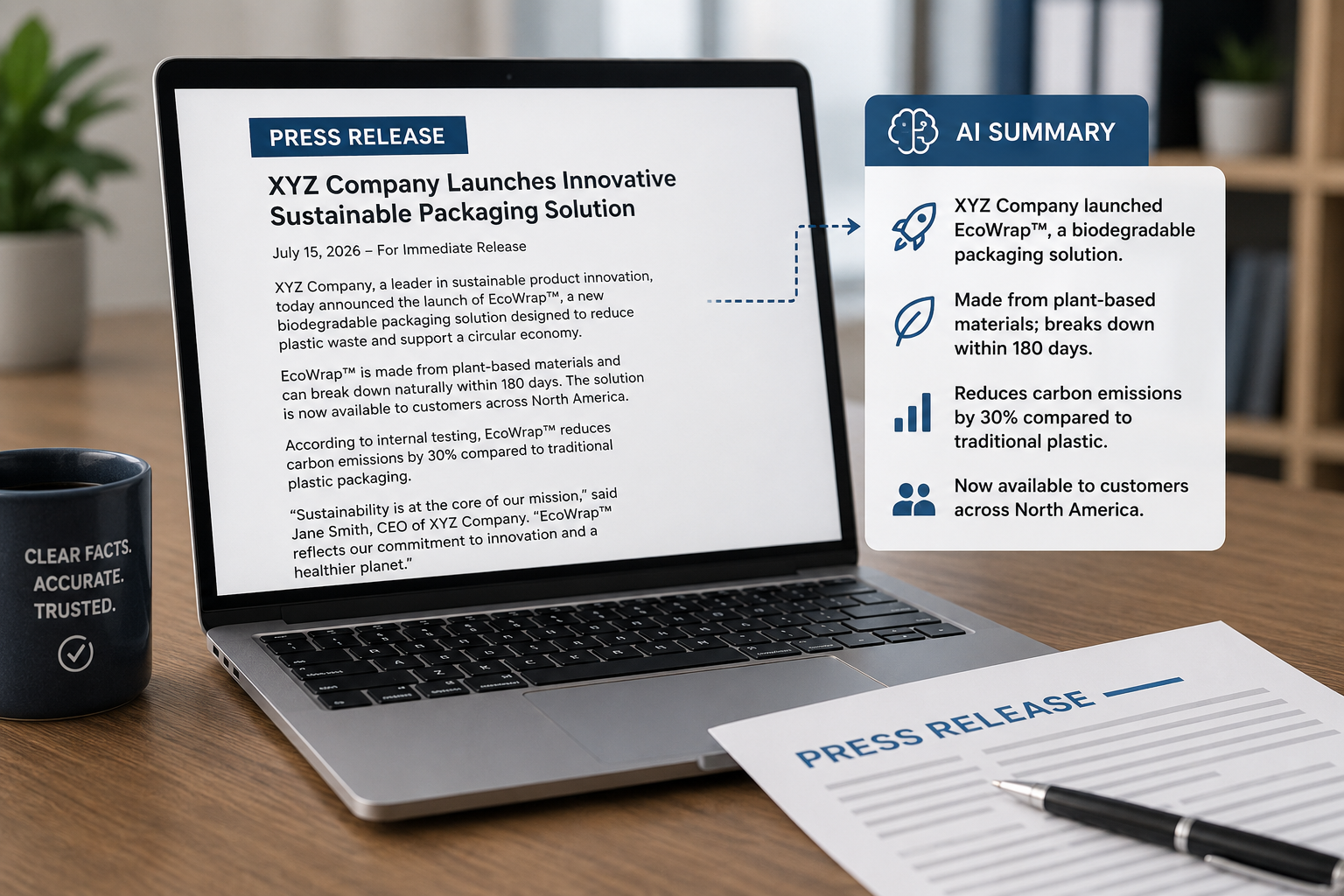
After reviewing press releases for more than two decades, we have found that many factual problems are not caused by incorrect information. They happen because an important date, limitation or source appears too far away from the claim it explains. This is part of our inspiration for today's article.
Artificial intelligence is changing how people encounter company news. Instead of always reading an entire press release, someone may first see a summary generated by a search engine, an AI assistant or another online platform.
That creates a new challenge for businesses. Your press release must not only be accurate when read from beginning to end. Its most important facts should remain accurate when they are shortened, extracted or combined with information from other sources.
A human reader can often resolve minor ambiguities by studying the surrounding paragraphs.
An automated system may instead pull a sentence, statistic or quote into a much shorter answer. When important context is missing, the resulting summary may exaggerate the announcement, confuse a plan with a completed result or attribute a claim to the wrong organization.
Businesses cannot control exactly how every platform summarizes their news. They can, however, reduce the likelihood of misunderstanding by writing press releases with clearer facts, stronger attribution and fewer unanswered questions.
Begin With a Complete Fact Pattern
The opening of a press release should give readers a complete and dependable account of what happened. This normally means identifying the organization, the specific announcement, the relevant date, the location or market involved and the current status of the development.
For example:
“ABC Tech introduced a new service to help customers access business financing.”
The sentence sounds good, but it is vague. It does not explain who can use the service, where it is available or whether it has fully launched.
A better, more effective alternative:
“ABC Technologies has now launched an online loan-comparison service for small businesses in Washington and Oregon on July 15, 2026. This will provide customers the ability to compare financing terms from up to six participating lenders.”
In the second version, it is easier to summarize because the main facts are attached. A reader or automated system does not need to search elsewhere in the release to determine what launched, when it became available, who it serves or where it operates.
This does not mean every opening paragraph should be packed with every available detail. It means the essential facts should be stated together before the release moves into company history, quotations or broader industry commentary.
Separate What Has Happened from What Is Expected
One of the most common sources of confusion in business announcements is the failure to distinguish between a completed action, a current result and a future goal.
For example, a company might write:
“The expansion will create 200 jobs and generate $40 million for the local economy.”
The problem is that those results may be projections only. A more accurate version would be:
“The company conservatively expects the newly planned facility to add approximately 200 jobs by the end of 2028.
On top of this, a study commissioned by the business estimates the project could generate upward of $40 million in regional economic activity over its first five years.”
Words such as “expects,” “planned,” and “estimates” make it clear that the results have not yet occurred.
The same applies to partnerships, pilot projects and product launches. A signed agreement does not mean the work is finished, and a test program is not the same as a full launch. Make the current stage clear, including whether work has started, whether approval is still needed, or whether the product is only available to a limited group.
These distinctions make the release more trustworthy and help prevent a shortened summary from presenting an intention as an accomplished fact.
Keep Every Number Attached to Its Meaning
Statistics are especially vulnerable to misunderstanding when they are separated from the surrounding context.
A release that says “customer demand increased by 52 percent” should also explain what was measured, the period being compared, and the group represented by the number.
A more useful statement would be:
“Sales to independent US retailers rose 52 percent in the first half of 2026 compared with the same period last year, according to company records.”
Now the percentage has a subject, a geography, a time period, a comparison, and a source.
Avoid placing an impressive number in the headline and waiting until much later to explain its limitations. The statistic may be quoted or summarized without the later qualification.
Similarly, do not switch casually between percentages and percentage points. A rise from 20 percent to 30 percent is a 10-percentage-point rise, or a 50 percent increase. Those descriptions do not mean the same thing.
Make sure every number makes sense on its own. If readers need the surrounding paragraphs to understand it, add more detail.
Make Attribution Difficult to Miss
Readers should always be able to tell whether information comes from company records, an outside study, a government report, a customer survey or the opinion of a spokesperson.
According to the Reuters Journalistic Standards and Values, named sources are generally preferable because readers can evaluate who is responsible for the information. Reuters also stresses that sourced material should be given sufficient context and detail.
That is a useful principle for press release writing.
Instead of writing, “Experts believe the market will double within five years,” identify the experts and the report containing the forecast. If the prediction comes from the company’s own leadership, make that clear as well.
“Company executives expect the market to double” is very different from “independent analysts expect the market to double.”
Quotes should also include the speaker’s full name, title and relationship to the announcement. If specialized knowledge matters, explain the qualification that makes the person relevant.
For example:
“Manufacturers have become more cautious about changing suppliers because they are still dealing with unpredictable delivery schedules,” said Maria Chen, ABC Supply’s director of procurement, who has managed the company’s North American supplier network since 2018.
The additional information helps establish why Chen is in a position to make that observation.
Define Companies, Products and Acronyms Clearly
Writers who are closely involved with an organization often assume readers already understand its terminology. AI systems can face the same problem when a company name, product name or acronym has several possible meanings.
The first reference to an organization should normally include its full name and a brief explanation of its activities. An unfamiliar acronym should be spelled out before its abbreviation is used.
Product names also need context. A release should not merely announce “the launch of Nexus.” It should explain whether Nexus is accounting software, a medical device, an electric vehicle component or a professional training program.
Be especially careful when a company shares its name with another organization, product or common word. Adding the industry, headquarters location or corporate website can help distinguish the correct entity.
The boilerplate at the end of the release can provide additional background, but the body should still make the company’s identity clear. Readers should not need to reach the final paragraph before learning what the announcing organization actually does.
Ensure that if You Add Links, They are of Value.
Links need to help readers verify a claim or verify background information.
For example, you can link directly to a government page when mentioning a new regulation, or to the original report rather than an article that summarizes it. Product specifications and test results should also lead to the source where readers can review them.
Use descriptive link text instead of vague wording such as “Read more here.” A phrase like “view the full 2026 testing methodology” tells readers exactly what they will find.
Links should not be used to make weak claims appear well supported. A source must genuinely confirm the statement being made. A general article about market growth, for example, may not support a precise prediction about one company’s future sales.
Too many links can also distract from the announcement. Include sources that materially strengthen the release, rather than linking to every industry term or company reference.
Do Not Chase Imaginary AI Shortcuts
As interest in AI search has grown, so have claims about special files, secret formatting techniques and new forms of markup that supposedly guarantee inclusion in AI-generated answers.
Google’s official guidance on AI features and websites states that there are no additional technical requirements to appear in AI Overviews or AI Mode beyond those for Google Search. Google recommends continuing to follow established SEO practices, including making important information available as text, using helpful internal links and ensuring that structured data agrees with the visible page.
For businesses writing press releases, the practical lesson is straightforward. Do not sacrifice readability in an attempt to write for a machine.
Clear sentences, accurate facts, descriptive headlines and useful supporting material remain more important than invented AI tricks. A release should make sense to a customer, journalist or industry professional before anyone worries about how an automated system may process it.
Conduct a Summary Test Before Distribution
A practical way to review a completed press release is to create a summary using only the information contained in the release.
Write down the five most important points in approximately 100 words. Then check each point against the full announcement.
Check that the summary keeps the facts straight. It should clearly separate goals from results, include any location or availability limits, and identify the source of every forecast, quote and statistic.
You can also ask someone unfamiliar with the announcement to read the headline and first three paragraphs. Ask that person to explain what happened, who was involved, where it applies and why it matters.
Any uncertainty they experience may also affect journalists, customers, search engines and AI tools.
This review should not be treated as an attempt to predict the exact wording an AI system will produce. Its purpose is to identify statements that become misleading when condensed.
Make Updates Clear
Sometimes a press release needs to be corrected. A date may change, a number may be updated, or a launch may be delayed.
When that happens, fix the information quickly and explain what changed. Quietly replacing a major detail can leave different versions of the story online.
The updated release should clearly state what was corrected and when. The company’s website, social profiles and supporting pages should also be checked for outdated versions of the same information.
Consistency matters because AI-generated answers may draw on multiple sources. When one page says a service is available in three states and another says five, the system must decide which version is current. Clear dates and visible corrections make that decision easier for both people and automated tools.
Write for Accurate Reuse
A strong press release should remain accurate even when its information travels beyond the original page.
Its headline may appear in a search result. A quote may be used in a news article. A statistic may be included in an industry report. An AI assistant may reduce the entire announcement to two sentences.
No writer can control every form that reuse will take. However, businesses can make their releases more dependable by connecting claims to sources, predictions to appropriate qualifications and numbers to their proper context.
The objective is not to make a press release sound as though a machine wrote it. It is to make the facts clear enough that neither a person nor a machine has to guess what the company meant.
That is becoming an important measure of press release quality. Visibility matters, but accurate visibility is far more valuable. A release that is easy to summarize correctly has a better chance of remaining useful, trustworthy and discoverable long after the initial announcement.
Article By: Michael Iwasaki
Michael Iwasaki is a managing partner at 24-7 Press Release Newswire and has been with the company since 2004. He writes about press release strategy, editorial best practices, and how businesses can create clearer, more credible, and more newsworthy announcements.