 +1 888-880-9539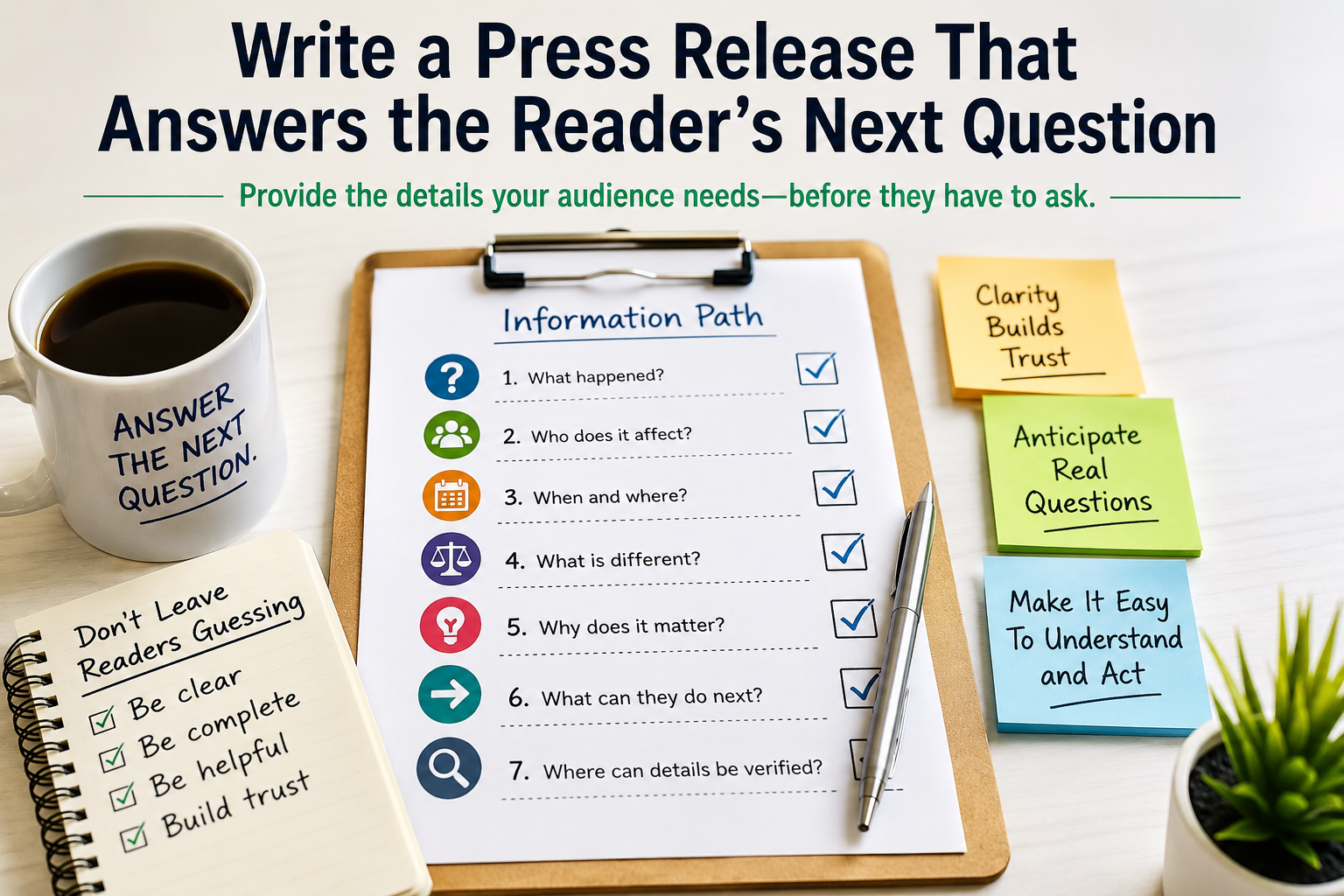
A press release can state the main announcement accurately and still leave the reader unsatisfied.
We see this all too often at 24-7PressRelease.com, where a company launches a new product, but does not say when customers can purchase it. An organization announces an expansion, but does not identify the locations involved. A business promotes a new service without explaining who qualifies, what it costs or how it differs from what was previously available.
In each case, the basic announcement is present. The information needed to understand or act on it is not. Sometimes this is done deliberately to encourage people to keep reading. However, many readers now recognize the tactic and simply move on instead.
After reviewing press releases for more than two decades, we have found that many announcements create unnecessary questions. The writer knows the full story and may not notice what remains unexplained. The reader, however, approaches the announcement without that inside knowledge.
This matters to journalists and potential customers, but it has become increasingly relevant to search engines and AI-powered search tools. People are no longer searching only for a company's name or an announcement. They ask detailed follow-up questions about availability, cost, eligibility, comparisons, timing and practical consequences.
A useful press release should therefore do more than answer, “What happened?” It should anticipate the reasonable question that comes next.
Understand the Difference Between Curiosity and Confusion
A press release does not need to answer every imaginable question. Attempting to cover every minor detail can make an announcement unfocused and difficult to read. The objective is to eliminate confusion, not curiosity.
Curiosity encourages someone to learn more because the news is interesting. Confusion forces someone to search elsewhere because the release failed to provide an essential fact.
Here is an example:
“Northstar Financial introduced a new financing program for small businesses.”
The reader might wonder which small businesses qualify, where the program is available, what type of financing is offered, whether the program has already launched or is coming later, and how a business can apply.
The questions the reader has aren’t obscure questions. They determine what the announcement actually means.
A more complete opening might state:
“Northstar Financial has launched an online equipment-financing program for independently owned restaurants in Washington, California and Nevada. Applications were starting to be accepted on August 3, 2026. Financing is provided through three participating commercial lenders.”
The revised version does not contain every program condition, but it resolves the questions most likely to affect the reader’s understanding.
Build the Release Around an Information Path
Writers often treat a press release as a sequence of standard components: headline, opening paragraph, quote, background and boilerplate.
That structure can work, but it should not become a substitute for thinking about the reader’s information needs.
A more useful approach is to build an information path:
1. What happened?
2. Who does it affect?
3. When and where does it apply?
4. What is different from before?
5. Why does it matter?
6. What can an interested person do next?
7. Where can important details be verified?
Not every announcement requires a separate paragraph for all seven questions. The answers should appear naturally according to their importance.
A product recall, for example, should quickly identify the affected products, model numbers, purchase dates, the safety concern, and the actions customers should take. A research announcement should identify the central finding, sample, methodology and limitations. An event announcement should include the date, location, intended audience, registration process and any attendance restrictions.
The correct information path depends on the news.
Explain What Changed
Many press releases describe the new development without establishing what is actually new about it.
A company might announce an “expanded service,” but fail to say whether it added locations, features, operating hours or customer groups. A software business might promote a “new platform” that is actually a renamed version of an existing product. An organization might announce a partnership without explaining what either party will do.
The reader should not have to compare several webpages to determine what changed.
A useful sentence might say:
“Previously available only to hospitals with more than 500 beds, the service will now be offered to independent clinics and regional medical practices.”
That comparison gives the announcement meaning. It also provides language that a journalist, a customer, or an automated system can use to explain the development.
Without the comparison, words such as “new,” “expanded,” “improved” and “enhanced” may communicate very little.
Include the Details That Affect a Decision
One way to identify missing information is to ask whether a detail could change what the reader does next.
For a product announcement, that may include:
• Release date
• Price or expected price range
• Availability by country or region
• Compatibility requirements
• Intended user
• Ordering or registration process
For a business expansion, decision-relevant details might include the number and location of new facilities, the opening schedule, services offered, hiring plans and whether required approvals have been obtained.
For a professional service, readers may need to know who qualifies, what problem the service addresses, whether it is available remotely and how an initial consultation works.
A press release does not always need to publish confidential pricing, contract terms or technical specifications. When a relevant detail cannot be disclosed, it may still help to acknowledge that limitation.
For example:
“Pricing will be announced before customer orders open in October.”
That is more informative than ignoring the subject entirely.
Use Real Questions, Not Keyword-Stuffed FAQs
Adding a question-and-answer section can be useful when an announcement involves several practical details. However, an FAQ should not be created merely to repeat keywords or restate the same promotional claim in different forms.
Questions should reflect what a genuine reader would need to know.
Weak questions include:
“What makes ABC Company the leading provider of innovative solutions?”
That is advertising disguised as a question.
Useful questions might include:
“Can existing customers use the new service?”
“Is the program available outside the United States?”
“Will previously purchased equipment be compatible?”
The answers should be direct, factual and consistent with the main release.
Google does not expect publishers to create a different page for every slight variation of a search query. The better approach is to produce clear, well-organized content that genuinely helps the reader. In most cases, one thorough press release that addresses several related questions will provide more value than multiple shallow pages that repeat much of the same information.
Give Supporting Links a Specific Purpose
A link should help the reader continue the information path.
Instead of linking generally to a company homepage, consider directing readers to the exact resource that answers their next question. Depending on the announcement, that may mean a link to the complete product specifications, registration instructions, research methodology, eligibility requirements, participating locations or even a media kit.
Descriptive link text is considerably more helpful than “click here.” Readers should understand what they will find before opening the page.
The linked information must also agree with the press release. Conflicting launch dates, prices, product names or geographic details can create uncertainty about which source is current.
Ask Someone Unfamiliar With the News to Review It
The writer is often the worst person to identify missing context because they already know the answers.
Before distribution, give the release to someone who was not closely involved in preparing the announcement. Ask that person to explain:
• What changed?
• Who is affected?
• When does it happen?
• Are there any limitations?
• What would an interested reader do next?
Pay attention to every assumption the reviewer makes. If the person has to guess whether the product is currently available, whether a result is projected or whether the announcement applies nationally, the release probably needs clarification.
This is not an attempt to make the announcement unnecessarily long. It is a way to remove information gaps before journalists, customers and search systems encounter them.
Completeness Creates Lasting Value
Google has explained that its AI search features can explore several related subtopics and sources when responding to a complex question. That does not mean businesses should stuff every press release with loosely related subjects. It means a well-developed announcement is more likely to be useful when it includes the natural supporting details readers require.
The strongest press releases establish the news, define its boundaries, explain what changed and guide the reader toward the appropriate next step.
They do not make people conduct another search to understand the announcement.
Before distributing your next release, do not stop after asking whether it contains the five Ws. Ask one additional question:
“What will the reader want to know next?”
The answer may reveal the most valuable information currently missing from the release.
Article By: Michael Iwasaki
Michael Iwasaki is a managing partner at 24-7 Press Release Newswire and has been with the company since 2004. He writes about press release strategy, editorial best practices, and how businesses can create clearer, more credible, and more newsworthy announcements.