 +1 888-880-9539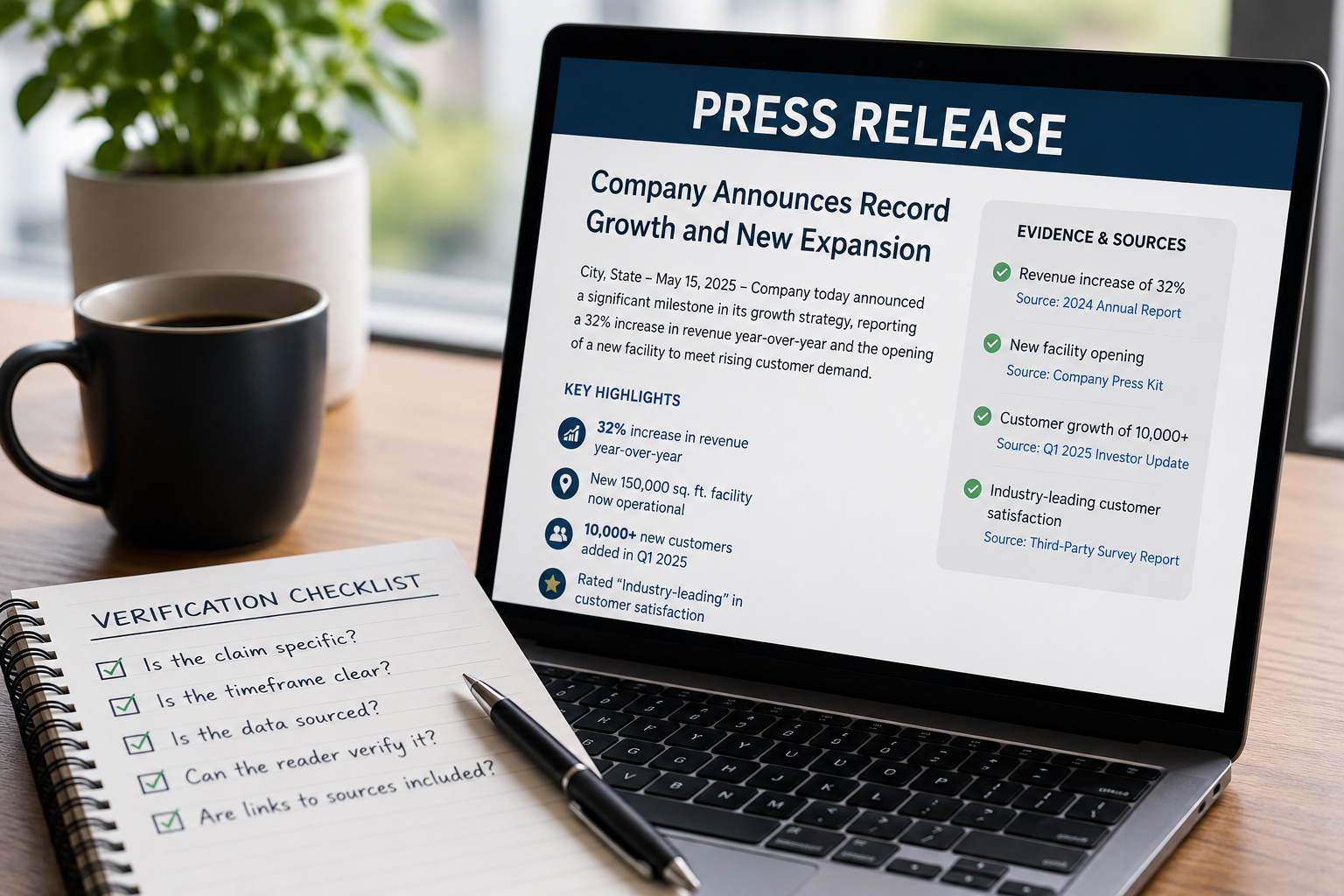
A press release makes claims. Some are straightforward facts, such as when an event will take place or where a new location will open. Others carry considerably more weight.
A company may say sales increased by 32 percent. A manufacturer might claim its new process reduces waste. A software company may announce that it now serves 10,000 customers. A business might describe itself as the fastest-growing company in its market.
All of those statements could be completely accurate. The question is whether someone outside the company has any way of knowing that.
That distinction matters more than it once did. Journalists have always needed to check information before using it, but they are no longer the only ones doing the checking. Customers routinely research claims before making decisions. Search engines look for signals that help them understand whether information is reliable. AI-powered search and answer tools also have to decide which pieces of information they can confidently use when putting together an answer.
For businesses writing press releases, there is a simple lesson here: don't just publish facts. Make the important ones easy to verify.
Think About the Person Checking Your Work
A useful way to review a press release is to imagine that the person reading it has never heard of your company and has no particular reason to take your word for anything.
Suppose they come across this sentence:
“Reliable Tech Manufacturing has reduced production waste by 38 percent since introducing its new manufacturing process.”
It sounds impressive, but it also leaves quite a bit unanswered.
Reduced compared with what? Over what period? How was waste measured? Does the number cover the whole company or a single facility? Is there a report or some other source behind the figure?
You don't have to answer every conceivable question in the same sentence. That would make for a terrible press release. You should, however, give the reader enough information to understand where an important number came from.
Here is a better, more detailed version:
“The company’s 2025 operational review advises that material sent to landfill at its Seattle facility declined 38 percent between January and December compared with the same period in 2024.”
The claim hasn't become less impressive. It has become more useful. We now know what was measured, where it was measured, the period involved and where the number originated.
Link to the Evidence When It Exists
Companies frequently include a link to their homepage in a press release and leave it at that.
There is nothing wrong with linking to your website, but a homepage often isn't very helpful to someone who wants to check a particular statement.
If you mention a study, link to the study. If you announce financial results, link to the financial report or investor information. If an announcement involves a government approval, certification or public record, consider linking to the organization responsible for it. When you publish survey results, give readers somewhere to learn how the survey was conducted.
This doesn't mean filling a release with links. A few useful links are better than a dozen that lead back to product and sales pages.
Google makes a similar point in its guidance on creating helpful, reliable, people-first content. Among the questions Google suggests publishers ask are whether the content provides original information, research or analysis and whether it presents information in a way that encourages trust through clear sourcing and evidence of expertise.
Those are sensible questions for a press release writer to ask as well.
Go Back to the Original Source
Suppose your company announces that it has received approval from a government regulator.
You could link to a news article mentioning the approval. But if the regulator has a public record confirming it, why not send the reader there instead?
The same principle applies to other types of information. If you quote government statistics, link to the government agency. If you reference research, link to the research itself when possible. If you discuss a new patent, the relevant patent record may be useful. If the numbers in your announcement also appear in a regulatory filing, consider directing readers to that filing.
News articles and other secondary sources can provide useful context, but they aren't always the best evidence for a factual claim. Going back to the source makes verification easier and saves a journalist from having to track it down independently.
Be Careful With Claims That Sound Too Good
Some of the hardest claims to verify are also among the easiest to write.
“Industry-leading.”
“Number one.”
“Fastest growing.”
“Most trusted.”
“Best performing.”
These phrases often find their way into marketing copy without much thought. Put one in a press release, though, and there is an obvious follow-up question: according to whom?
If an independent industry report ranked your company first, name the report. If a customer survey found that 94 percent of respondents would recommend your service, explain who was surveyed and when. If you are the largest provider in a particular market based on annual revenue, make it clear what market you are talking about and where the comparison came from.
If you can't reasonably support a claim, think twice about putting it in the release.
There can be legal considerations as well. The Federal Trade Commission's policy on advertising substantiation says advertisers should have a reasonable basis for objective advertising claims before those claims are disseminated. The amount and type of evidence required can depend on the nature of the claim.
Press releases and advertisements aren't the same thing, and the rules surrounding claims can differ depending on where and how they are published. But the practical takeaway is fairly simple: if you're going to make a factual claim, you should know how you can back it up before including it in the release.
Don't Leave Out the Qualification That Changes the Meaning
Verification isn't only about providing a source. You also have to accurately describe what that source actually shows.
Imagine a company commissions a survey of 600 small-business owners in California and finds that 71 percent plan to increase their cybersecurity spending.
A headline that says “71% of U.S. Businesses Plan to Increase Cybersecurity Spending” would stretch the research far beyond what it established.
That may seem like a small distinction when someone is trying to write an attention-grabbing headline, but it becomes much more important once the information starts travelling.
A journalist may quote the statistic. Another website may reference it. Google may index it. An AI system may eventually encounter several versions of the claim and try to work out which one is accurate.
Details such as geography, sample size, date and methodology aren't clutter when they materially change the meaning of a claim. They are what keep the claim intact as it gets repeated elsewhere.
Put Numbers in Context
Statistics can make a press release more convincing, but only when the reader understands what they actually represent.
Saying that customer registrations increased by 46 percent sounds significant, but the number means very little without a starting point or a period of comparison. The same is true of a claim that a company has saved customers $2 million. Was that achieved over six months, five years or the entire history of the business?
Even a statement such as “more than 15,000 people use the platform” can leave room for interpretation. That figure could refer to registered accounts, paying customers or people who actively use the service each month.
A little extra detail can turn a promotional-sounding statistic into useful information. Whenever possible, give the reader the timeframe, comparison or definition needed to understand what the number is actually measuring.
Whenever an important number appears in a press release, read the sentence again and ask whether somebody encountering it for the first time would know what the number actually represents.
Often, a few extra words are enough.
“Monthly active users increased 46 percent compared with May 2025” tells us considerably more than “users increased 46 percent.”
The second statement sounds good. The first one tells us something.
Quotes Don't Get a Free Pass
Quotes are naturally more subjective than the rest of a press release. They give executives, researchers and other sources room to explain why something matters, what surprised them or what they expect to happen next.
Problems arise when a quote is used to slip in an unsupported factual claim.
Consider this:
“Hospitals throughout North America are now using our technology and have reduced patient wait times by more than 20 percent,” said the company's CEO.
Putting the statement inside quotation marks doesn't change the fact that it contains two claims that someone may want to check.
Quotes are a good place for opinion, interpretation and perspective. When a spokesperson introduces an important statistic or factual assertion, however, it should be held to the same standard as information appearing elsewhere in the release.
Create a Short Evidence Trail
Before publishing, go back through the release and identify the three or four claims that matter most.
Where did each one come from? Could you show the source if a journalist asked? Have you represented that source accurately? Does the claim need a date, comparison or qualification to make sense? Is there a source you could link to?
This doesn't mean turning a press release into an academic paper. Nobody wants to read a news release with a footnote attached to every sentence.
The idea is to leave a short evidence trail around the facts that matter.
Sometimes the evidence will be a public report. Sometimes it will be government data, research, a regulatory filing or published methodology. Other times the information will come from the company's own records and won't be publicly available. In that case, being specific about how the figure was calculated can still make the claim more useful.
Verification Makes a Press Release More Useful
Supporting evidence is sometimes treated as something defensive — information you keep on hand in case somebody challenges a claim.
It is better to think of it as part of the value of the release.
Good sourcing saves a journalist time. It gives customers more confidence in what they are reading. It provides search engines with clearer context about the information on the page. It can also make it easier for AI-powered systems to distinguish a specific, well-supported fact from a vague marketing statement.
Most importantly, it tends to improve the press release itself.
Before publishing your next release, don't stop at asking whether everything in it is accurate.
Ask one more question:
If somebody wanted to check this, could they?
If the answer is yes, you have probably created a stronger piece of news.