 +1 888-880-9539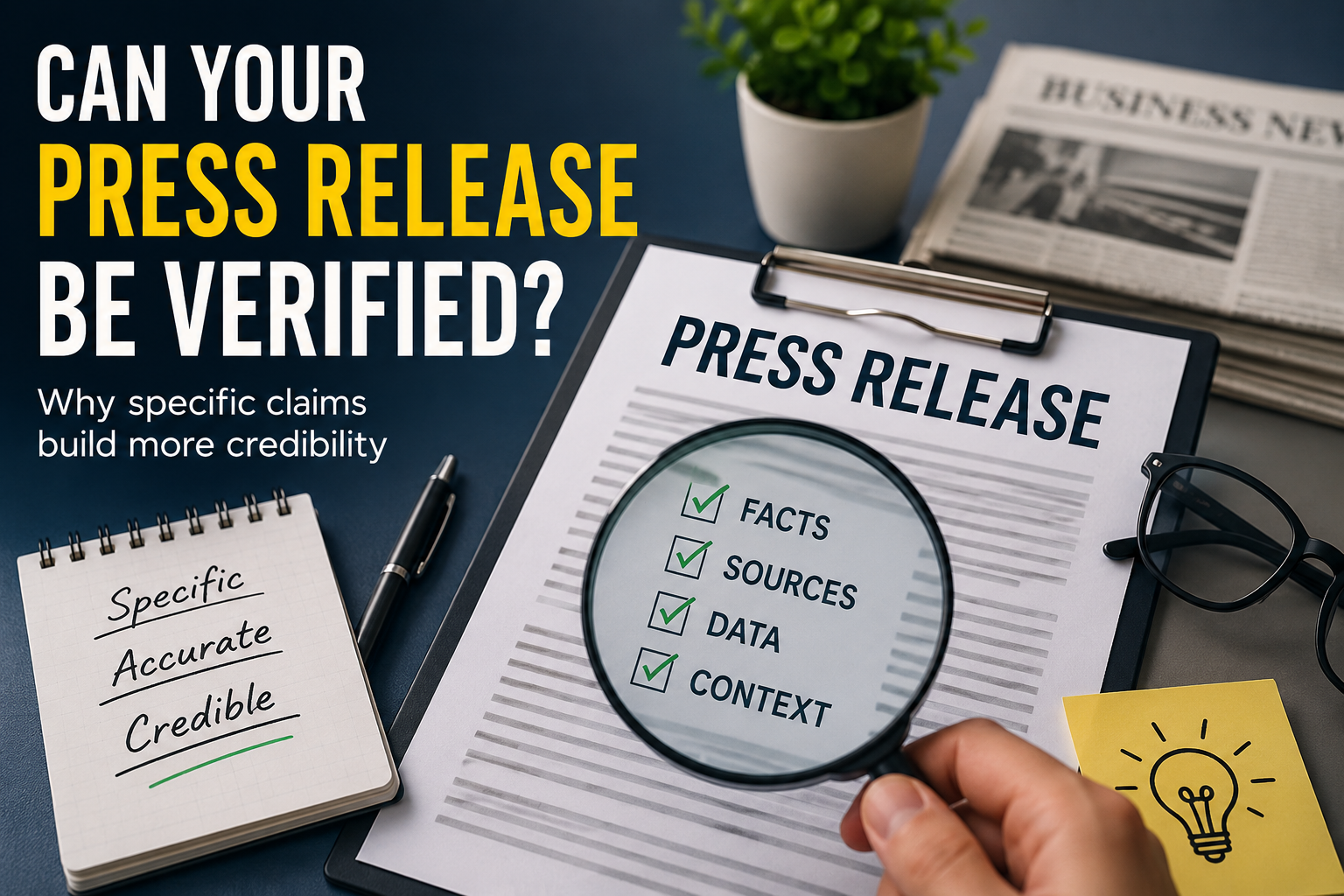
A press release makes claims.
A company is growing quickly. A product is the first of its kind. A new service will save customers time. An executive is an industry leader. Research shows that consumer behaviour is changing.
Some of those claims may be completely accurate. But press release writers don't always consider an important question: Could someone outside the company figure out where the claim came from?
That question matters more than it once did.
A press release may be read by journalists, customers, investors and potential business partners. It may also appear in search results, be referenced by other websites or become source material for AI-powered search and answer tools.
Once information travels beyond the original release, the reader may know very little about the company that published it. Specificity becomes one of the easiest ways to establish credibility.
Give Important Claims a Verification Path
Consider a company that describes itself as “one of the fastest-growing technology companies in North America.”
That sounds impressive, but what does it actually mean?
Was the company included on a recognized growth ranking? Is the statement based on revenue? Customer growth? Employee count? Is “North America” based on an independent comparison or simply the company's own assessment?
Now consider:
“ABC Technologies ranked No. 214 on the 2026 Inc. 5000 after reporting three-year revenue growth of 1,240 percent.”
The second version gives the reader somewhere to go. It includes a ranking, a year, a position, and a measurable result. Now the reader can go to, and verify the details at Inc. 5000
You do not necessarily need to link every claim in a press release to an outside source. But important claims should have what you might call a verification path. Give readers enough information to understand where a statement came from and, when appropriate, investigate it themselves.
“According to Research” Isn't Much of a Source
Vague attribution appears frequently in press releases.
“Research shows consumers increasingly prefer sustainable products.”
“Studies have found that employees are more productive when working remotely.”
“Industry data indicates demand is expected to double.”
These statements sound authoritative because words such as “research,” “studies,” and “data” suggest evidence exists somewhere. But without identifying that evidence, the reader is being asked to take the writer's word for it.
If a statistic or finding is important enough to include, name the source whenever possible.
Instead of saying “research shows,” tell readers who conducted the research. Include the name of the report or study, when it was published and a link when one is available.
This matters most when a statistic supports why the announcement matters.
If a cybersecurity company launches a new service and says cyberattacks increased 40 percent last year, that number helps establish the launch's significance. If nobody can determine where the 40 percent came from, however, the statistic can weaken the release instead of strengthening it.
Be Clear When the Source Is Your Own Company
Not every useful fact can be independently verified.
Private companies routinely have information that isn't available anywhere else. They know how many customers they have, how many orders they processed, which products are selling, where demand is increasing and what customers are asking for.
That information can make a press release much more interesting.
The key is telling readers where it came from.
Suppose a company writes:
“Demand for recyclable packaging increased 52 percent in 2026.”
A reader could reasonably assume this is an industry statistic.
If the number actually comes from the company's own orders, say so:
“According to the company's internal order data, customer orders selecting recyclable packaging increased 52 percent during the first six months of 2026 compared with the same period in 2025.”
That is arguably more useful than the original statement.
It identifies the source, the measurement, the time period and the comparison. It also prevents company data from accidentally being presented as an industry-wide finding.
There is nothing wrong with being the source of your own information. In fact, original company data can make a release worth citing. The problem begins when readers cannot tell who measured what.
Watch the Words That Quietly Make Claims Bigger
Some of the hardest claims to verify are surprisingly small.
Words such as “leading,” “largest,” “fastest,” “only,” “first,” and “best” can turn ordinary promotional language into factual claims.
Calling a company “a leading provider” may feel harmless because the phrase appears in thousands of press releases. But leading according to what measure?
Likewise, saying a product is “the first AI-powered platform designed specifically for independent insurance brokers” is a much larger claim than saying the company has launched an AI-powered platform for independent insurance brokers.
One requires proving that the product exists. The other potentially requires proving that nobody else has ever done it.
That doesn't mean companies should avoid strong claims. It means the stronger the claim, the stronger the support.
If you won an award, name the award and organization that presented it. If you received a patent, identify the patent. If you ranked first in a study, identify the study. If you genuinely introduced an industry first, explain what makes it a first.
Specific evidence is usually more persuasive than an adjective anyway.
Make Partnerships and Relationships Clear
Business relationships are another area where wording can unintentionally create a misleading impression.
“ABC Company partners with Microsoft” sounds very different from “ABC Company's software integrates with Microsoft Teams.”
A company may use another company's technology, participate in a partner program, resell its products, integrate with its software or have an actual contractual partnership. Those relationships are not interchangeable.
The same problem occurs with media coverage.
“As seen in Forbes” could mean a company was the subject of independent editorial coverage. It could also refer to a contributed article, a paid placement, a quotation in someone else's story or a brief mention.
If the connection matters to the story, explain it in a clear and concise manner.
Readers are more likely to trust a press release that is specific about the relationship than one that tries to make the association sound more important than it really is.
Give the Numbers Some Meaning
Numbers can be useful in a press release because they give readers something concrete to work with. The problem is that a percentage or total can sound impressive without telling the whole story.
For example, saying that sales rose 200 percent sounds significant. But if that increase was from two units sold to six, the result is still real — it just needs the surrounding context so the reader can judge what the number actually means.
“More than 100,000 customers served” raises another question: during the past year or since the company was founded 25 years ago?
“Nine out of ten customers recommend the service” sounds compelling, but how many customers were asked? Was it ten? One hundred? Ten thousand?
When using an important number, ask a few basic questions. What was measured? Over what period? Compared with what? Who measured it?
You don't need to turn a press release into an academic paper. Often, one additional sentence or phrase provides the necessary context.
Quotes Are the Right Place for Opinions
Not everything in a press release needs proof.
An executive can believe a new technology will transform an industry. A founder can be excited about entering a new market. An analyst can think consumer behaviour is changing.
Quotes provide a natural place for those interpretations.
Compare:
“This technology will fundamentally change how small businesses manage inventory.”
with:
“We believe this technology can fundamentally change how small businesses manage inventory,” said Jane Smith, CEO of ABC Company.
The second statement tells the reader exactly what it is: the CEO's assessment of the technology's potential.
Problems arise when predictions and opinions lose their attribution and start to appear as facts.
Think About What Happens After Distribution
Another reason verification matters has little to do with the initial reader.
Press releases travel.
A statistic from your announcement may be quoted in an article. A trade publication may summarize the release. Search engines may index copies distributed across different websites. An AI system may extract a sentence while answering a question months later.
At that point, the surrounding context may disappear.
A sentence like “the company serves more than 125,000 customers across 12 countries as of July 2026” can stand reasonably well on its own.
Using a sentence like “The company has experienced tremendous global growth” does not sound as convincing.
This is one reason precise dates, names, numbers, sources and attribution have become increasingly valuable. They give information context that can survive even when it is separated from the rest of the announcement.
Do the Verification Test Before You Publish
Before submitting a press release, read it once without thinking like the company that wrote it.
Pretend you know nothing about the organization.
When you encounter an important claim, ask: How would I know this is true?
Sometimes the answer will be an independent source. Sometimes it will be clearly identified company data. Sometimes it will be a named person's opinion. And sometimes you may realize there is no clear answer.
Those are the sentences worth revisiting. For claims involving products or services, the Federal Trade Commission also emphasizes that objective advertising claims should be supported by a reasonable basis and appropriate evidence.
A credible press release does not need to prove every word to the reader. It does, however, need to make clear what is fact, what is company-supplied information, what comes from an outside source, and what is opinion.
The goal isn't to make a release sound cautious.
It's to make it specific enough that readers don't have to take your word for it.
Article By: Michael Iwasaki
Michael Iwasaki is a managing partner at 24-7 Press Release Newswire and has been with the company since 2004. He writes about press release strategy, editorial best practices, and how businesses can create clearer, more credible, and more newsworthy announcements.