 +1 888-880-9539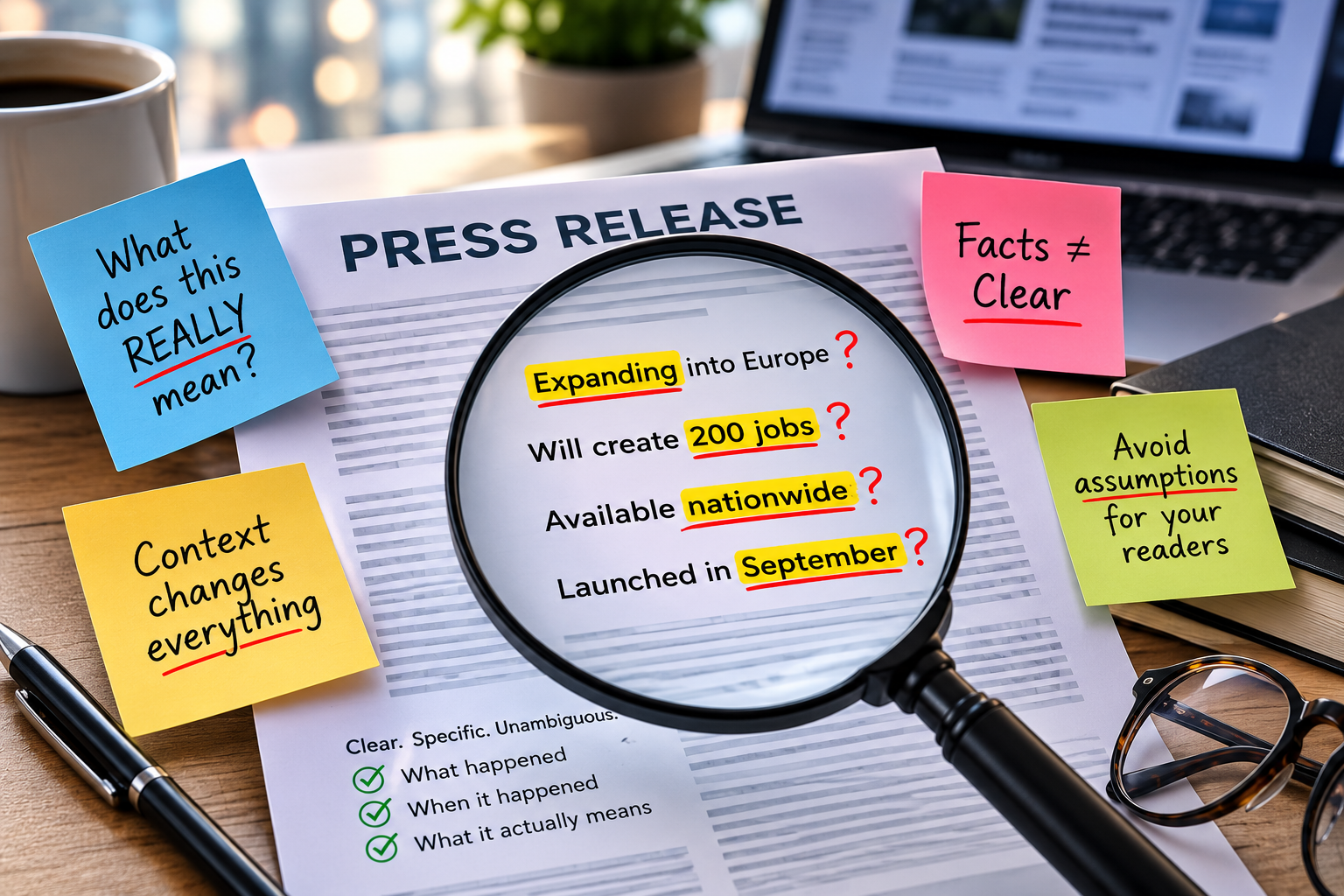
A press release can be factually correct and still leave readers with the wrong impression.
That can happen when a company says it is “expanding into Europe,” without explaining what expanding actually means. Is it opening an office, hiring employees, entering into a distribution agreement, or simply making an online product available to European customers?
The statement may be true in each case, but the reader could leave with a very different understanding of what happened.
This is an easy problem to overlook because the people writing and approving a press release already know the story. They know what the company means. Someone encountering the announcement for the first time doesn't have that advantage.
Avoid Leaving it up to the Reader to Fill in the Blanks
Imagine a company announces that a new facility is expected to bring 200 jobs to the area.
At first, that seems clear enough. But the number alone doesn't tell readers very much. Are these full-time positions with the company, jobs related to construction, or a combination of both? Will the hiring happen immediately, or gradually as the facility grows? It is also worth making clear whether the 200 jobs are already planned or simply an estimate of what the project could eventually create.
Sometimes a few additional words are all it takes.
“The company expects to hire approximately 200 full-time employees at the facility over the next three years” gives the reader a much clearer picture.
The goal isn't to make every sentence longer. It is to notice where important details have been left for the reader to assume.
Separate What Has Happened From What Is Planned
Timing is another common source of confusion.
A meaningful difference exists between a company planning to open a location, beginning construction on it, and actually opening the doors.
The same applies to products. “The company launched its new software platform” tells readers something has happened. “The company plans to launch their latest software platform in October” tells them something is expected to happen.
Problems arise when those stages become blurred.
Words such as “will,” “expects,” “plans,” “scheduled,” and “proposed” aren't unnecessary qualifiers when they accurately describe the status of an announcement. They help prevent an intention from being mistaken for a completed event.
Watch for Words That Can Mean More Than You Intended
Even ordinary business terms can be surprisingly vague.
A company might announce a “partnership” when the relationship is actually a software integration. It might describe a product as “available nationwide” when customers in certain regions still can't purchase it. A business might say it has “entered” a new market when it has made its website accessible there but has no employees, offices or customers in that market.
None of these descriptions is automatically wrong. The question is whether an average reader is likely to understand them the way the company does.
This is where being specific usually works better than trying to make the announcement sound bigger.
The Associated Press has made clarity central to its approach to news writing. In discussing how it develops its Stylebook, AP says its overriding consideration is helping reporters and editors present news accurately, concisely, and clearly. Its guidance also stresses using precise words so readers understand the meaning. The Associated Press Stylebook provides a useful example of why precision matters in news-oriented writing.
Give Numbers Enough Information to Stand on Their Own
Numbers can create ambiguity too.
Suppose a release says, “Customer demand increased 63 percent.”
The obvious question is: compared with what?
Perhaps orders increased 63 percent compared with the previous month. Maybe the comparison is year over year. Perhaps only one product category experienced the increase.
The number itself could be accurate, while the surrounding sentence leaves the reader guessing.
Dates deserve the same attention. Terms such as “recently,” “this year” and “last quarter” make sense when a release is first published, but become less useful when someone encounters it months or years later. Whenever the date matters, stating the month, quarter or year can make the information easier to understand later.
See Whether an Important Sentence Can Survive on Its Own
Press releases rarely remain in one place.
A journalist may quote a single sentence. A trade publication might summarize one paragraph. Search engines can display portions of the release in search results, while AI-powered tools may encounter individual statements without all of the surrounding explanation.
That creates a useful final test before publication.
Take several of the most important sentences in the release and read them without the paragraphs around them.
If a sentence says the company is expanding, does it explain what is expanding? If it gives a percentage, is the comparison clear? If it describes something as happening, can you tell whether it has already happened or is still planned?
You don't need every sentence in a press release to tell the entire story by itself. The important claims, however, should not depend on the reader making the same assumptions as the writer.
Read the Release Like an Outsider
One of the simplest ways to catch ambiguity is to forget, temporarily, what you already know about the announcement.
Read it as though you have never heard of the company.
When you reach an important statement, ask yourself whether there is another reasonable way to interpret it. If there is, a small amount of additional detail may prevent a much larger misunderstanding later.
Accuracy is essential, but accuracy alone isn't always enough.
A good press release should leave readers understanding what you meant, not simply let the company say what it wrote was technically true.
Article By: Michael Iwasaki
Michael Iwasaki is a managing partner at 24-7 Press Release Newswire and has been with the company since 2004. He writes about press release strategy, editorial best practices, and how businesses can create clearer, more credible, and more newsworthy announcements.