 +1 888-880-9539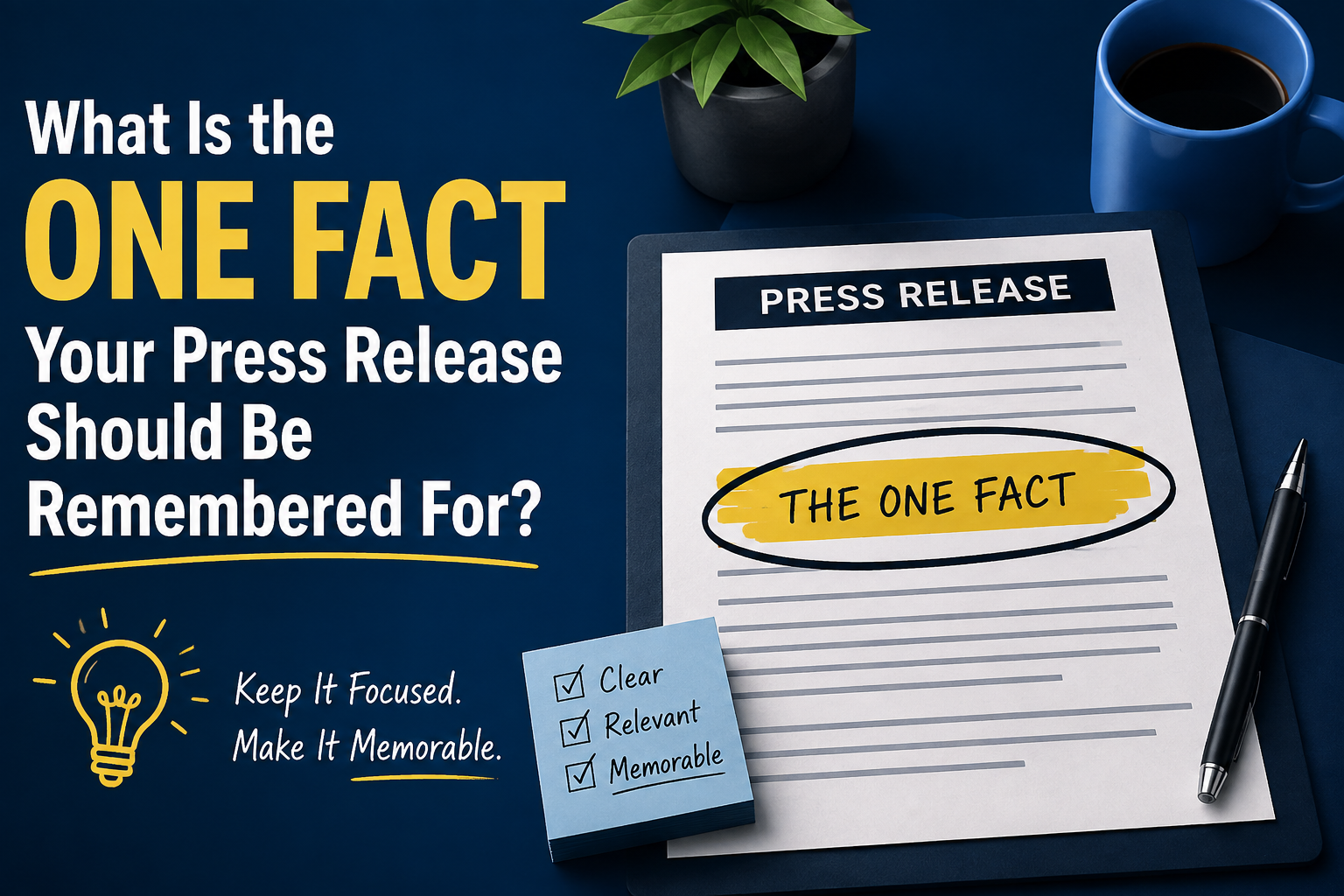
Companies rarely struggle to find things they want to say in a press release. More often, the problem is deciding what deserves the most attention.
A company opening a new manufacturing facility may also want to mention recent growth, an industry award, plans to hire more employees, a sustainability initiative and an upcoming product launch. All of those things may be worth talking about. Put too many of them together, however, and the reader can lose sight of why the press release was issued in the first place.
There is a simple question that can help:
If someone remembers only one fact from this press release, what should it be?
The answer should be obvious to the person writing the release. More importantly, it should be obvious to the reader.
Find the Sentence You Can't Afford to Lose
Imagine a manufacturer has opened its first U.S. production facility in Texas.
Somewhere in the release should be a sentence that makes that announcement unmistakable:
“ABC Manufacturing has opened its first U.S. production facility in Austin, Texas.”
Take that sentence away, and the reason for the press release largely disappears. That's a good sign you've found the central fact.
Now look at the other information being considered for the release. The company was founded in 2017. Its CEO has 25 years of industry experience. It recently received an award. It makes 14 different products. It hopes to expand internationally.
There may be perfectly good reasons to include some of those details, but none of them should compete with the facility opening for the reader's attention.
This doesn't mean repeating the same announcement in every paragraph. It means building the rest of the story around it.
Not Every Interesting Fact Belongs Near the Top
One reason press releases become crowded is that companies understandably want to make the most of the opportunity.
If a business is issuing an announcement, why not mention the award it won last month? Why not include another paragraph about its newest product? Why not tell readers about the founder's background?
The problem is that an interesting fact isn't necessarily important to the news being announced.
Suppose the Texas facility will employ 180 people. That belongs high in the release because it helps explain the significance of the opening. If the facility will increase the company's production capacity by 40 percent, that also adds useful context.
The CEO's 25 years of experience may be relevant elsewhere, but it probably doesn't help readers understand why the new facility matters.
A useful editing question is: What does this detail do for the story?
That idea is consistent with a basic principle of news writing: clarity matters more than trying to fit every available detail into the story. The Associated Press Stylebook describes helping reporters and editors present news accurately, concisely and clearly as an overriding consideration in its guidance. A press release isn't an AP news story, but the same principle helps you decide which details deserve the reader's attention.
If it explains what happened, shows why it matters or gives the announcement credibility, it is probably doing useful work. If it simply gives the company one more thing to say about itself, consider moving it lower in the release or leaving it out.
Supporting Information Should Support Something
Market statistics are a good example.
A company launching a service for electric vehicle owners might include data showing that EV adoption has increased in the markets it serves. That information gives readers context for the launch.
But adding three paragraphs of general automotive statistics can quickly turn the press release into a report about the EV industry rather than an announcement about the company's new service.
The same can happen with quotes. A strong quote can explain why the company made a decision or what it expects the announcement to mean. A quote that introduces an unrelated accomplishment can pull the story in another direction.
Supporting information earns its place when it makes the main news easier to understand.
Watch for the Second Press Release Hiding Inside the First
Sometimes the problem isn't unnecessary information. Another legitimate story may be buried in the release.
Imagine this headline:
“ABC Technologies Opens Seattle Office and Launches New AI Software Platform”
Which is the news?
Opening the company's first US office could justify an announcement. Launching a major new product could, too.
Combining the two may seem efficient, but it forces them to compete. A journalist interested in the expansion has to work around the product launch. Someone interested in the software has to read through details about the office.
Sometimes two developments should be together. Perhaps the Seattle office was established specifically to develop and support the new platform. In that case, the connection itself may be the story.
If the two announcements would make sense independently, though, you may have two press releases rather than one.
Remember That Your Release Will Be Broken Apart
The people reading your website aren't necessarily the only audience for a press release.
A journalist may pull one fact from it. A trade publication might summarize the first few paragraphs. A search engine may display only part of the page. An AI-powered answer may use a sentence from the release without carrying every surrounding detail with it.
That makes a clear central fact even more valuable.
If the most important information is buried beneath company history, promotional language and secondary announcements, there is no guarantee that the part you care about will be the part someone else takes away.
You can't control how every reader or system will use the information, but you can make the story's hierarchy hard to miss.
Try the One-Fact Test
When the release is finished, put it aside for a moment and come back to the headline and opening paragraphs.
Ask yourself a very basic question: What happened?
Better yet, give those paragraphs to someone who isn't closely involved with the announcement and ask them the same thing.
If their answer matches the fact you wanted people to remember, the release is probably doing its job.
If they mention a secondary statistic, an award, or something from the company background instead, look again at how the story is organized.
A press release can contain plenty of information. It just shouldn't make all of that information compete for first place.
Before you publish, decide what you would want someone to remember if everything else in the release were forgotten.
If you can't identify that in one sentence, the problem may not be the writing. You may still be trying to tell more than one story.
Article By: Michael Iwasaki
Michael Iwasaki is a managing partner at 24-7 Press Release Newswire and has been with the company since 2004. He writes about press release strategy, editorial best practices, and how businesses can create clearer, more credible, and more newsworthy announcements.