 +1 888-880-9539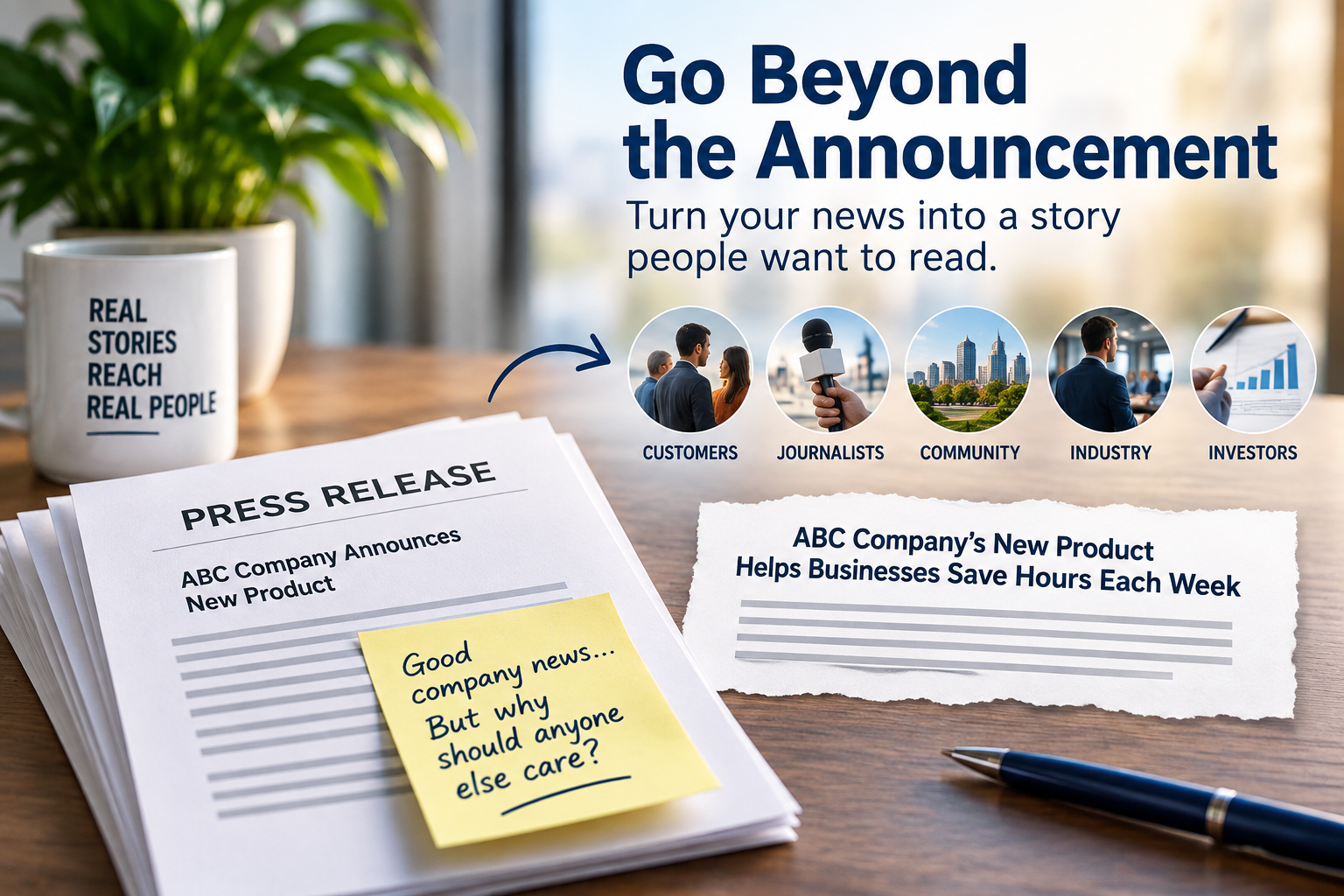
Companies naturally become invested in their own announcements. A product may have taken two years to develop. A new office might result from months of planning. An anniversary can represent decades of hard work.
Inside the company, these things can feel significant.
The challenge is that the person reading the press release wasn't part of any of that.
A journalist, customer, someone in the community, or industry reader approaches the announcement from the outside. They don't know about the late nights, meetings or problems that had to be solved along the way. They have a much simpler question:
Why should I care about this?
It may sound a little harsh, but it's one of the most useful questions to ask before distributing a press release.
Important to the Company Isn't Always Important to the Reader
Suppose a software company has spent 18 months developing version 6.0 of its platform. The development team may see the launch as a major accomplishment. Management may consider it one of the company's most important releases in years.
The headline, however, says:
“ABC Software Announces the Release of Version 6.0”
For someone outside the company, there isn't much to work with yet. Now suppose the new version automates a process that previously took accounting departments three hours and can complete it in about 20 minutes. That's different. The software release is still the announcement, but the time savings give people a reason to pay attention. The story is no longer simply that ABC Software released something new. It's that the new version may solve a recognizable problem for the people who use it.
That's often the difference between company news and a story.
Find the Person Outside Your Company Who Is Affected
One way to uncover the stronger angle is to stop thinking about the company for a moment. Who does this announcement affect? The answer doesn't have to be millions of people. It could be customers, local residents, retailers, healthcare workers, investors or people working in a very specialized industry.
Imagine a manufacturer announces that it is opening a new facility. To the company, the facility itself is the milestone. To a local community, the more interesting fact may be that it will create 75 jobs. Customers may care because the facility will reduce delivery times. An industry publication might be interested because the company is bringing production back to North America. The same announcement can matter to different audiences for completely different reasons.
This is why trying to make every press release appeal to everyone can actually weaken it. A story doesn't need universal importance. It needs a clear reason for the right audience to care.
Connect the News to a Problem People Already Recognize
Product announcements often benefit from this approach. Companies know their products extremely well, so press releases can quickly fill up with feature names, technical specifications, and terminology that means more internally than to the reader. A new feature may use an impressive technology. But what problem does it solve? If a new scheduling system reduces the time a medical clinic spends booking appointments, say that. If a manufacturing process produces less waste, explain how much less. If new software eliminates a task customers currently perform manually, that's useful information. This doesn't mean turning the press release into an advertisement. In fact, being specific can help avoid that. “Revolutionary new technology transforms business productivity” sounds promotional. Explaining what the technology actually changes gives the reader something concrete to evaluate.
Company Milestones Usually Need an Outside Angle
Anniversaries are a good example.
“ABC Manufacturing Celebrates 25 Years in Business” may be genuinely important to the owners and employees. But the number 25 alone doesn't necessarily give a journalist or reader much of a story.
Look at what happened during those 25 years.
Maybe the company started with four employees and now employs 600 people in the same community. Perhaps it still manufactures locally while much of its industry moved production overseas. Maybe the company began with one product and now exports to 30 countries.
Those details give the anniversary meaning beyond the company celebrating another year.
The same thinking can apply to awards, certifications, executive appointments and other corporate milestones. The objective isn't to disguise an ordinary announcement as something bigger. It's to determine whether a legitimate part of the story matters outside the organization.
Don't Manufacture Importance That Isn't There
This is where press release writing can go wrong. When an announcement doesn't have an obvious reason for people to care, you may be tempted to compensate with bigger language. A product becomes “groundbreaking.” A relatively routine partnership becomes “transformative.” A new feature becomes “game-changing.” An executive appointment supposedly marks “an exciting new era.” None of those phrases makes the underlying news more significant. In some cases, they can have the opposite effect. Readers have to work through the promotional language to determine what actually happened. If you can't explain why an announcement matters without relying on exaggerated adjectives, it may be worth looking at the story again. A better angle may be there that hasn't been identified yet. Or the announcement may be modest. That's okay too.
A Small Story Can Still Be a Good Story
Newsworthiness is relative to the audience.
A company creating 20 jobs may not attract national media attention, but those jobs could matter to a local business publication or community newspaper. A highly specialized piece of industrial equipment might mean very little to the general public while being genuinely interesting to a trade publication whose readers use that equipment every day. A small nonprofit reaching a fundraising milestone may not be a national story, but it could be relevant to the community the organization serves. The mistake isn't having a narrow audience. The mistake is assuming an announcement has to sound important to everyone.
For press release distribution, knowing who the story is for can be just as valuable as knowing what the story is.
Think About the Reader Before Adding More Information
When a release feels weak, the instinct is sometimes to add more. Another statistic gets inserted. The company history becomes longer. A second executive quote is added. More product features appear. But more information doesn't necessarily give readers more reason to care. Before adding another paragraph, ask what it contributes from the reader's point of view.
Does it explain why the announcement matters? Does it show who is affected? Does it provide evidence for an important claim? Does it help someone understand the news's significance? If not, the release may not need more information. It may need a clearer reason for being read.
Try the “Who Cares?” Test
Before sending out your next press release, answer three questions in plain language:
What happened?
Who outside the company does this affect?
Why would it matter to them?
Try answering without using words such as “innovative,” “leading,” “groundbreaking,” or “revolutionary.”
If you can do that, you've probably found something useful. Companies will always care about their own milestones. They should. Those milestones represent real work, investment and progress. The reader is simply starting from a different place. They don't know how difficult the accomplishment was or how important it felt inside the company. They only know what's in front of them. A good press release closes that gap.
It doesn't just tell people why the company cares about the announcement. It gives the right readers a reason to care too.
Article By: Michael Iwasaki
Michael Iwasaki is a managing partner at 24-7 Press Release Newswire and has been with the company since 2004. He writes about press release strategy, editorial best practices, and how businesses can create clearer, more credible, and more newsworthy announcements.