 +1 888-880-9539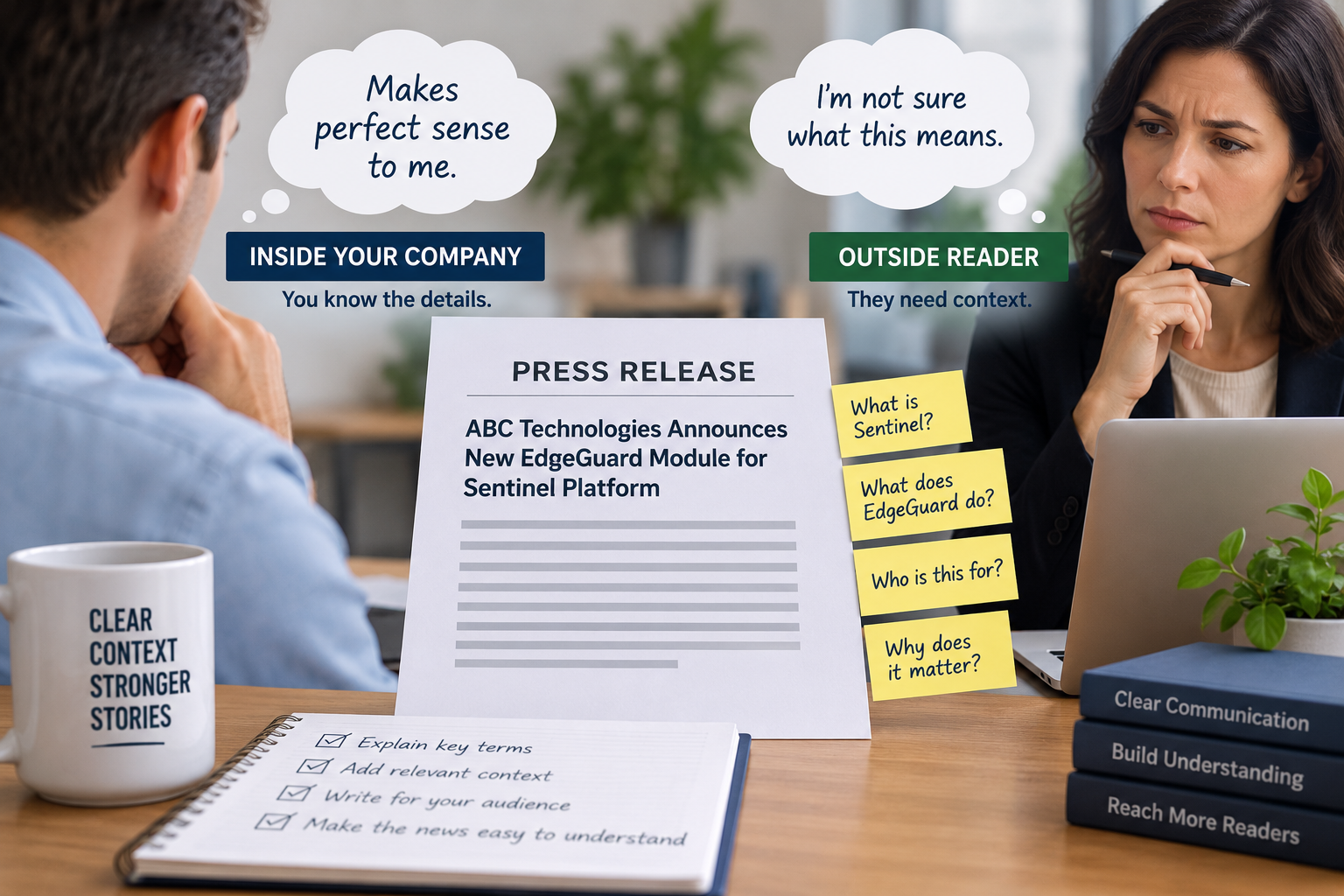
One of the easiest mistakes to make when writing a press release comes from knowing your own company too well.
You know what your products do. You know your services by name. You understand the acronyms people use around the office. You remember the announcement from six months ago and know exactly why the latest development is important.
The reader may know none of those things. That's where a perfectly accurate press release can become surprisingly difficult to follow. The information is there, but some of the pieces needed to understand it are missing. A useful way to catch this is to read the release as though you've never heard of the company before.
Start With Someone Who Has Never Heard of You
Imagine a press release begins like this:
“ABC Technologies today announced that its new EdgeGuard module is now available as part of the Sentinel platform.”
If you work at ABC Technologies, that sentence might seem clear. But a first-time reader could already have two questions: What is Sentinel, and what does EdgeGuard actually do?
The writer hasn't necessarily used confusing language. The problem is that the sentence assumes knowledge the reader may not have. A small amount of context can change that: “ABC Technologies today announced EdgeGuard, a new module for Sentinel, its cybersecurity platform used by manufacturers to monitor connected equipment across factory networks.”
Now the reader has something to work with. This doesn't require a long explanation. Often, a short phrase or sentence is enough to keep someone from getting lost.
Explain the Noun Before You Explain the News
Product and service names are especially easy to overlook. After hearing a name hundreds of times, it stops sounding unfamiliar. To someone encountering the company through a news release for the first time, however, “Project Nova,” “XG-400,” or “ConnectPro” doesn't mean anything yet. Before explaining what changed, make sure the reader knows what you're talking about.
The same applies to organizations, programs and initiatives. If a release says a company has joined the “GreenPath Initiative,” don't assume everyone knows what GreenPath is. A few additional words explaining that it is an industry program aimed at reducing packaging waste could be all that's needed. This is one area where an outside reader can be particularly useful during editing. Someone not involved in the announcement is more likely to notice the missing explanation.
Watch the Language Everyone at Your Company Uses
Every business develops its own vocabulary. Some of it comes from the industry. Some comes from inside the company. Acronyms, abbreviations, product nicknames and technical terms become so familiar that employees barely notice them anymore. That doesn't mean those terms shouldn't appear in a press release. If you're distributing news about medical equipment to healthcare trade publications, for example, it's unnecessary to explain every term a healthcare journalist would reasonably be expected to understand. Doing so could make the release awkward and tedious.
The important question is whether the intended reader is likely to understand the terminology. This also aligns with advice from writing and journalism educator Poynter, who recommends either avoiding jargon or translating it when writing about technical subjects. Poynter also makes a useful observation for anyone writing about a subject they know extremely well: sometimes the writer knows too much and forgets what it was like to encounter the subject for the first time. That can happen very easily in press release writing.
Context Isn't the Same as Company History
There is another trap here. Telling someone a press release needs more context can lead to several paragraphs about the company's history, its mission, its founder, and everything it has accomplished over the past decade. That's not necessarily useful context. The reader probably doesn't need to know that the company was founded in 2008 to understand a new software feature released in 2026. Context should help the reader understand the news.
If the company is launching software for independent pharmacies, explain the problem the software addresses. If a manufacturer is opening a second production facility, it may be useful to explain what the existing facility produces and why another one is needed. If an organization announces a certification, briefly explain what the certification represents if the intended audience may not know. The goal isn't to tell readers everything about the company. It's to give them the information they need when they need it.
Don't Make the Reader Do the Research for You
Links can be useful in a press release. A reader who wants product specifications, research data or more information about the company should have somewhere to go. However, a link should not be required in order to understand the basic announcement. Here is an example sentence: “The company just received certification under the GRS program, marking an important step in its sustainability strategy.”
If understanding the announcement's significance requires the reader to search for “GRS program,” the release hasn't quite done its job. Briefly explaining what the certification covers gives the announcement meaning. A link can then provide additional information for anyone who wants to dig deeper. There is a difference between giving readers the option to learn more and requiring them to leave the press release to understand it.
Think About Where the Press Release May Be Encountered
This matters even more because people don't always encounter company news on the company's website.
A press release may appear through press release distribution, a search result, a news site, a journalist's research or an AI-generated answer. Individual sentences may also be quoted or summarized without all the surrounding material.
That makes self-contained explanations increasingly useful.
It also fits with Google's broader guidance for web publishers. Google Search Central recommends creating content primarily for people and asks publishers to consider whether someone will leave a page feeling they've learned enough about the topic to accomplish what brought them there.
A press release shouldn't try to explain everything there is to know about a subject. But someone who reads it should understand the announcement without having to reconstruct the story themselves.
Know What Your Audience Can Reasonably Be Expected to Know
No single level of explanation works for every press release. A release about a clinical trial sent primarily to medical publications can assume more background knowledge than one intended for general consumer media. An announcement about semiconductor manufacturing may use terminology that's perfectly normal for an electronics trade publication but confusing to a local newspaper reader. The answer isn't to remove all technical language or write every announcement for a general audience.
Write for the people you're actually trying to reach. The useful question is not, “Could absolutely everyone understand this?” It's, “Could the people we want to reach understand this without unnecessary effort?”
Try the First-Time Reader Test
Once the release is finished, put aside what you know about the company for a moment. Could someone encountering the business for the first time answer a few basic questions? What does the company do? What product, service, or program is being discussed? What happened? Why does it matter? Are there acronyms or names that only make sense if you've seen them before? If any of those answers require a Google search or a visit to the company's About page, another sentence of context may be worthwhile. The people closest to an announcement are often the least likely to notice what's missing. They've heard the product name hundreds of times. They know the acronym. They remember the previous announcement. They understand why the latest change matters.
Your reader may be encountering it all for the first time.
A good press release doesn't make them catch up before they can understand the news. It gives them enough context to start in the right place.
Article By: Michael Iwasaki
Michael Iwasaki is a managing partner at 24-7 Press Release Newswire and has been with the company since 2004. He writes about press release strategy, editorial best practices, and how businesses can create clearer, more credible, and more newsworthy announcements.