 +1 888-880-9539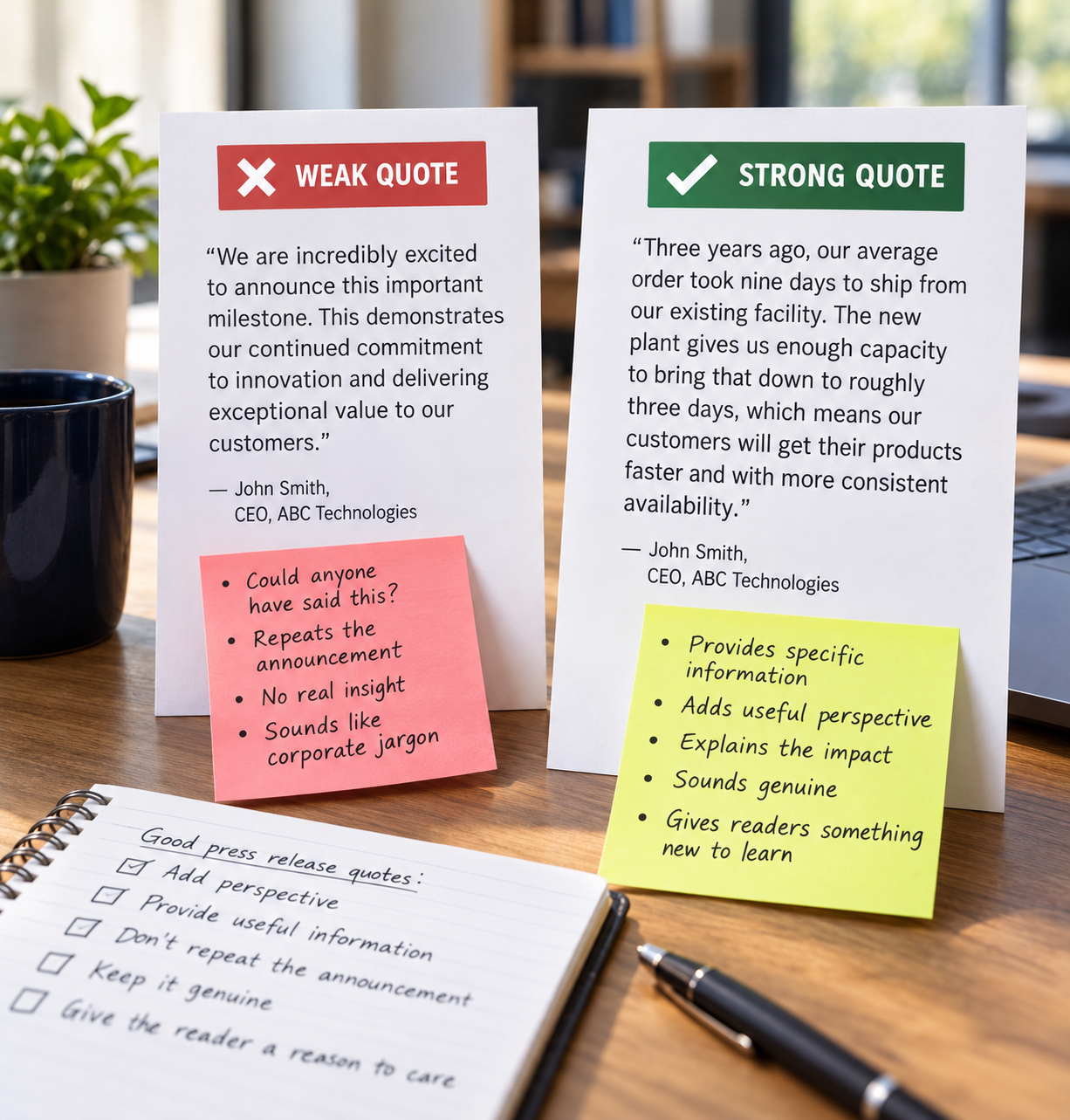
A certain kind of quote appears in press releases all the time.
It usually sounds something like this:
“We are very excited to announce this amazing milestone,” said John Smith, CEO of ABC Company. “This demonstrates our continued commitment to innovation and delivering exceptional value to our customers.”
There is nothing technically wrong with it. It is positive. It sounds professional. It uses all the familiar language you would expect in a company announcement.
But what did the reader actually learn?
Probably not much.
Quotes can be some of the most valuable parts of a press release because they give a real person an opportunity to add perspective to the facts. Too often, though, they become a formality. The release needs a quote, so someone writes two sentences for the CEO, adds a few words such as “excited” and “committed,” and moves on. The result sounds like a quote without really saying anything.
Try the “Could Anyone Have Said This?” Test
One simple way to evaluate a press release quote is to remove the person's name and company. Could the same quote appear in a press release from a software company, restaurant chain, manufacturer or financial services firm?
“We're thrilled to reach this milestone and look forward to continuing to provide exceptional service to our valued customers.”
Who said it? It could be almost anyone. Now consider something more specific:
“Three years ago, our average order was taking nine days to ship from our existing facility. The new plant gives us enough capacity to bring that down to roughly three days.”
That quote belongs to a particular story. It gives us information about the company's experience, explains why the new facility matters and helps put the announcement into perspective. That's what a useful quote can do.
A Quote Shouldn't Repeat the Paragraph Above It
Another common problem is repetition. The release tells us:
ABC Manufacturing announced Tuesday that it will invest $8 million in a new production facility in Ohio. The next paragraph says:
“We are excited to announce our $8 million investment in this new Ohio facility,” said the company's CEO.
We've now been told essentially the same thing twice. This isn't just a press release issue. Writing and journalism educator Poynter specifically advises writers to avoid what it calls “echo quotes”—quotes that repeat what has just been written. Poynter also suggests using a quote when the source can say something better than the writer can.
That's a useful principle for press release writing. Let the factual part of the release tell readers that the company is investing $8 million. Give the CEO something else to tell them.
Why Ohio? Why is the investment happening now? What problem has the existing facility been experiencing? What will the expansion allow the company to do that it couldn't do before?
The answers could produce a much better quote.
Let the Release Give the Facts, and the Person Give the Perspective
Not everything needs quotation marks. If a company was founded in 1998, operates 14 locations and employs 600 people, those are facts. They can simply be stated. A quote becomes useful when it adds something that sounds as though it came from someone with firsthand knowledge of the situation.
Imagine a retailer announcing a major expansion of its online business. The release could say that online orders now represent 55 percent of sales. That's a fact. The founder might then say:
“When we opened our first location, almost every customer came through the front door. Today, more than half of our orders begin online. We've had to rethink what a store needs to do for the customer.”
Now the quote has a job. It adds experience and perspective rather than repeating the statistic.
Give People Something Specific to Talk About
One reason press release quotes become generic is that the person being quoted is asked a generic question. “What would you like to say about the announcement?”
The predictable answer is that they're pleased, proud or excited. Try asking better questions.
What surprised you about this project? Why did the company decide to do this now? What was the biggest problem you were trying to solve? What has changed in the industry during the past five years? What are customers asking for that they weren't asking for before?
Those questions tend to produce details. And details tend to sound more human than corporate language. If you're announcing research, for example, the researcher doesn't need to repeat the headline finding. Ask what result surprised them or what they think people might misunderstand about the findings. If you're announcing a new product, ask the person who developed it what problem kept coming up with customers.
There may be a much better quote hiding in that answer.
Not Every Quote Needs to Come From the CEO
The CEO is an obvious person to quote, and sometimes the CEO is exactly the right person.
But not always. If the announcement involves a new manufacturing process, perhaps the operations manager can explain what changed on the production floor. If it's about research, the person who conducted the research may have more to contribute. If a company is opening a new location, the person responsible for that market might explain why it chose that location.
Different people also give a range of perspectives. Including three quotes adds little value if all three people essentially say, “We're excited.”
One useful quote is better than three ceremonial ones.
Don't Make Everyone Sound Like the Same Person
You can often spot a heavily polished corporate quote before you even reach the attribution.
“We are thrilled to embark on this exciting journey as we continue our unwavering commitment to innovation and excellence.”
People don't generally talk that way. That doesn't mean a press release quote has to reproduce every “um,” unfinished thought or casual expression someone uses in conversation. A quote can still be concise and professional. But it should still feel like an actual person wrote it.
A physician discussing a clinical development shouldn't necessarily sound like a technology CEO. An engineer may focus on a technical problem. A founder may talk about how the company has changed. A local manager may talk about customers in that community.
Those differences make quotes more believable and more interesting.
In Your Press Release, Be Careful With Quotes Written on Someone Else's Behalf
In corporate communications, quotes are sometimes drafted for executives rather than taken directly from an interview. If that's how the quote is produced, the person whose name appears underneath it should have the opportunity to review it and be comfortable saying, in effect, “Yes, that represents what I think.”
This is one place where journalistic standards provide a useful perspective. Reuters Agency describes quotes as especially important to accuracy and says quoted material should faithfully represent what a speaker is saying and include the appropriate context. Those are Reuters' standards for its journalists, not rules governing corporate press releases. Still, the underlying principle is worth keeping in mind: quotation marks tell a reader that these words genuinely belong to the person being identified.
Reuters Journalistic Standards
If an executive reads a prepared quote and says, “I would never say that,” that's probably a sign it needs another pass.
Read the Quote Out Loud
This may be the easiest editing test of all. Read the quote aloud. Does it sound like something a person might actually say?
Long sentences packed with words such as “innovative,” “transformative,” “strategic,” “industry-leading,” and “commitment” often sound much stranger when spoken than they do on a screen.
Reading aloud also exposes sentences that are too long, overly formal or trying to make too many points at once. You don't have to make the quote casual. You just want it to sound human.
Give the Quote a Reason to Be There
A press release doesn't become stronger simply because it contains quotation marks. A good quote earns its space. It might explain why a decision was made. It might provide an observation from someone with firsthand experience. It could put a number into perspective, explain what has changed or tell the reader something that couldn't be expressed as effectively in the regular copy.
Before publishing, go back to the quote and try the test again. Remove the person's name.
Could almost anyone at almost any company have said it? If the answer is yes, don't necessarily delete the quote. Give the person another chance to say something worth hearing.
Article By: Michael Iwasaki
Michael Iwasaki is a managing partner at 24-7 Press Release Newswire and has been with the company since 2004. He writes about press release strategy, editorial best practices, and how businesses can create clearer, more credible, and more newsworthy announcements.