 +1 888-880-9539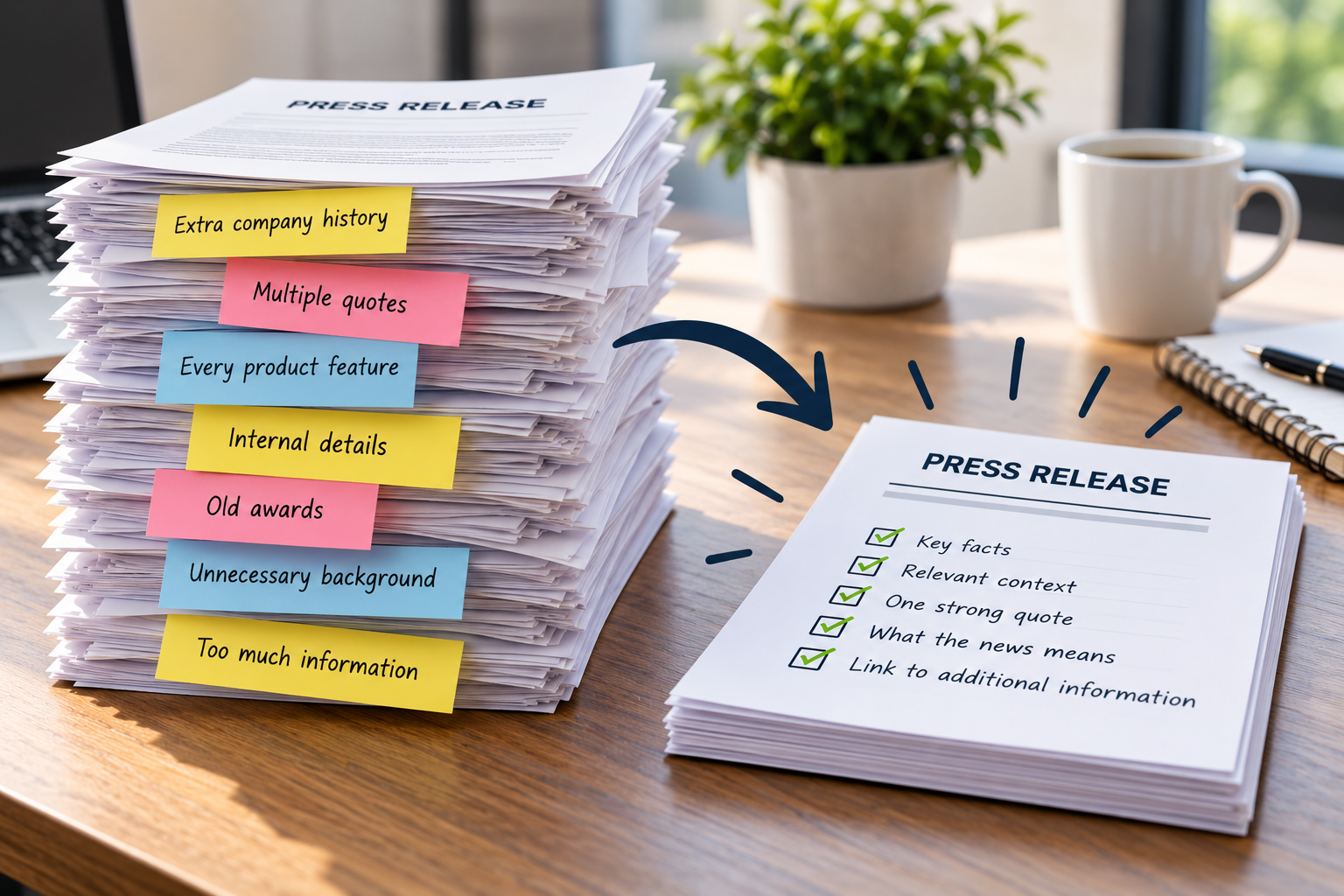
When people think about writing a press release, most advice focuses on what to include.
Include the important facts. Add a quote. Explain why the announcement matters. Give the reader enough background to understand the story. All good advice. But there is another question worth asking before you send a release out:
What can you leave out?
Companies are understandably close to their own news. By the time an announcement is ready for press release distribution, several departments may have contributed information. Marketing wants the product benefits included. The CEO wants some company history. Sales has another feature worth mentioning. Someone suggests a second quote. Then a third.
Before long, a fairly straightforward announcement has become much harder to find inside its own press release.
Not Everything That's True Needs to Be Included
A detail doesn't have to be inaccurate or poorly written to weaken a release. Sometimes it simply isn't important enough to be there. Imagine a manufacturer announcing a new production facility. Readers probably need to know where the facility is, what will be produced there, how large the investment is and when operations are expected to begin. If the project creates jobs or significantly increases production capacity, those details may matter too.
Do readers need the history of every product the company has introduced since 2017? Probably not. That information may be perfectly accurate. It just doesn't help someone understand this announcement.
This is an important distinction. Editing a press release isn't only about correcting bad information. It's also about removing good information that's in the wrong place.
Watch for Company History Creep
A little background can help, especially when the company isn't widely known. The trouble begins when background gradually turns into biography. A sentence explaining that the business manufactures commercial refrigeration equipment may give a journalist useful context. A paragraph describing when the company was founded, where its first office was located, an award it received six years ago, and three previous expansions probably doesn't.
Most of that information can live in the boilerplate or on the company's website. The reader needs enough background to understand the news, not the complete history of the organization making it.
Every Product Feature Doesn't Deserve Equal Space
Product announcements are especially vulnerable to this problem.
The people who developed a product know how much work went into every feature. Naturally, they want to talk about all of them. The reader has a different perspective. Suppose the biggest improvement in a new software platform reduces a process from three hours to 20 minutes. That's probably worth explaining.
If the same release gives equal attention to seven minor interface changes, the strongest part of the announcement can disappear into a list of features. Choosing what deserves the most space is part of good press release writing.
Poynter makes a useful point in its guidance on writing shorter stories: brevity comes from selection, not compression. In other words, the answer isn't necessarily to cram everything into shorter sentences. Sometimes the better choice is to leave out the material doing the least work.
Poynter: Advice on Writing Short
Quotes Need to Earn Their Space Too
The same principle applies to quotes.
If the CEO explains why the company made a decision, provides firsthand perspective, or helps put a number into context, the quote contributes something. If the CEO says the company is excited, the COO says the company is proud, and a partner says the announcement is an important milestone, do you really need all three? Probably not.
Using a press release service doesn't mean every available quote, statistic or company detail needs to be included before the release is distributed. One useful quote can do more for the story than three ceremonial ones.
Some Information Belongs Behind a Link
Leaving something out of a press release doesn't mean hiding it. Detailed technical specifications can live on a product page. A complete research methodology can accompany the original study. Executive biographies can remain on the company website. A conference page can provide the full event schedule. The release can link to those resources for readers who want more.
This approach is consistent with guidance from the UK's Office for National Statistics, which recommends checking content against the reader's needs and removing material that doesn't meet them. It also recommends linking to supporting information rather than repeatedly including material that isn't central to the page.
Office for National Statistics: Structuring Content
The press release can give readers the story. Supporting pages can give them the deeper detail.
Don't Confuse Internal Effort With Reader Importance
This may be the hardest editing decision. Something can take months of meetings, revisions, and work without needing several paragraphs in the final release. The reader wasn't in those meetings.
They are seeing the finished announcement and trying to understand what happened, why it matters and whether it is relevant to them. Remember that difference in perspective before adding “just one more thing.”
Try the “Delete It and See” Test
When you're unsure about a paragraph, temporarily remove it. Then read the paragraphs before and after it.
Does the announcement become harder to understand? Did you lose an important fact, necessary context or evidence supporting a claim? If so, put it back. If nothing important seems to be missing, you may have found something the release doesn't need.
A strong press release isn't the one that contains everything a company could say about an announcement. It's the one that gives the reader what they need to understand the story without making them search through everything else. Sometimes improving a press release isn't about adding another sentence.
It's recognizing the sentence you can remove.
Article By: Michael Iwasaki
Michael Iwasaki is a managing partner at 24-7 Press Release Newswire and has been with the company since 2004. He writes about press release strategy, editorial best practices, and how businesses can create clearer, more credible, and more newsworthy announcements.