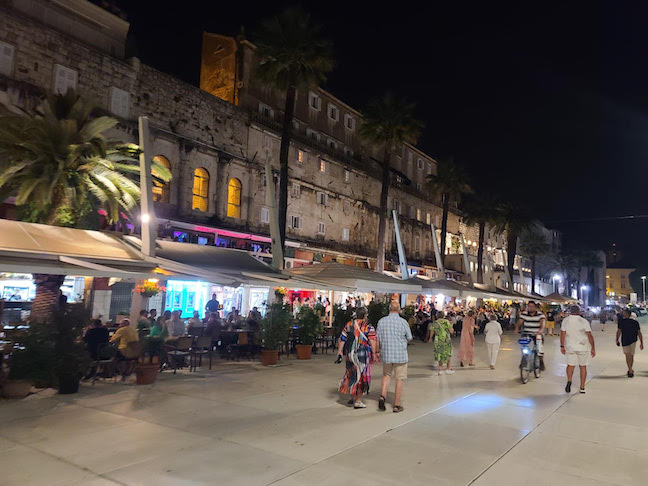

BETHLEHEM, PA, July 03, 2025 /24-7PressRelease/ -- Ammar Jali's recent visit to Split Old Town was driven less by sightseeing and more by curiosity about how a city integrates the ancient into everyday life. Located along Croatia's Adriatic coast, Split is best known for Diocletian's Palace, a Roman complex built at the turn of the 4th century. What interested Jali wasn't just the site's historical significance but how it continues to operate as part of the city's infrastructure.
Diocletian's Palace is a mixed-use urban space, unlike many historical landmarks, which are often roped off or surrounded by controlled entry points. Inside its walls are residential apartments, restaurants, grocery stores, souvenir stands, and religious buildings. This was a clear example of how Split handles preservation through use rather than isolation for Jali.
He spent several days walking through the network of narrow streets, noting the absence of formality in how people interact with the space. Deliveries are made in small carts, conversations happen under Roman arches, and the stone pathways serve tourists and locals heading to work or school. Visitors are present, but they don't dominate the environment. The palace is not a frozen relic; it's a functioning district.
Jali focused on understanding the place's mechanics. For instance, he observed how shops often adapt their interiors around immovable structural elements. A wine shop might feature a Roman column in the middle of the floor, not as decoration but as part of the original wall layout. Some buildings lack standard foundations because they are built directly into palace ruins. This blend of ancient and modern is not emphasized with signage or storytelling; it's simply part of how the city operates.
Ammar Jali noted that one of the more structured parts of the Old Town is the Peristyle, a former imperial courtyard that now acts as a central meeting point. It's often used for public events or informal performances, but on regular days, it's a place where people sit, talk, or take a break. Jali spent time here watching the ebb and flow of people through the square. He wasn't looking for symbolic meaning; he was just trying to understand how the space is used on an average afternoon.
His itinerary included visiting the Cathedral of Saint Domnius, a building that started as a mausoleum and was later converted into a church. It's part of the palace complex and still holds regular services. The transition from imperial tomb to religious center didn't seem unusual in a place where multiple centuries are stacked within walking distance. Entry was straightforward, and the structure didn't appear to have been overly modified for tourism.
Jali also walked along Riva, the city's main waterfront promenade, just outside Old Town. It's a wide pedestrian area with palm trees, benches, and cafés. The layout is practical: it gives residents space to walk and talk while also providing access to the sea and ferry terminals. It's a shared space, with no separation between tourists and locals.
In terms of food, Jali avoided curated experiences. He ate at standard konobas, Croatian taverns serving local dishes like grilled fish, stews, and risottos. The menus were not heavily designed for international appeal, and the service was relaxed. Meals were unhurried, and portions reflected local eating habits rather than tourist expectations. Jali noted that the food didn't try to tell a story; it simply reflected what was typical for the region.
He also visited the Pazar, a produce market just outside the palace's eastern gate. The market was straightforward and busy. Stalls offered fruit, vegetables, homemade goods, and household items. There were no guided tours or performances, just buyers and sellers completing daily tasks. Jali walked through, observed the setup, and moved on. It functioned like any other market in a small coastal city.
The rest of his time in Split was spent walking without a fixed route. The Old Town is compact, so that most areas can be reached on foot in under 15 minutes. Jali chose not to document each landmark. Instead, he tried to understand how people navigate the space without treating it as special. In many ways, Split does not treat its history as a product. It is simply part of the setting.
Jali's visit did not result in any grand conclusion. The city didn't present a single defining moment. Instead, it offered a working example of how historical infrastructure can be integrated into modern routines. For Jali, Split Old Town wasn't a spectacle but a case study in urban continuity.
To learn more visit: https://ammarjali-travel.com
# # #
Contact Information
Ammar Jali
Ammar Jali
Bethlehem, Pennsylvania
United States
Telephone: 6167541345
Email: Email Us Here
Website: Visit Our Website