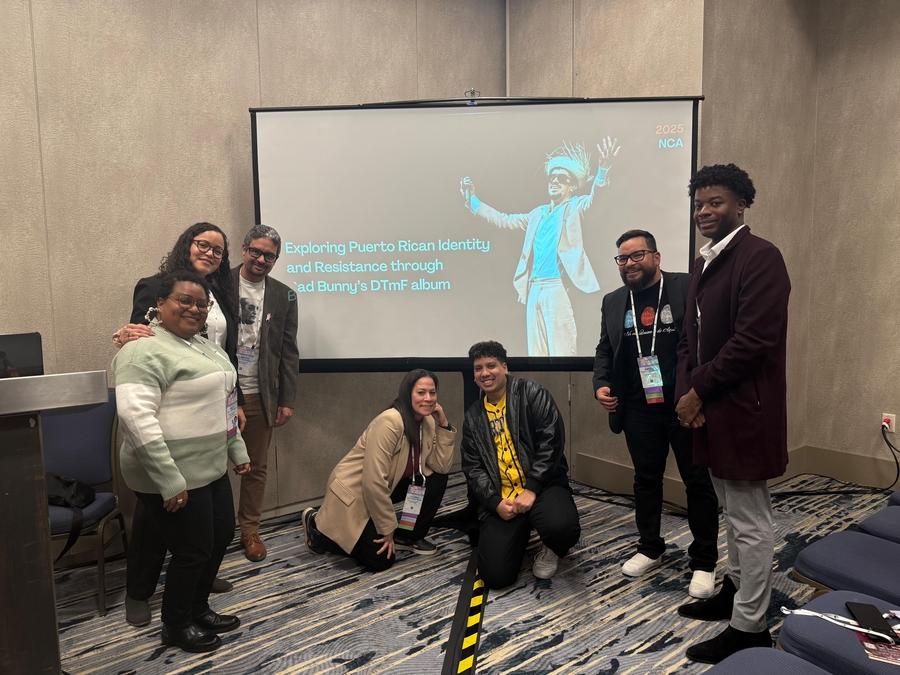

DENVER, CO, November 25, 2025 /24-7PressRelease/ -- Puerto Rican representation reached a new academic milestone with the selection of the panel "Exploring Puerto Rican Identity and Resistance through Bad Bunny's DTmF album", presented at the 111th edition of the National Communication Association (NCA) Annual Convention, held November 20–23, 2025, in Denver, Colorado.
The proposal surpassed a rigorous evaluation process in one of the most competitive calls of this prestigious academic event. It was presented with support from the Caribbean Communication Caucus and co-sponsored by La Raza Caucus and the Latino/Latina Communication Studies Division. The panel brought together leading voices from academia, journalism, law, strategic communication, and cultural studies. All participants shared the mission of examining the identity-related, political, and social dimensions of Bad Bunny's most recent album, Debí tirar más fotos (DTmF), and its impact on the diaspora and the public discussion surrounding Puerto Rican identity.
The purpose of the panel was to analyze how DtMF serves as a tool of resistance, cultural archive, and social commentary in a Puerto Rico marked by economic crises, inequality, displacement, and colonial challenges. The presentations highlighted themes of race, gender, class, colonialism, environmentalism, and diaspora—all present in the artist's work.
Journalist, digital strategist, and doctoral student in Communication, Media, and Culture at Howard University, Lillian Enid Agosto Maldonado, explained that her contribution is based on a critical analysis of social media content—primarily on TikTok—to understand how the diaspora interprets and connects with the album's themes.
"The album's reception among the diaspora offers a powerful lens for examining cultural identity and the sense of belonging," she noted.
Meanwhile, researcher, content creator, and doctoral student at Louisiana State University, Nildy Mary Chapman Sánchez, contributed from a performance studies perspective, analyzing how Bad Bunny employs gestures of cultural reaffirmation while adapting his image to the global market. She emphasized the use of Puerto Rican symbols such as the jíbaro, the pava, and rhythms like salsa, bomba, and plena to construct an identity performance that resonates with both local audiences and international publics.
Chapman Sánchez also applied Yomaira Figueroa's concept of the photo/poetics of Boricua aesthetics, highlighting how the artist's everyday aesthetic functions as a living archive of Puerto Ricanness. According to her analysis, the album invites listeners to "leave a trace" through photos, videos, and texts, concluding that cultural creation documents and preserves what it means to be Puerto Rican.
Journalist, lawyer, and University of the Sacred Heart academic Rafelli González Cotto addressed the communicational dimension of the phenomenon, describing Bad Bunny as a kind of modern cultural journalist who has transformed the norms of digital content distribution.
"Is Bad Bunny a journalist? Not in the traditional sense. But in the sense that matters for cultural survival, yes," he argued. "He is a chronicler of Puerto Rico's present, an archivist of resistance, and a narrator who refuses to let the island disappear after the storm, the blackout, or the colonial shadow."
Environmental affairs specialist Lilliana Alemán delved into how Bad Bunny's music becomes a vehicle for denouncing climate vulnerabilities and gentrification. Her analysis included songs such as Lo que le pasó a Hawaii, La mudanza, Café con ron, and Turista, in which she identifies metaphors of displacement, migration, and environmental degradation.
Columnist, legal professional, and University of New Mexico student Ínaru de la Fuente Díaz emphasized the need to examine narratives of cultural transformation and the tensions between reggaeton and LGBTQI+ experiences. Her commentary highlighted Bad Bunny's role in subverting the homophobic and misogynistic discourses traditionally tied to the urban genre.
In her notable participation, De la Fuente Díaz stressed the urgent need to study how queer people reinterpret and transform culture within a genre that has historically perpetuated homophobic and misogynistic narratives. She underscored that such symbolic violence can make many people feel foreign within their own culture, creating distance or even rejection toward what should be a space of belonging.
According to her analysis, Bad Bunny's work—by subverting gender norms and opening space for non-normative expression—creates conditions to heal that past, allowing queer identities to reclaim, rebuild, and live their Puerto Ricanness without renouncing themselves.
Meanwhile, president of Boricuas Unidos en la Diáspora (BUDPR) and author of the forthcoming book Free Puerto Rico: The Case for Independence, Alberto Medina, situated his analysis within the political context. He argued that Bad Bunny has managed to bring the topic into the mainstream like no other contemporary communicator, becoming a reference point for pro-independence youth.
"Puerto Rico's colonialism is one of the gravest injustices in the United States, yet it is almost absent from public discourse," he stated as the centerpiece of his intervention.
Finally, Howard University doctoral student and adjunct professor specializing in communications and public relations, Nicholas Uptgrow, presented a multimodal critical discourse analysis of interviews and music videos such as Caro and Yo Perreo Sola. He concluded that Bad Bunny's body of work articulates counter-hegemonic discourses on gender norms and fluid expressions of identity.
The panel's presentation represented not only a recognition of the academic rigor of its members but also a historic moment in the internationalization of Puerto Rican cultural analysis. From Denver, the discussion on identity, resistance, and national future sought to claim a central place thanks to an artist who has transcended the musical stage to become a cultural and political agent of global reach.
# # #
Contact Information
Rafelli Gonzalez Cotto
Shared Media
San Juan, PR
Puerto Rico
Telephone: 7876977665
Email: Email Us Here