
LOS ANGELES, CA, February 11, 2026 /24-7PressRelease/ -- For years, sleep technology has followed a simple belief: the closer a device is to your body, the more accurate it must be. It's an idea reinforced by design. Rings tighten around fingers. Watches press against wrists. Patches cling to skin overnight. The message is subtle but clear—physical attachment equals precision. And while that logic makes sense on paper, sleep itself doesn't follow paper rules. Sleep is messy. It's uncontrolled. It's the one part of the day where people stop managing their bodies altogether. And that reality quietly exposes a flaw in how most sleep tracking systems are designed.
When the Night Starts, the Assumptions Fall Apart
Think about the moment just after you fall asleep. Your breathing slows. Muscles relax. Your arm shifts under a pillow. A blanket slides off your shoulder. Your wrist bends at an unfamiliar angle. The room temperature changes as the night goes on.None of this is intentional. None of it feels disruptive. And yet, every one of these changes affects how a wearable device reads data.A smartwatch that sat perfectly at bedtime may rotate as you turn onto your side. A ring that felt snug while awake may loosen slightly once circulation changes. A patch designed for stillness now has to interpret motion it was never meant to handle. The problem isn't that these devices are poorly made.The problem is that sleep itself refuses to stay still.
Why Wearables Struggle With Long-Term Accuracy
Most wearable sleep trackers rely on a combination of optical sensors, accelerometers, and skin-based measurements. These tools are sensitive by necessity—but sensitivity without stability creates noise.Optical sensors depend on consistent light reflection. Accelerometers detect movement but can't distinguish intention. Skin-contact measurements fluctuate with temperature, pressure, and moisture.
On a single night, these issues may barely register. But sleep tracking isn't about a single night. It's about patterns.Over weeks and months, subtle inconsistencies accumulate. A slight change in strap tightness here. A different sleeping position there. Slowly, the data begins to reflect changing sensor conditions more than changing sleep behavior. Users often don't realize this is happening. They simply see fluctuating scores and unclear trends—and assume sleep itself is unpredictable.
The Real Question: What Does "Accuracy" Actually Mean?
In sleep monitoring, accuracy is often misunderstood. It's not about capturing a perfect data point at one moment in time. It's about capturing the same type of data under the same conditions, night after night. Consistency is what allows meaningful comparisons.Stability is what turns raw data into insight. Once you look at accuracy through that lens, the idea that sensors must always be worn starts to feel less obvious—and less necessary.
SOMNDEEP Started With a Different Question
Instead of asking, "How can we get closer to the body?" The team behind SOMNDEEP asked something else entirely: "What if we remove the variable that changes the most?"
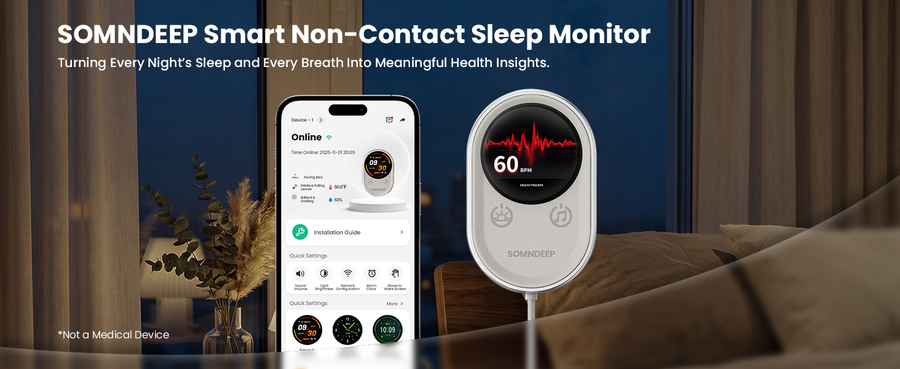
That variable was physical attachment.Rather than designing another device that users must wear, adjust, remember, and tolerate every night, SOMNDEEP Contactless Smart Sleep Monitor was built to observe sleep from a fixed position—without touching the body at all.Observing Sleep Instead of Interfering With ItSOMNDEEP Contactless Smart Sleep Monitor uses millimeter-wave radar technology to detect ultra-fine micro-movements associated with breathing and sleep behavior.
Placed near the sleep area at an appropriate sensing distance, the device remains stationary throughout the night. It doesn't shift. It doesn't loosen. It doesn't respond to sweat, skin tone, or temperature changes.
The environment stays consistent.And because the sensor doesn't move, the signal remains stable.This is the core difference.While wearable devices move with the body, SOMNDEEP Contactless Smart Sleep Monitor observes the body from outside the system. That separation eliminates many of the variables that quietly undermine long-term sleep accuracy.
Why Radar Changes What's Possible
Radar sensing works in a fundamentally different way than optical or contact-based technologies. Instead of relying on light, pressure, or skin conductivity, radar detects subtle physical motion in space. Even minute movements caused by breathing are reflected in the radar signal.
This allows SOMNDEEP Contactless Smart Sleep Monitor to focus on what actually matters during sleep:
1)Breathing rhythm and consistency
2)Motion continuity across sleep cycles
3)Long-term behavioral trends
Because radar is not affected by surface-level conditions, it avoids many of the confounding factors that wearables must constantly compensate for. The result is a cleaner, more repeatable signal—one that reflects sleep behavior rather than sensor placement.
Stability Requires Design, Not Guesswork
Non-contact does not mean uncontrolled. SOMNDEEP Contactless Smart Sleep Monitor is designed to operate within a defined sensing range, ensuring accuracy without requiring physical attachment. Once placed correctly, the system maintains the same spatial relationship to the sleeper every night. This controlled distance allows radar signals to remain consistent while avoiding the distortions caused by body-worn sensors. Accuracy, in this context, comes not from proximity alone—but from repeatable conditions.
What This Means in Real Life
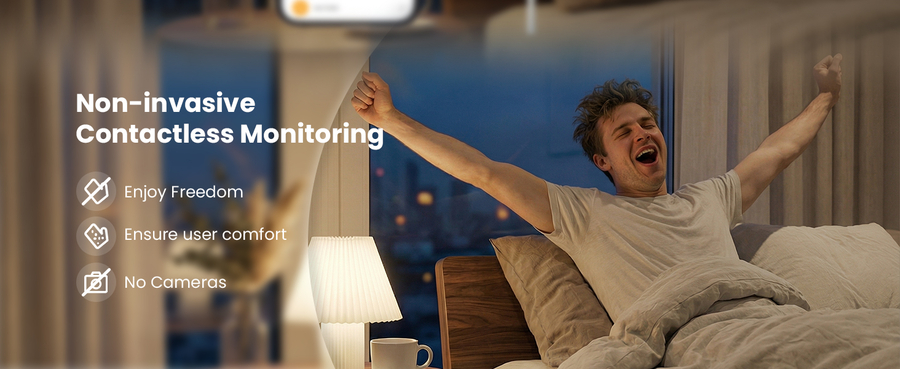
For users, the difference becomes apparent over time.There's no device to put on before bed. No discomfort from tight straps or hard edges.No data gaps from forgetting to wear something. Sleep happens naturally. Monitoring happens quietly. And because the sensing conditions remain stable, changes in the data are more likely to reflect actual changes in sleep behavior—rather than shifts in how a device was worn. This makes long-term trends easier to interpret and trust.
Built for How People Actually Sleep
Sleep doesn't follow instructions.People roll over. They sprawl. They curl up. They kick blankets away and pull them back hours later. They travel. They change routines. They stop thinking about technology entirely once the lights go out. SOMNDEEP Contactless Smart Sleep Monitor is designed for this reality.
By staying off the body and maintaining a constant sensing position, it works in the background—night after night—without asking users to adapt their habits. In many ways, the most important feature of SOMNDEEP is what users don't notice. Rethinking What "Accurate" Really MeansAccuracy in sleep monitoring is often framed as a race toward more sensors, tighter attachment, and higher sensitivity. But sensitivity without stability leads to confusion.
SOMNDEEP takes a different view:that true accuracy emerges from consistency, repeatability, and minimal interference.By removing physical contact and focusing on stable observation, it offers a clearer picture of sleep as it actually happens.
Summary
Not wearing a device doesn't mean less accurate. In many cases, it means removing the very variables that make sleep data unreliable in the first place.Accuracy in sleep monitoring isn't determined by physical contact alone. It depends on maintaining an appropriate sensing distance, along with signal consistency and environmental stability over time.
SOMNDEEP Contactless Smart Sleep Monitor demonstrates that when non-contact monitoring is designed correctly, it can deliver reliable, meaningful sleep insights—quietly, comfortably, and consistently. And sometimes, the most accurate way to measure sleep is to stop touching it at all.
(Note: SOMNDEEP for general wellness use only; not a medical device.)
# # #
Other Media
Contact Information
SOMNDEEP OFFICIAL
SOMNDEEP
Los Angeles, California
United States
Telephone: +852 69192451
Email: Email Us Here
Website: Visit Our Website