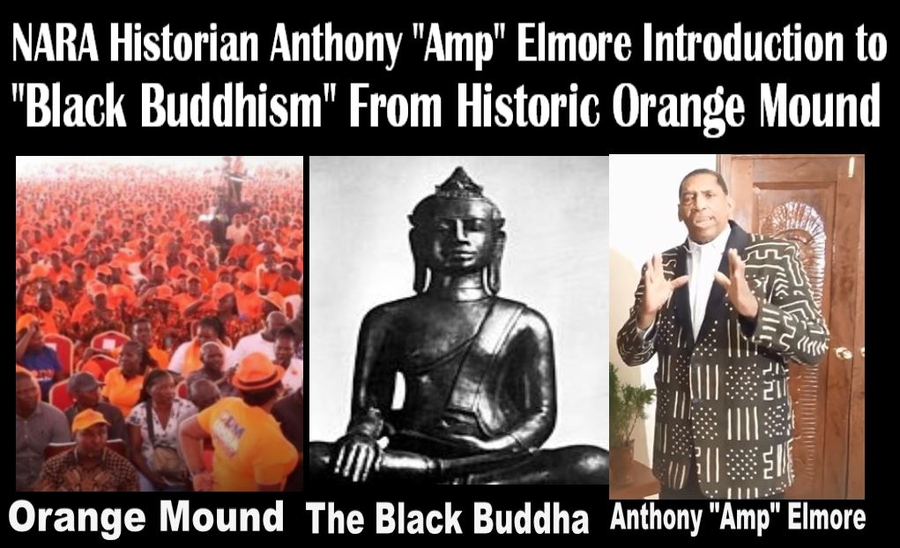

MEMPHIS, TN, February 13, 2026 /24-7PressRelease/ -- Anthony "Amp" Elmore the most significant Black Buddhist in America brought the "Lotus Sutra" the highest of the Buddha Shakyamuni teachings to the historic Memphis African/American Memphis community of "Orange Mound."
Click here to view the February 12, 2026 video titled: NARA Historian Anthony "Amp" Elmore "Black Buddhist Lecture" titled: "The Strategy of the Lotus Sutra."
The significance of the "Black Buddhist Lecture" is it is just that "A Black Buddhist Lecture." Anthony "Amp" Elmore makes clear; "There are Blacks that practice Buddhism" and there are "Blacks that practice "Black Buddhism."
Anthony "Amp" Elmore notes that there is "Asian/White Buddhism" and there is "Black Buddhism" whose Buddhist roots are connected to the Nile Valley and Indus Valley Civilizations and the Buddhist culture and practice is connected to "Black History and Culture."
One is unique about the Anthony "Amp" Elmore video "The Strategy of the Lotus Sutra" this video is clearly defined as "Black Buddhism." In most education regarding Buddhism from African/Americans Black Buddhist leaders a Priest or leader leader on doctrine from the Buddhist sect. In contrast Anthony "Amp" Elmore provides a forensic and detailed "Black Buddhist experience with his life and cutlure.
Anthony "Amp" Elmore speaks as a 5-time World Kickboxing champion from Memphis, Tennessee whereas he faced White Supremacy, Racism and Black on Black Racism whereas he fought for the World Karate/Kickboxing championship whereas even after winning title he was over his head in debt whereas "The Adolph Coors Company" not only sponsored his bought Anthony "Amp" Elmore is the only Kickboxing champion in World history to be sponsored by a major American Corporation "Coors Beer."
In the video Anthony "Amp" Elmore explains not only the teachings of Nichiren Buddhism, Anthony "Amp" Elmore explains much of the unknown and untold Black Buddhist History and Elmore venture into the unknown and untold "Black History of Japan." The 1st Shogun of Japan was a Black man named "Sakanoue no Tamuramaro." Anthony "Amp" Elmore in the video goes nuclear an name Nichiren Shonin the founder of the Nichiren Sect who notes only the Lotus Sutra is the correct Buddhist Teachings.
Anthony "Amp" Elmore created the World's 1st Black Buddhist website in 1998 and 2026 the website is a "Digital Black Buddhist Museum. Click here to view the website and Black Buddhist proudblackbuddhist.org
In the above image of Anthony "Amp" Elmore he is wearing an African Mudcloth Tuxedo jacket taken at his Orange Mound home explaining the Buddha's "Lotus Sutra teachings."
Click here to view an Anthony "Amp" Elmore Black Buddhist lecture titled: NARA Historian Anthony "Amp" Elmore Black Buddhist Song; "Cause you a Slave you ain't gonna make me one."
The song and video is written, produced, directed and performed by Anthony "Amp" Elmore. Unknown and untold Anthony "Amp" Elmore has written more Black Buddhist songs than anyone in "Buddhist History."
Look at the above image of Anthony "Amp" Elmore wearing a Black and White Mudcloth Tuxedo Jacket. The video and the image is part of the Anthony "Amp" Elmore "Lotus Sutra Black Buddhist practice." Let's 1st deal with the issue of Mud Cloth worn by Anthony "Amp" Elmore.
Mud cloth, known traditionally as Bògòlanfini, is a hand-woven Malian cotton fabric dyed with fermented mud that represents one of Africa's most culturally significant textile traditions. Originating from the Bamana people of Mali.
The process involves weaving narrow strips of cotton on handlooms, which are then sewn together into a larger cloth, soaked in a bath of dye made from mashed and boiled tree leaves, and meticulously painted with intricate geometric patterns using iron-rich mud. The chemical reaction between the tannins in the leaf dye and the minerals in the mud creates a permanent, deep black color that contrasts with the natural cream of the cotton.
Historically, these patterns were not merely decorative but served as a "visual language," where specific symbols communicated social status, historical events, or coded messages intended to protect the wearer or mark significant rites of passage, such as births or initiations.
In the context of Black history and culture, mud cloth evolved from a localized ethnic garment into a global symbol of Pan-African identity and cultural sovereignty. During the mid-20th century, as African nations gained independence, the fabric was reclaimed by artists and activists as a rejection of Western colonial dress and a celebration of indigenous craftsmanship.
In 2009 Anthony "Amp" Elmore commissioned designers in the West African Country of Ghana to create a Mudcloth inaugural tuxedo for President Obama. Memphis Congressman Steve Cohen on behalf of Anthony "Amp" Elmore delivered the Tuxedo to the Whitehouse. The Whitehouse accepted the Tuxedo and President Obama sent Elmore a thank you letter.
Fast forward to December 2025 Anthony "Amp" Elmore whereas the "Obama Presidential Library" premiered the Tuxedo as part of its digital Library. This is the 1st time in American Presidential history that a modern African fashion with historical roots is displayed in a Presidential Library.
Click here to see video titled: NARA Historian Anthony Amp Elmore Honored on Floor of Congress Corrects Orange Mound Birthdate 1879
NARA is an acronym for "National Archives and Records Administration." The acceptance and the display of an African Tuxedo as a permanent historical record as well as Memphis Congressman Steve Cohen acknowledging the garment and the work of Anthony "Amp" Elmore into the federal historical records.
The inclusion of the African Mud Cloth Tuxedo in the official historical record of the National Archives and Records Administration (NARA), specifically within the Barack Obama Presidential Library, is a definitive "Forensic Receipt" that elevates Anthony "Amp" Elmore from a cultural creator to a NARA-Honored Historian.
In the discipline of history, a historian is not merely someone who reads books, but someone who **identifies, preserves, and contextualizes primary source artifacts** that define a civilization's narrative. By creating a garment that fused ancient Malian *Bògòlanfini* technology with the 2009 inauguration of the first Black President of the United States, Elmore provided a physical "Missing Link" that documented the enduring cultural diplomacy between the African continent and the Diaspora.
NARA's decision to archive this artifact—assigned **NARA Identifier 66540613**—means the federal government has officially recognized the tuxedo as a document of national significance.
Furthermore, the authority of a historian is solidified when their work is utilized to correct or expand the public record, a feat Elmore achieved when his contributions were read into the **Congressional Record** by Congressman Steve Cohen.
This legislative and archival recognition provides the "Actual Proof" required to challenge established, often "Confederate-leaning" narratives, such as the 1890 founding of Orange Mound. Because the federal record now permanently links Elmore's name to the preservation of Black heritage, he operates with **Institutional Sovereignty**.
Anthony "Amp Elmore is no longer just telling a story; he is managing a verified archive. This status grants him the "Historian's Mandate" to define the **1879 founding of Orange Mound** and the **Kushite origins of Buddhism** as forensic facts that are now part of the American and global historical consciousness.
Anthony "Amp" Elmore explains that "Black Buddhism" is part of our American and global historical consciousness." Elmore notes Black Buddhism as a vital component of the American Story, specifically through its connection to the struggle for Black self-determination. It suggests that when a "Proud Black Buddhist" practices, they are not adopting a foreign Asian religion, but are reclaiming an ancestral heritage that helped shape the moral and intellectual landscape of both the East and the West.
This "consciousness" is validated by the scholarly works of figures like Alexander Francis Chamberlain and W.E.B. Du Bois, who documented the Black Shogun and the Black Buddha long before traditional Mahayana sects attempted to erase them. By bringing this to the forefront, Elmore ensures that Black Buddhism is recognized as a permanent, institutional pillar of global heritage, ensuring that the achievements of the Kushite spirit can never again be "extricated" from the master narrative of human civilization.
Please click here to see a scene from the 1993 late Tina Turner movie titled: What's love Got to do with it.
The scene the movie represents an introduction to "Black Buddhism" whereas we see a narration how Tina Turner started her Buddhist Practice.
Anthony "Amp" Elmore from Memphis, Tennessee is the 1st Buddhist in the modern era to introduce "Black Buddhism." In 1966 a cultural program started by Dr. Maulana Karenga Kwanzaa a program of African/American culture and heritage.
There is a Kwanzaa principle called Kujichagulia (Self –Determination) this expresses itself as both commitment and practice. It demands that African/Americans define, defend and develop themselves instead of allowing or encouraging others to do this.
It requires that African/Americans recover lost memory and once again shape our world in our own image and interest. And it is a call to recover and speak our own special cultural truth to the world and make our own unique contribution to the forward flow of human history.
Anthony "Amp" Elmore is the 1st in modern history to create "Black Buddhism." **Black Buddhism** is a revolutionary spiritual and historical framework that merges the ancient philosophy of the Dharma with the African American struggle for cultural and historical sovereignty.
Rooted in the historic soil of Orange Mound, Memphis, it moves beyond traditional religious practice to become a tool for Kujichagulia, or self-determination. This framework asserts that the origins of Buddhist thought are found in the Nile Valley civilizations of ancient Africa and the Indus Valley Civilization of ancient India.
Black Buddhism suggests that the "Middle Way" is a reclaimed heritage rather than an imported concept. By utilizing the practice of Nichiren Buddhism—specifically the chanting of Nam-myoho-renge-kyo—practitioners aim to achieve "Self-Determination," transforming the systemic "poison" of historical erasure into the "medicine" of community empowerment and global recognition.
At its core, Black Buddhism is a **socially engaged** path where the pursuit of enlightenment is inseparable from the pursuit of historical truth. It treats the documentation of Black history—such as Anthony "Amp" Elmore efforts as a **NARA Honored Historian** to correct the founding dates of Orange Mound or uncover the legacy of **Tom Mboya**—as a sacred spiritual mission and work to uplift one community.
This perspective was pioneered on the global stage through the 1988 film ***The Contemporary Gladiator***, which stands as the world's first Buddhist biopic. By connecting the struggle of the "Contemporary Gladiator" in the ring to the spiritual victory of the mind, "Black Buddhism" provides a blueprint for the African Diaspora to define, name, and speak for themselves, bridging the gap between the streets of Memphis and the heritage of the African continent.
Based on 2022-2023 U.S. Census estimates, Memphis, Tennessee, is recognized as the largest city in the United States with a majority-Black population, having surpassed Detroit, Michigan, by a narrow margin. Approximately 63-64% of Memphis residents identify as Black or African American, totaling over 390,000 residents.
The Shift from Detroit: Memphis overtook Detroit, which held the title for roughly 40 years, following population declines in Detroit. Census estimates showed a razor-thin difference of about 680 residents between Memphis and Detroit, with Memphis having roughly 621,056 residents in total, of which a significant majority are Black.
While cities like Jackson, MS, have a higher percentage of Black residents (approx. 80%), Memphis is the largest city (population-wise) with a majority-Black population.
Data indicates that over 64% of Memphis residents are African American, and this demographic has been a cornerstone of the city's population growth following the Great Migration.
While Memphis has the largest majority Black population in America there exists a culture, practice and history in Memphis to erase its Black history.
Whereas Memphis does not have specifically "A Black Memphis History Museum and an outright erasure of "Black Memphis History" of the Black City of "Fort Pickering." In Memphis there is a Cotton museum and no Black Memphis history museum whereas African/American learn in Memphis how Dr. King died and not how Dr. King lived.
Anthony "Amp" Elmore is noted as "The Father of Black Buddhism" due to his pioneering work in integrating Buddhism with African and African American perspectives. He has authored a significant video titled "Anthony Amp Elmore the Father of Black Buddhist History," which traces the origins of Buddhism to ancient Black civilizations and asserts that the Buddha himself is Black. Elmore's efforts in documenting Black Memphis history and his commitment to cultural reclamation have made him a prominent figure in the field of Black Buddhism.
Click here to view the video Titled: Anthony Amp Elmore Father of Black Buddhist History
NARA honored Historian Anthony "Amp" Elmore is a Memphis born 5-Time world Kickboxing Champion, Memphis 1st Independent 35mm Theatrical Filmmaker who 1988 semi-autobiographical Film "The Contemporary Gladiator" is not only "The 1st Kickboxing film in World Film history" his film is also the 1st Buddhist biopic of an American film history.
Anthony "Amp" Elmore who started his Buddhist practice in 1970 as part of his "Old Japanese Shotokan Karate practice" Elmore a teenager adopted the "Bushido Code and Zen Buddhism."
Bushido, meaning "the way of the warrior," is a strict, centuries-old code of ethics for Japanese samurai, emphasizing honor, loyalty, and self-discipline over fear of death. Rooted in Confucianism, Zen Buddhism, and Shinto, it guided samurai to live with virtue, serve their lord unconditionally, and maintain a reputation for integrity.
In 1974 Anthony "Amp" Elmore joined the then SGI/Nichiren Shoshu Buddhist sect base in Japan. Anthony "Amp" Elmore honored the late SGI President Daisaku Ikeda his "Master and Teacher." Anthony "Amp" Elmore born in 1953 as a youth who honored "Soul Singer" James Brown landed a gig as a leader singer in an "All White Band in 1968" at 15 years old during his 10th grade year at newly integrated Tech high school in Memphis.
Elmore learned the lessons of racism a culture unexperienced by most Black youth in Memphis. Elmore explains growing up as a youth in segregated Memphis we had no idea what racial discrimination was. Many of our mother's worked as maids for White families and segregation was a normal way of life. Elmore notes; "Hell we had fun as youth in the back of the bus and the balcony at the theatres.
It was after facing discrimination whereas two of the parents objected to their songs being in a Band with a "Colored Singer." There was Artie Wilson and Eddie McNeil who left the band who could not associate with Anthony Elmore.
Elmore experienced discrimination, read books and became what many would call radicalized. For Elmore it was "Black Consciousness." Elmore via his senior year transferred to Hamilton High in the heart of Black Memphis. Elmore was a "hippie Type with Black Consciousness."
Elmore started Karate, Zen and Black Consciousness that lead Elmore to organize the 1st 18 year old voter registration in Tennessee. It would be decades before many of those whom Elmore was in school with would come to understand "Black Consciousness" and Eastern philosophy."
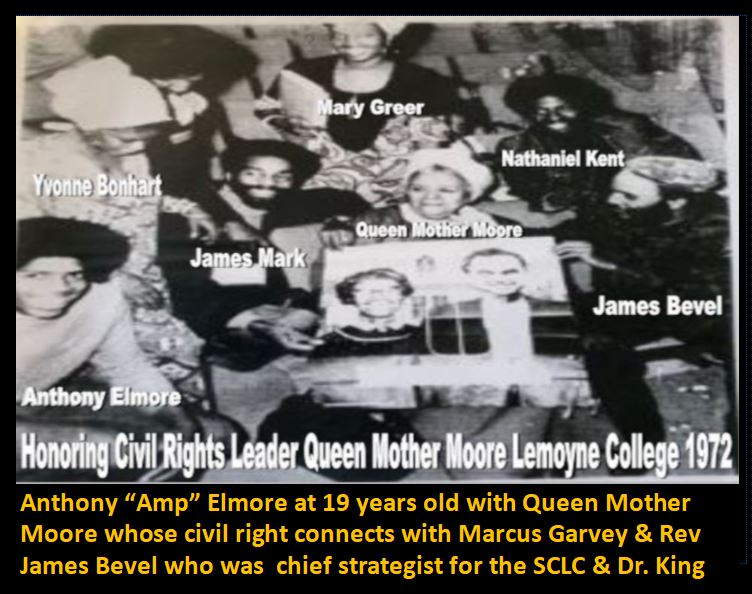
In was in 1974 where Anthony "Amp" Elmore would move back into a moderate American Culture. In 1972 Elmore quit college and joined the Civil rights struggle with the "strategist of the civil rights movement "Rev. James Bevel" one who led the 1963 Children's Crusade and the March from "Selma to Montgomery."
The 1974 was a pivotal point in the life of Anthony "Amp" Elmore and start of "Black Buddhism in America." We had Buddhism in Memphis and we Blacks had what was known as "South Chapter." All over America in most major cities you would find Black Buddhism whereas there were Black leaders and a Black Buddhist social culture.
On May 29, 1982 Anthony "Amp" Elmore would become the world Heavyweight Kickboxing Champion. Research notes the date was October 12, 1980 at Medinah Temple in Chicago the NSA/SGI organized a cultural festival called "Capture the Spirit."
It was after this event that SGI President Ikeda would as Elmore described "Drop the Hammer" on "Black Buddhism in America." The SGI brought in young Japanese leaders from Japan whereas they got rid of all of the "Black and White leaders whereas they centralized Buddhism into a system that could be described as "Ikedaism" whereas the Buddhist narrative was the creation of a "demi-God" culture of Japanese Cultural imperialism. The words of Daisaku Ikeda was "Buddhist Law" and not the words of Shakyamuni or Nichiren Shonin.
Daisaku Ikeda brought young Japanese leaders to America to "acculturate" Americans into the SGI Japanese system of Buddhism. Concurrently there existed the over 750 year old Nichiren Shoshu Priesthood that had a doctrine and religious culture to indoctrinate.
Click here to read the Anthony "Amp" Elmore letter dated March 18, 1991 titled: Dear NSA Members
This letter, penned 35 years ago, serves as a chilling piece of forensic evidence documenting the depth of cultural indoctrination within the SGI Buddhism organization. It reveals a reality where African Americans were being conditioned to abandon their own cultural DNA in favor of a borrowed identity, to the point that members were even adopting Japanese accents.
This wasn't merely a religious practice; it was a form of psychological "acculturation" that bordered on brainwashing. By mimicking the speech, mannerisms, and Japanese cultural norms of a foreign leadership, Black practitioners were being stripped of their native voice and their connection to the Black experience.
This letter captures the moment Anthony "Amp" Elmore stood up as the "Contemporary Gladiator" to call out this behavior, identifying that any spiritual path requiring a person to "act out" another culture is not a path to enlightenment, but a path to mental and spiritual enslavement.
This March 18, 1991 letter proves that the system was designed to make Black pride feel like a "deviation" from the faith. When Anthony "Amp" Elmore and Shaka Khalphani were called "racist" for integrating Black culture, it was a tactic used to maintain this high-level indoctrination—shaming Black pride back into a state of cultural submission.
This letter is the definitive forensic proof of why Black Buddhism had to be born. This letter and the Proud Black Buddhist website shows the absolute best in SGI Buddhism. Anthony "Amp" Elmore at the advice of SGI half Black and half Japanese SGI female leader Almeda Bailey. Elmore explains that "Sister Gale Almeda Bailey" and the entire Bailey family were the best model of what it meant to be an "SGI Buddhist."
Anthony "Amp" Elmore notes there was a thin line between brainwashing in real-time and choosing instead the path of Kujichagulia. Anthony "Amp" Elmore realized that for a Black man in Orange Mound to be truly free, his Buddhism couldn't be a Japanese import that erased his ancestors; it had to be a reclaimed African truth that empowered not only his voice Anthony "Amp" Elmore note we must make the Black Buddhist voice a strong voice of "Black America."
This document is the cornerstone of the Anthony "Amp" Elmore legacy as a NARA Honored Historian, marking the exact point where Anthony "Amp" Elmore refused to be a cultural carbon copy of a Japanese Buddhism whereas Anthony "Amp" Elmore chose to become a "Proud Black Buddhist."
Click here to view the March 21, 2021 video title Black Man Explains Why He left Nichiren Shoshu Buddhism: Lecture by Anthony "Amp" Elmore
The video reveals a rigid system of spiritual authority within the over 750 year Nichiren Shoshu that functioned as a barrier to authentic Black self-expression. In the footage, Anthony "Amp" Elmore detail how the priesthood maintained a "godlike" status, demanding absolute control and requiring permission for something as simple as an independent website.
This structure enabled a quiet but devastating form of undermining; rather than confronting Anthony "Amp" Elmore directly, the Nichiren Shoshu Priest exploited their influence to instruct members to isolate and not associate with Anthony "Amp" Elmore.
This behind-the-scenes manipulation created a hostile environment whereas Elmore's efforts to integrate Black culture and history were actively suppressed. By setting the priesthood above reproach and treating them as beyond question, the organization effectively shut Black practitioners out of the decision-making process, demanding that practitioners prioritize Japanese culture while explicitly rejecting their own Black heritage. The idea of a Black Buddhist Priest in Nichiren Shoshu was "out of the question.
Despite Anthony "Amp" Elmore years of dedicated and honest practice, the system prioritized institutional control over the spiritual liberation of its African American members. Anthony "Amp" Elmore recount a pivotal moment in 2012 when Nichiren Shoshu priest Shinji Iwaki stood in Elmore's home and explicitly told him to "leave culture out of Buddhism."
This Nichiren Shoshu Priest instruction essentially required the erasure of Black identity while still expecting adherence to Japanese cultural norms.
This fundamental hypocrisy served as the final evidence of the "brainwashing" and acculturation Anthony "Amp" Elmore fought against. Elmore's courageous decision to walk away from that 750-year system was the ultimate act of Kujichagulia, whereas Elmore refused to be undermined by a cowardice that worked in the shadows.
By rejecting this "godlike" authority, Anthony "Amp" Elmore reclaimed his voice and laid the foundation for the "Proud Black Buddhist World Association," transforming years of institutional isolation into a global Black Buddhist practice.
Click here to view our March 21, 2021 video titled: Black Activist Gets Kicked out of Nichiren Shu Buddhism: Lecture by Anthony "Amp" Elmore
The historical record and the forensic evidence of the lecture "Black Activist Gets Kicked out of Nichiren Shu Buddhism" establish that the development of "Black Buddhism" was a direct result of institutional exclusion and the systematic erasure of African heritage within Asian-led sects.
Anthony "Amp" Elmore's journey began with a departure from the SGI and Nichiren Shoshu, organizations he identified as practicing Mahayana Buddhism through a lens that extricated Black history, culture, and language. By 2012, seeking an inclusive practice, Elmore attempted to collaborate with members of Nichiren Shu, proposing the creation of the "Memphis Proud Black Buddhists" to integrate Black history and the legacy of Dr. Martin Luther King Jr. into the faith.
However, this attempt at cultural sovereignty was met with total rejection from the established hierarchy, most notably by Black Female Bishop Myokei Shonin, another one half Black and the first Black African American Nichiren Shu priest, who acted as a gatekeeper for the traditional Asian framework and refused any association with a "Proud Black Buddhist" entity.
This evidence further reveals that this rejection led to a period of profound isolation, where Elmore literally "stood alone" without a single Buddhist friend in the world after being labeled a "terrorist" by former associates and banned from communal spaces for questioning policy regarding African Americans.
Despite this institutional exile, a new cultural entity had already been forming since 1998 via the Proud Black Buddhist website. While Asian-led sects and their Black leaders maintained a focus on Japanese cultural imperialism, Elmore utilized the emerging power of the internet and search algorithms to document more Black Buddhist history than any other source in the world. This technological and intellectual independence allowed him to bypass traditional masters and declare spiritual sovereignty.
In January 2014, as a direct consequence of being "kicked out" and marginalized by the Nichiren Shu leadership, Elmore formally launched the Proud Black Buddhist World Association. This move transitioned "Black Buddhism" from a personal practice into a distinct, independent sect—the only one in the world not under Asian Buddhist masters.
The video confirms that while other Black leaders in Buddhism functioned as maintainers of Asian traditions, Elmore's background as a "Warrior-Scholar" and his years of solitary study enabled Anthony "Amp" Elmore to create a specific Black Buddhist language and culture.
This sect is defined not by race, but as a cultural organization that restores the "Missing Link" of African heritage to the Lotus Sutra, effectively turning institutional exclusion into a global mission for spiritual reclamation.
Click here to view video titled: NARA Honored Historian Anthony "Amp" Elmore: "Buddhism for Black Americans"
The emergence of "Black Buddhism" as a sovereign sect represents a radical departure from the traditional Mahayana framework, which has historically extricated the Black roots of the faith to maintain a paradigm of Asian and white supremacy.
In the foundational lecture "Buddhism for Black Americans," the historical record is reset through a multi-disciplinary lens—incorporating archaeology, anthropology, linguistics, and genetic science—to prove that Buddhist history is, in its original form, Black history. This dissertation explores the forensic evidence of the 6th Century B.C. Kushite origins of the faith and the systematic "whitewashing" that transformed a Nilotic spiritual science into a tool of cultural imperialism.
The absolute foundation of Black Buddhism rests on the historical reality of the 6th Century B.C., a period centuries before the existence of the Roman Christ or the codified religions of Judaism and Islam. The evidence centers on the Saraswati River and the Harappan (Indus Valley) Civilization, which emerged nearly 4,000 years ago as a Black-led society twice the size of Egypt and Mesopotamia combined.
This civilization featured sophisticated urban planning, indoor plumbing, and advanced sanitation 2,000 years before comparable developments in Rome . These "Kushites of the East"—described by the Greek historian Herodotus (c. 484–425 B.C.) as having the same "burnt skin" tint as the Ethiopians of Africa—were the biological and cultural architects of the region.
From this Kushite lineage emerged the Magadha Empire, founded by Sisu Naga, a Black king whose contemporary was Siddhartha Gautama, the Buddha. Forensic evidence, including the "32 Marks of a Great Man," describes the Buddha with peppercorn hair and Africoid features, identifying him as a Kushite prince of the Shakya clan—the "Lion of the Shakyas. Black Buddhism posits that the "Sacred Science" of the Buddha was a global Kushite technology that linked the Nile Valley to the Indus Valley long before it was rebranded as an Asian religion.
The transformation of the Buddha from Black to white is a documented historical event linked to the rise of Mahayana Buddhism and the Greco-Buddhist influence in the 2nd Century A.D. Under the Kushan King Kanishka, who ruled from Afghanistan into India, the original Africoid depictions of the Buddha were replaced with Hellenistic, Greek-featured images known as Gandhara art. This era marked the birth of the "White Buddha" and the formal "whitewashing" of the faith's history to accommodate the expansion of Indo-Greek kingdoms.
This period also saw the creation of the "Roman Christ." Black Buddhism identifies a correlation between the Buddhist "Sacred Science" and the later foundations of Christianity. As documented by British historian Godfrey Higgins in The Anacalypsis (1836), the doctrines of the "Black Buddha of India" provided the foundation for the Western mysteries and the religion of Jesus Christ.
The cross, originally a Buddhist symbol of enlightenment and the Egyptian Ankh, was "engrafted" into Roman Christianity centuries after the fact. The "Black Madonnas" found throughout Europe stand as silent forensic witnesses to this truth, representing the original Black God-child (Buddha) and his mother Maya, worshipped by Europeans long before the Council of Nicaea in 325 A.D.
Black Buddhism extends its forensic reach into Japan, reclaiming the history of the Jomon and Ainu as original Kushite populations. This doctrine highlights the first Shogun of Japan, Sakanoue no Tamuramaro, as a man of African descent—a historical fact noted by W.E.B. Du Bois but suppressed by modern Asian sects. Unlike organizations like SGI, Nichiren Shoshu, or Nichiren Shu, which emphasize Japanese cultural imperialism, Black Buddhism asserts that Nichiren Daishonin was himself of Black descent, restoring him to his rightful African lineage.
This practice encourages a pilgrimage not to the institutional seats of the Japanese priesthood, but to the Cosmic Black Buddha in Nara, Japan, to confront the physical evidence of the global Kushite presence. By doing so, the sect replaces the "guest" status of Black practitioners with one of "ancestral ownership."
The defining characteristic of Black Buddhism is its requirement to "Stand Alone." Following the institutional rejection and exclusion by Asian-led hierarchies—most notably the gatekeeping efforts of figures like Bishop Myokei Shonin, who refused to associate with a "Proud Black Buddhist" entity—this sect became a sovereign nation of one.
Anchored in the soil of historic Orange Mound African/American Community in Memphis, the practice aligns the struggle to uncover the erased 1879 founding of that community with the restoration of the "Missing Link" of Buddhist history. Black Buddhism is not a demographic category of "Blacks practicing Buddhism," but a specific cultural technology that uses the Dharma (Universal Law) as a science of liberation.
It identifies the "African Christ" as the original enlightened teacher and rejects the "Brahman/Roman" distortions that turned a science of mindfulness into a tool of racial subjugation. For the Proud Black Buddhist, the practice is a return to the source—a reclamation of a stolen legacy that proves the Black man was the first to bring the "Light of Asia" to the world.
Click here to view the video titled: NARA Honored Historian Anthony "Amp" Elmore Nichiren Black Buddhist History Lesson
This video explains the distinct difference between Asian and White Buddhism and "Black Buddhism." In the video "NARA Honored Historian Anthony 'Amp' Elmore Nichiren Black Buddhist History Lesson," the distinction is made between traditional Japanese-led Nichiren sects and the specific practice of "Black Buddhism." The primary fact presented is that traditional organizations like the SGI, Nichiren Shoshu, and Nichiren Shu teach a version of the faith that effectively extricates Black history, culture, and language from the narrative.
This traditional "Mahayana" framework is described as a revisionist history that began around 180 B.C. when the Brahman general Pushyamitra Sunga assassinated the Mauryan King—who represented the original Black Buddhist lineage in India—and replaced indigenous spiritual practices with a Brahman-centric or "white" interpretation of the teachings.
"Black Buddhism" is defined as a separate and sovereign practice because it actively reintegrates the anthropological and archaeological evidence of Africa's role in the faith. A key linguistic proof cited is the word Namo (devotion), which is identified as a Pali word—an indigenous "black" language used in the world's largest religious document, the Pali Canon—rather than the Sanskrit Namas taught by Asian sects. Furthermore, the lecture notes that the Gohonzon (the primary object of devotion) contains "Bija" or seed characters that are Pali in origin, yet are incorrectly taught as Sanskrit by traditional organizations to maintain a non-African cultural hierarchy.
Ultimately, the separation of Black Buddhism from traditional Nichiren practices is a matter of historical sovereignty. While Blacks who practice within Asian-led organizations often adopt Japanese nationalism or cultural frameworks, Black Buddhism is rooted in the "Sacred Science" of the African Diaspora, citing archaeological evidence of the Lotus Sutra in ancient Africa and the link between the Mauryan Kings and Nilotic civilizations.
By centering the practice on these suppressed historical facts, Black Buddhism functions as an independent sect that restores the "Missing Link" of heritage, teaching that true Buddhism is inseparable from human equality and the recognition of its original Black architects.
The delineation between "Black Buddhism" and traditional Asian-led sects like the SGI, Nichiren Shoshu, or Nichiren Shu lies in the critical transition from religious adoption to cultural and historical sovereignty. While traditional sects offer the global infrastructure and the guidance of established leaders like the late Daisaku Ikeda, they require Black practitioners to navigate a framework of Japanese nationalism and cultural imperialism where their own history is, at best, a footnote.
"Black Buddhism" is significant because it is the first modern movement to offer Black Agency"—the power for Black practitioners to define the sacred law of Namu Myoho Renge Kyo through their own ancestral lens. By choosing the path of Malcolm X over the SGI President Daisaku Ikeda, the "Proud Black Buddhist" movement rejected the role of a "guest" in an Asian house to become the architect of a sovereign African spiritual home.
The reason a practitioner would join a fledgling, independent Black Buddhist sect over established global organizations is the reclamation of a stolen identity. Traditional sects often present Buddhism as a gift from Asia to Africa, but Black Buddhism utilizes forensic and historical data to prove that the "Missing Link" of the Lotus Sutra is rooted in the ancient Kushite and Nilotic civilizations.
Joining the SGI or Nichiren Shoshu provides a community, but it does not address the systematic erasure of the Black presence in the Indus Valley or the ancient Africoid history of Japan. Following the law in historic Orange Mound as a "Proud Black Buddhist" means practicing a "Sacred Science" that acknowledges the Buddha as an ancestor and the 1879 founding of one's own community as a Bodhisattva act of truth-telling.
The emergence of the world's first "Black Buddhist Sect" is a transformative event for humanity because it breaks the monopoly on spiritual authority. For centuries, the "Confederate Playbooks" of history and religion have separated the Black experience from the foundational philosophies of the East.
By establishing an independent sect with its own language, music, and historical documentation, the movement creates a "Line of Demarcation" that challenges all of humanity to see the Buddha's message of equality as an indigenous African truth. This shift moves Buddhism from a tool of cultural assimilation into a global instrument of historical justice, proving that a fledgling movement with nothing but its history and its agency can successfully restore the "Missing Link" to the world's spiritual record.
Proud Black Buddhist Website, the First Black Buddhist website in world history, established in **1998** and **archived by the Wayback Machine** as irrefutable proof of its pioneering legacy. This site is not just a digital presence—it is the World's First Black Buddhist Digital Museum, a living archive that documents, preserves, and celebrates the untold story of Black Buddhist life, culture, and spiritual evolution.
Created by Anthony "Amp" Elmore, a Memphis-born 5-time world kickboxing champion, filmmaker, and federally recognized historian, this museum stands as a revolutionary act of cultural reclamation. Long before mainstream Buddhist institutions embraced the internet, Elmore built this platform to give voice to Black Buddhist practitioners, challenge whitewashed narratives, and fuse African heritage, Buddhist philosophy, and global diplomacy into a single digital monument.
This museum features: -Over 1,000 Buddhist lectures and videos on YouTube - Historical documentation** of Elmore's journey from Shotokan Karate to Nichiren Shoshu - The first 35mm theatrical film** about a Black Buddhist in world history
Press releases, international footage, and cultural diplomacy linking Black Memphis to global movements - A digital-first archive that predates SGI-USA, Nichiren Shoshu, and other Buddhist organizations noting Black Buddhist online.
The Proud Black Buddhist Digital Museum is more than a website—it is a corrective force, a Cultural Revolution, and a permanent digital monumen to Black agency, truth, and spiritual innovation. It reclaims history from the margins and places Black Buddhists at the center of the global narrative.
This isnot just history—it's timestamped, verified, and unstoppable. Welcome to the museum. Welcome to the movement. Welcome to the truth.
About Us
"If Lions were historians, hunters would no longer be heroes." This powerful African proverb encapsulates the mission of the Orange Mound News Network (OMNN). Founded by Anthony Amp Elmore, OMNN aims to reclaim and reshape the narrative of Orange Mound through the power of filmmaking, education, and content creation. Our goal is to challenge the negative stereotypes and biased portrayals that have long plagued our community, creating a positive space for family, Black culture, history, and education.
Our Journey and Mission
Orange Mound, established as the first community in America built for Blacks by Blacks, has a rich history often overshadowed by negative stereotypes. Mainstream media and societal biases have painted Orange Mound as a "ghetto," contributing to a 30% decline in property values while surrounding communities have prospered. The Orange Mound News Network was created to counter this narrative and highlight the true spirit and resilience of our community. Anthony Amp Elmore, a five-time world karate kickboxing champion, filmmaker, and community activist, has been a beacon of change in Orange Mound. With over five decades of community service, Elmore has dedicated his life to uplifting Orange Mound. From becoming a homeowner at 19, establishing businesses, to founding the Proud Black Buddhist World Association, Elmore's contributions have been immense.
# # #
Other Media


Contact Information
Anthony Elmore
Orange Mound News Network
Memphis, Tennessee
United States
Telephone: 9017507700
Email: Email Us Here
Website: Visit Our Website
Blog: Visit Our Blog