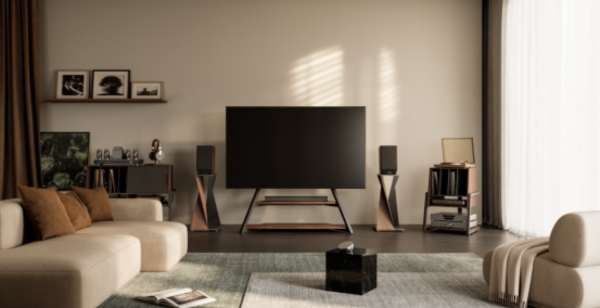

LOS ANGELES, CA February 15, 2026 /24-7PressRelease/ -- For decades, audiovisual furniture was treated as a technical necessity— something to support screens, hide cables, and remain visually invisible.
But as living spaces evolve, this perception is quietly changing.
Design research increasingly suggests that furniture is not merely functional infrastructure, but a bridge between the human body, technology, and living space. In this shift, audiovisual furniture is no longer an afterthought. It is becoming an active part of interior design.
From Supporting Devices to Shaping Everyday Life
Modern homes are no longer static. Living rooms function as entertainment spaces, work environments, and social settings — often within the same day. As architecture becomes harder to modify, furniture is expected to absorb this complexity.
Qualitative design research has shown that people no longer evaluate furniture purely by function or appearance, but by its ability to adapt over time — to changing layouts, lifestyles, and emotional needs. In this context, audiovisual furniture plays a critical role: it mediates how technology fits into daily life without dictating it.
Furniture as a Behavioral Element
Rather than being passive objects, furniture increasingly influences behavior — where we sit, how we gather, how we move, and how we interact with technology at home. Design studies describe this as a feedback loop: furniture shapes behavior, and behavior reshapes space.
Audiovisual furniture sits at the center of this loop. The placement of a screen, its height, its orientation, and its mobility all subtly affect how people experience a room. This is why decisions about TV mounting are no longer purely technical — they are spatial and behavioral choices. Understanding this distinction is key to how we choose between wall-mounted and floor TV stands.
Wall-Mounted vs. Floor TV Stands: A Design Perspective
The discussion around wall-mounted and floor TV stands is often framed as a matter of installation or space-saving. From a design perspective, however, the difference runs deeper.
Wall-Mounted Solutions: Stability Through Fixity
Wall-mounted TV setups offer visual minimalism and architectural alignment. They work well in environments where layouts are fixed and long-term, and where the screen is meant to disappear into the wall.
Yet this permanence also introduces constraints. Fixed height, limited flexibility, and structural modification can make adaptation difficult as living patterns change.
Floor TV Stands: Adaptability and Spatial Freedom
Floor TV stands reflect a different design philosophy — one centered on mobility and reversibility. Rather than anchoring the screen to architecture, they allow audiovisual equipment to remain part of the furniture ecosystem.
Design research consistently identifies adaptability as a key driver of furniture longevity. Furniture often becomes obsolete not because it breaks, but because it can no longer respond to new needs. Floor-standing solutions align with this insight by allowing screens to move, rotate, and reposition without altering the space itself.
Longevity as a Design Principle
Sustainability in furniture design is often discussed in terms of materials alone. However, design research highlights that longevity is equally shaped by emotional attachment and adaptability. Furniture that evolves with users is more likely to be kept, maintained, and valued over time.
In audiovisual furniture, this means designing for flexibility rather than fixed scenarios — enabling products to remain relevant across different homes, layouts, and phases of life.
A Design-Led Approach to Audiovisual Living
Brands such as FITUEYES approach audiovisual furniture from this broader design perspective. By treating TV stands and audio supports as spatial elements rather than accessories, they reflect a growing understanding that technology does not need to dominate a room to belong in it.
This approach mirrors a wider shift in interior design: integrating technology through form, proportion, and movement rather than concealment.
Designing for How Life Moves
The future of audiovisual furniture is not defined by screens becoming thinner or larger, but by how seamlessly they integrate into everyday life. As homes continue to change, furniture must respond — not by locking spaces into fixed solutions, but by offering flexibility and freedom.
The question, then, is no longer whether audiovisual furniture belongs in interior design. It is whether our living spaces are designed to evolve with how life actually moves.
Note: Selected perspectives in this article are informed by qualitative design research conducted within MIT's Integrated Design Management program on adaptability and the future of furniture in contemporary living.
# # #
Contact Information
Leon Zhao
FITUEYES INC
City of Industry, California
United States
Telephone: +44 7391224332
Email: Email Us Here
Website: Visit Our Website