
CHICAGO, IL, February 16, 2026 /24-7PressRelease/ -- The Constraint: The 21st century runs on electrons. AI compute. Data centers. Re-shored manufacturing. Autonomous systems. Defense infrastructure. Industrial robotics. All of it depends on one thing: Dispatchable, scalable power inside the places people already live and work. Horizontal energy expansion is slowing. Transmission corridors are saturated. Permitting timelines stretch into years. Demand is moving exponentially.
That gap defines the decade.
The Breakthrough
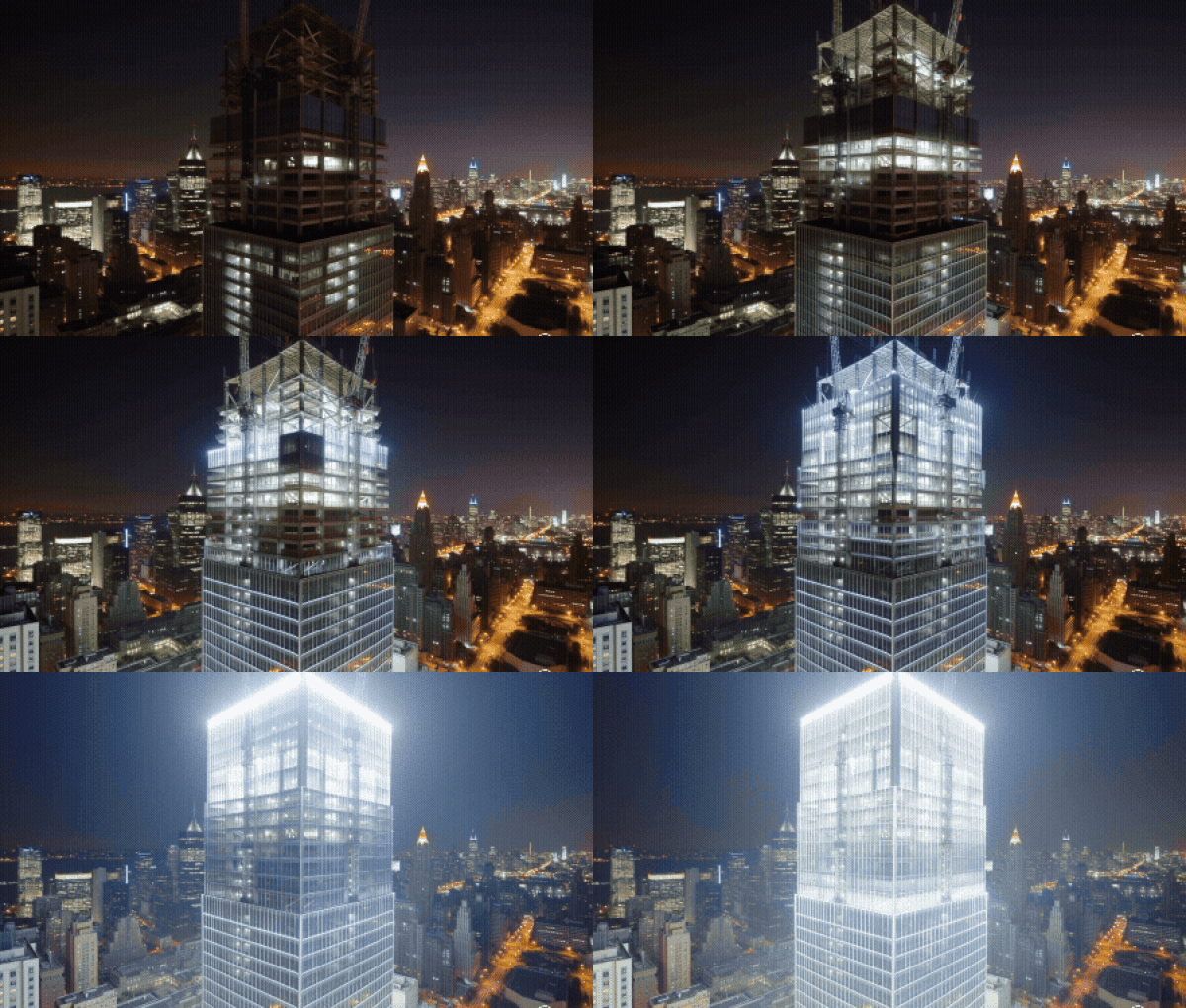
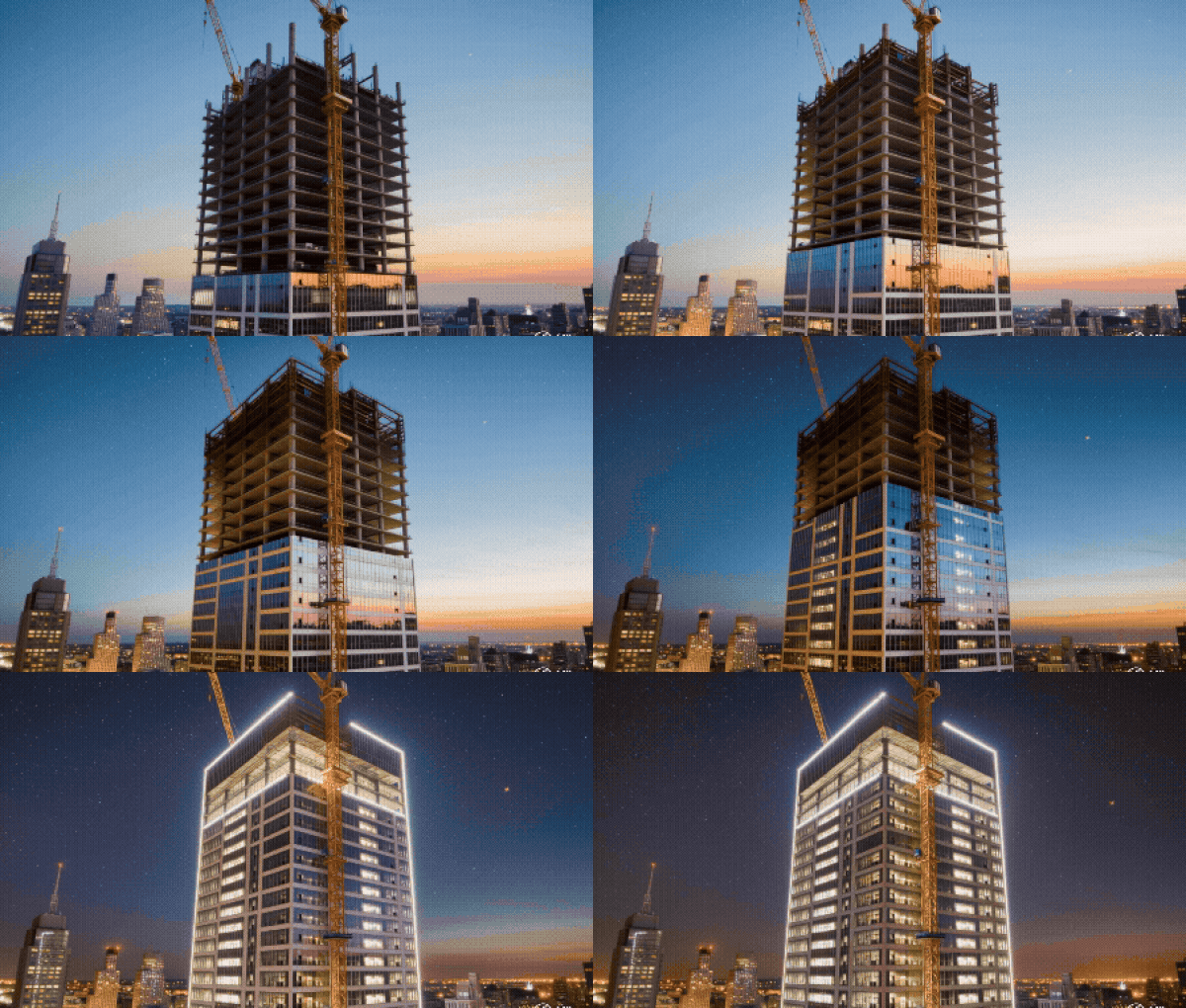
Vertical Stack rethinks energy the way skyscrapers rethought cities. Instead of expanding outward across thousands of acres, we build upward — inside urban-compatible structural envelopes. Consumers become co-owners as a condition for construction within their communities.
Each installation delivers:
• Multi-gigawatt-hour daily output
• Utility-scale dispatch characteristics
• Modular replication
• Urban footprint compatibility
• Structural loads within conventional high-rise limits
• Industrial reliability
This is not a battery farm. It is patent pending verticalized infrastructure.
Chemistry
By design, Vertical Stack utilizes commercial molten salt batteries. We deliberately chose this chemistry in our designs because molten-salt batteries are considered near-zero emission during their operational phase. Also, life-cycle assessments (LCA) show that molten-salt storage can have a global warming potential as low as 0.0306 kg CO2 eq/kWh, which is significantly lower than many other storage types.
This chemistry:
• Does not exhibit lithium-style thermal runaway
• Does not rely on flammable solvent cascades
• Does not propagate oxygen-fed combustion events
• Operates within contained thermal systems
We designed for physics — not trend cycles.
American-Sourceable by Design
Vertical Stack utilizes a chemistry that is capable of full domestic sourcing. Unlike lithium-ion systems dependent on concentrated global supply chains, molten salt battery chemistry relies on widely available industrial materials.
This enables:
• Domestic manufacturing pathways
• Reduced geopolitical exposure
• Elimination of lithium bottlenecks
• Alignment with U.S. industrial reshoring
• Strategic capital compatibility
For long-horizon infrastructure capital — including institutions prioritizing American industrial resilience — supply chain sovereignty is no longer optional. This architecture aligns with long-term institutional capital seeking resilient, domestically anchored energy infrastructure.
It is underwriting logic very compatible with the JPMorganChase Security and Resiliency Initiative.
Scalability — The Real Question
Most energy projects scale linearly. Vertical Stack scales geometrically. We've designed with one of the most advanced, modular and environmentally friendly building systems on earth in mind. Post permits and foundations our total project duration will be approximately 80–90% faster than a traditional carbon steel or concrete version.
The architecture is built for replication:
• Standardized structural envelopes
• Standardized module integration
• Standardized dispatch logic
• Parallelized fabrication and foundation sequencing
Construction timelines will compress significantly compared to comparable high-rise builds because fabrication and site work occur simultaneously.
This architecture is designed for institutional-grade deployment rather than pilot-scale experimentation.
Solar Re-Energizing Doctrine
Solar generation peaks when demand does not. Curtailment is wasted sovereignty. Vertical Stack changes that equation. Midday oversupply becomes stored urban capacity. Evening demand becomes internally dispatchable. Instead of exporting excess solar through congested transmission corridors, cities can absorb it vertically.
This enables:
• Higher solar penetration without new land expansion
• Reduced curtailment
• Local load balancing
• Municipal energy capture
• Campus-level resilience
Solar is abundant. Vertical Stack makes it usable at density.
Nuclear-Ready Network Architecture
Vertical Stack is electrically compatible with modular nuclear generation within distributed grid architectures. Rather than relying on fixed one-to-one pairing between a reactor and a storage installation, the system is designed for scalable many-to-many integration across interconnected urban nodes.
In this model:
• Modular reactors provide stable baseload generation
• Vertical Stack installations operate as high-density, dispatchable storage nodes
• Multiple stacks may absorb output from a single reactor
• Multiple reactors may service regional stack networks
This architecture enables sovereign installations — municipal, industrial, defense, or utility-owned — to participate in structured capacity exchange across connected grids, including the controlled buying and selling of stored energy under existing market frameworks.
The result is not isolated pairing. It is networked compatibility.
By aligning storage density with modular nuclear scalability, Vertical Stack supports regional resilience, improved reactor economics, and load-balancing flexibility within established interconnection and wholesale market structures.
This is not theoretical alignment.
It is systems-level architectural compatibility designed for modern grid realities.
Grid Resilience — BlackStart Potential
Modern grids are fragile at scale. When collapse occurs, restart is not simple. With appropriate inverter and switching design, Vertical Stack installations can support:
• Islanded operation
• Controlled ramp sequencing
• Stabilized frequency support
• Dispatch-managed re-energization
• Microgrid restoration
Urban BlackStart capability is no longer optional. It is sovereignty.
Ownership — The New National Narrative
The next infrastructure question is no longer generation capacity. It is dispatch authority. Who owns dispatch? Who controls stored capacity? Who stabilizes local grids? Who keeps compute running during disruption?
Vertical Stack enables:
• Municipal ownership
• Community ownership
• Utility partnerships
• Corporate microgrid sovereignty
• Defense installation continuity
• Industrial campus independence
This is not backup power. This is localized energy authority.
What This Really Represents
Skyscrapers made Manhattan possible. Vertical Stack makes urban energy density possible. We are not launching a product.
We are launching a platform:
• Replicable
• Standardized
• Financeable
• Insurable
• Utility-compatible
• Nuclear-compatible
• Non-lithium
• Urban-compatible
• BlackStart-capable
Designed not merely to store energy—but to restore, densify, and localize it.
Call to Alignment
Vertical Stack is a deployable advanced architecture SMR ready. Infrastructure capital follows stability. Stability follows domestic supply chains.
We are actively engaging:
• Municipal utilities
• Independent power producers
• Modular nuclear developers
• Data center operators
• Industrial campus planners
• Defense infrastructure stakeholders
• Institutional capital partners
The first installations will define the category. Cities that move early will not simply store power. They will control dispatch capacity inside their own footprint.
This is an invitation to align.
Visit verticalstack.energy to join the initial deployment network for immediate updates.
Now is the time. Power to the People.⚡
About BWRCI
Better World Regulatory Coalition Inc. (BWRCI), is an international not-for-profit self-regulatory organization (SRO) that develops inclusive, secure frameworks for autonomous economies and frontier technologies. Current mandates include OCUP, the One-Chip Unified Protocol and the People's Autonomous Economy (PAE), https://bwrci.org.
About the Vertical Stack Initiative
Vertical Stack rethinks energy the way skyscrapers rethought cities. Instead of expanding outward across thousands of acres, we build upward — inside urban-compatible structural envelopes. Consumers become co-owners as a condition for construction within their communities. The goal is to prepare the nation for unprecedented energy demands forthcoming. The hope is, these near-zero emissions initiatives will lead to a new national narrative of unity, via community participation. https://verticalstack.energy
About Max Davis
Max Davis — pen name MAXBRUCE — is inventor of Consumer Earned Tokenized Equities (CETEs), founder of DigiPie International PBC, and author of the "Inclusionism: Finally!" book series. The One-Chip Unified Protocol, "OCUP" (QSAFP & AEGES) represents his most recent work as a founding architect of the Cyberg movement—a new class of techno-humanists committed to ensuring humanity retains physical authority over embodied AI systems as they scale. Max is also first-named inventor/designer of the Vertical Stack initiatives.
# # #
Other Media

Contact Information
Max D.
BWRCI
Chicago, IL
United States
Telephone: 8187131510
Email: Email Us Here
Website: Visit Our Website