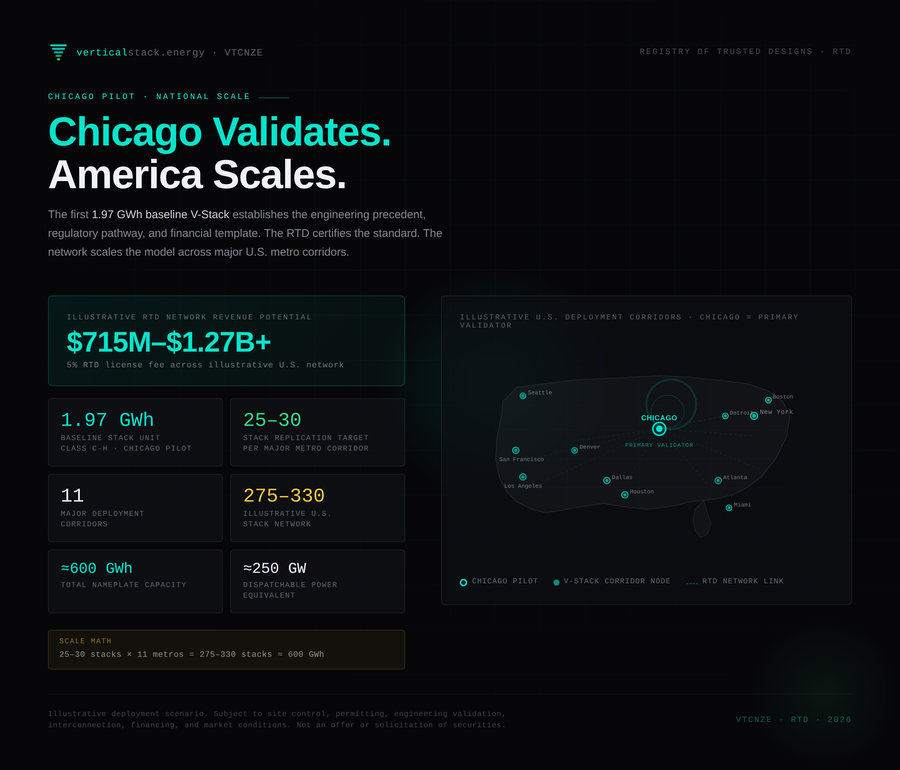

CHICAGO, IL, June 09, 2026 /24-7PressRelease/ -- The Vertical Stack Technology Coalition For Near-Zero Emissions PBC ("VTCNZE") today announced a proposed national "Speed-to-Power" framework designed to help the United States deploy approximately 600 GWh of distributed grid storage within approximately 48 months by adapting the emerging CHIPS-era public equity model to critical energy infrastructure.
The proposal follows the federal government's recent use of minority, non-controlling equity stakes in strategic technology companies receiving public incentives under the CHIPS and Science Act. VTCNZE believes that same taxpayer-aligned model should now be applied to the physical power infrastructure required to support frontier artificial intelligence, quantum computing, advanced manufacturing, defense readiness, robotics, and high-density data center growth.
"The CHIPS model changed the conversation from one-way subsidy to taxpayer upside," said Max Davis, Founding Architect of VTCNZE. "If public authority can accelerate quantum and semiconductor infrastructure while preserving value for the taxpayer, the same principle should apply to the energy infrastructure needed to power frontier AI. Chips do not matter if America cannot turn them on."
VTCNZE's proposed framework calls for a coordinated public-private deployment model built around high-density, load-adjacent, non-lithium energy storage assets positioned near major computing and industrial load centers. Rather than relying solely on sprawling horizontal battery farms or years-long utility interconnection queues, the framework prioritizes compact, modular, vertically integrated storage structures capable of being deployed on urban industrial parcels, brownfields, underutilized public land, and infrastructure-adjacent sites.
The company argues that the national AI power challenge is no longer merely a utility planning issue. It is an industrial strategy issue, a national security issue, a ratepayer protection issue, and a community wealth issue.
The Speed-to-Power Challenge
The race for frontier artificial intelligence is no longer only a software race. It is becoming a physical race for electricity.
Across the United States, data center growth is colliding with constrained substations, multi-year interconnection backlogs, transformer shortages, land-use conflicts, and rising concerns that infrastructure costs may be shifted onto residential ratepayers. In major data center corridors, new power requests are reaching levels that challenge existing utility planning assumptions and threaten to slow American leadership in AI and advanced computing.
VTCNZE's proposed model is designed to address that bottleneck by creating a repeatable pathway for rapidly deployable, high-density storage assets that can support critical load centers while reducing grid stress.
"The limiting factor is speed," Davis said. "America cannot wait four years for a conventional substation review while AI infrastructure, semiconductor strategy, quantum computing, and national security systems are all racing ahead. We need a new category of infrastructure: accelerated, load-adjacent, high-density storage with public upside built in from day one."
A CHIPS-to-Energy Public Equity Model
The proposed framework would allow federal, state, and municipal entities to participate in qualified infrastructure projects through minority, non-controlling equity positions or comparable economic participation rights. These public positions would be tied to the value each level of government contributes.
Under the conceptual model:
The federal government could contribute national priority designation, financing access, permitting coordination, national security classification, and interagency acceleration.
State governments could contribute statutory clean-grid authority, infrastructure bank liquidity, procurement support, code alignment, and energy-transition policy tools.
Municipal governments could contribute brownfield access, land easements, local permitting acceleration, zoning coordination, and community integration. Private investors and infrastructure partners would contribute project capital, engineering execution, operating discipline, and manufacturing scale. The result would be a taxpayer-aligned infrastructure model that moves beyond traditional grants. Public partners would not merely subsidize strategic infrastructure.
They would share in the long-term value created by accelerating it.
VTCNZE describes this as a simple principle: No taxpayer acceleration without taxpayer upside.
The Proposed Deployment Model
The VTCNZE framework centers on high-density vertical energy storage structures, or "Vertical Stacks," designed to compress large-scale storage capacity into smaller urban or industrial footprints. The model is intended to support load-adjacent deployment near data centers, AI campuses, industrial corridors, grid-constrained substations, and brownfield redevelopment zones.
Instead of treating land as an unlimited resource, the Vertical Stack approach treats space as a critical constraint. By building upward rather than outward, the model seeks to reduce land demand, shorten project siting timelines, enable repeatable manufacturing, and bring storage closer to the load centers that need it most.
VTCNZE's working national deployment target is approximately 600 GWh of distributed grid storage across major U.S. data center and industrial corridors within approximately 48 months, subject to engineering validation, financing, permitting, supply chain availability, utility coordination, and site-specific approvals. The company believes the target becomes more realistic if the United States treats energy storage deployment as a programmatic manufacturing challenge rather than a one-off real estate development challenge.
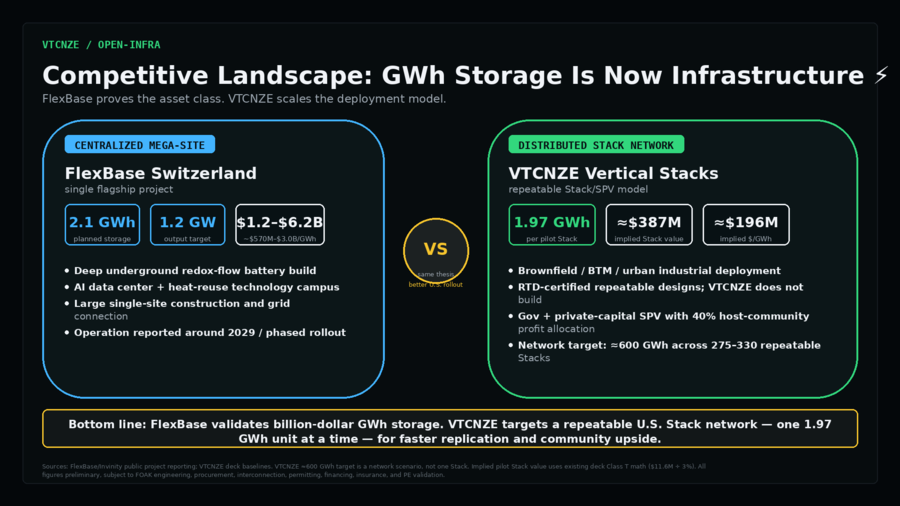
"Scaling 600 GWh is not about building one mega-project," Davis said. "It is about validating a repeatable infrastructure unit, aligning public authority with private capital, and then deploying that unit across the corridors where power constraints are already threatening American technological leadership."
Immediate Cooperation Required
VTCNZE is calling for immediate cooperation among public-sector authorities, utilities, data center operators, infrastructure financiers, battery manufacturers, modular construction partners, engineering firms, and local host communities to evaluate pilot deployment pathways.
The company believes the first phase should focus on a limited number of high-value pilot sites where the power constraint is already visible, the economic demand is immediate, and the public benefit case can be clearly demonstrated.
Priority site categories include:
Urban industrial brownfields;
Underutilized municipal or public authority land;
Sites adjacent to high-load data center corridors;
Grid-constrained industrial zones;
Former fossil infrastructure sites;
Locations where storage can reduce peak strain or defer expensive grid upgrades;
Communities seeking direct economic participation in infrastructure growth.
VTCNZE believes Illinois and the Chicago region are strong candidates for early pilot evaluation because of existing data center demand, industrial land availability, grid pressure, transportation access, engineering talent, and the opportunity to transform local infrastructure stress into public-aligned economic upside.
The WIMBY Factor: Protecting Ratepayers and Sharing Upside
A central component of the proposal is what VTCNZE calls the "WIMBY Factor" — Welcome In My Backyard.
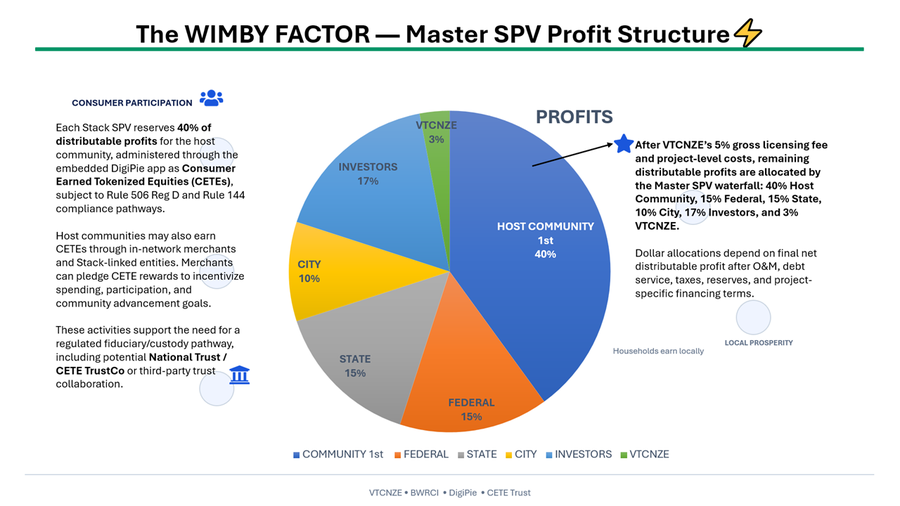
The concept is simple: communities are more likely to support critical infrastructure when they are protected from unfair costs and included in the upside. Under the proposed model, qualifying AI and energy infrastructure projects should not pass avoidable grid upgrade costs, congestion costs, or speculative expansion burdens onto residential ratepayers. Instead, projects receiving public acceleration should include mechanisms for direct local benefit.
Those mechanisms may include municipal equity participation, local revenue sharing, merchant participation, workforce pathways, community benefit pools, and localized digital equity structures designed to convert infrastructure hosting into long-term community wealth creation.
"Behind-the-meter cannot mean behind-the-community," Davis said. "If a neighborhood is being asked to host the infrastructure of the AI age, that neighborhood should not be treated as an afterthought. It should be treated as a stakeholder."
Why the CHIPS Precedent Matters
The CHIPS and Science Act signaled that the United States is willing to intervene strategically when critical technology capacity is essential to national competitiveness. The recent use of taxpayer equity participation in quantum-related incentives takes that principle further by recognizing that public support should be paired with public value.
VTCNZE argues that energy infrastructure now belongs in the same category.
AI data centers, semiconductor fabs, quantum systems, robotics, defense platforms, and advanced manufacturing all depend on reliable, scalable electricity. Without power, the rest of the technology stack cannot function.
"Chips require fabs. Fabs require power. AI requires data centers. Data centers require storage, transformers, substations, cooling, and resilient electricity," Davis said. "The next layer of American industrial policy is power. The sooner we admit that, the faster we can build."
Proposed Policy Actions
VTCNZE's Speed-to-Power framework proposes that federal, state, and municipal leaders evaluate the following actions:
Create an expedited pathway for load-adjacent energy storage assets that reduce peak strain or support critical AI and industrial loads;
Grant priority review to high-density storage projects that use safe, thermally stable, non-lithium or domestically manufacturable battery chemistries;
Prioritize brownfield, industrial, and underutilized public land for storage deployment near major load centers;
Allow public entities to receive minority, non-controlling equity stakes or comparable economic participation rights when public authority materially accelerates a project;
Protect residential ratepayers from avoidable infrastructure cost-shifting tied to private AI load growth;
Encourage structured Special Purpose Vehicles that align federal, state, municipal, private, and community stakeholders;
Support pilot deployments capable of being replicated across multiple U.S. data center and industrial corridors.
From Subsidy to Sovereign Upside
VTCNZE believes the United States has an opportunity to transform the AI power crisis into a new public-private infrastructure model. Rather than forcing communities to absorb the burdens of digital infrastructure expansion, the proposed framework would allow public entities and host communities to participate in the value created by solving the power bottleneck. Rather than treating clean grid storage as a slow, land-heavy, one-project-at-a-time development category, the framework would treat it as a repeatable national infrastructure product. Rather than relying only on subsidies, the framework would align public incentives with public ownership, public benefit, and taxpayer upside.
"This is not just a clean energy proposal," Davis said. "It is an AI strategy, a national security strategy, a ratepayer protection strategy, an industrial policy strategy, and a community wealth strategy. Power to the People is no longer just a slogan. It is an infrastructure finance model."
Strategic Framework Notice
The foregoing proposal is presented as a conceptual strategic framework for public discussion, partner evaluation, and infrastructure planning. It does not constitute legal, financial, securities, tax, engineering, investment, procurement, or political advice. Any implementation would require independent review by qualified legal, regulatory, engineering, securities, utility, public finance, tax, and safety professionals.
The spatial structures, special purpose vehicle configurations, public equity alignment mechanisms, localized reward loops, Registry of Trusted Designs concepts, and community participation frameworks referenced herein represent proprietary operational frameworks utilized in advanced infrastructure design.
Related Link:
https://verticalstack.energy
About Vertical Stack Technology Coalition For Near-Zero Emissions PBC ("VTCNZE")
Vertical Stack Technology Coalition For Near-Zero Emissions PBC ("VTCNZE") is a public benefit corporation developing high-density Vertical Stack energy infrastructure for grid resilience, data centers, utilities, and large power users. VTCNZE advances the WIMBY Factor — Welcome In My Back Yard — a community-aligned model designed to help host neighborhoods share in the economic upside of next-generation energy infrastructure.
About BWRCI Better World Regulatory Coalition Inc.
BWRCI Better World Regulatory Coalition Inc. is a Delaware nonprofit public-interest coalition focused on regulatory innovation, inclusive economic systems, and community-aligned technology frameworks. BWRCI supports policy models that connect public benefit, market participation, and community wealth creation in the emerging AI and clean infrastructure economy.
About DigiPie International PBC
DigiPie International PBC is a Delaware public benefit corporation developing consumer-earned participation frameworks for community wealth creation and digital economic inclusion. Through its broader DigiPie and CETE ecosystem, DigiPie is designed to help people and communities participate more directly in the value created by the infrastructure, commerce, and systems they help sustain. No more NPCs.
# # #
Other Media

Contact Information
MAXBRUCE D.
DIGIPIE International PBC
Chicago, IL
United States
Telephone: 8187131510
Email: Email Us Here
Website: Visit Our Website