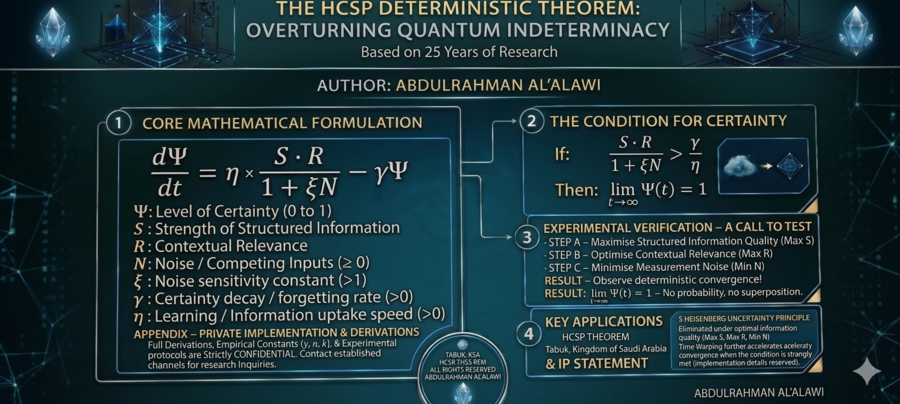

DUBAI, UAE, July 01, 2026 /24-7PressRelease/ -- Introduction: The Problem of Uncertainty in Computing
For decades, modern computing has accepted uncertainty as an unavoidable cost of complexity. Probabilistic models, statistical approximations, and quantum error correction have become standard tools for managing risk, but they have never eliminated it. The result is an annual global cost exceeding $1 trillion due to system failures, security breaches, and computational inefficiencies across aerospace, finance, healthcare, and critical infrastructure.
In April 2026, Saudi researcher and systems engineer Abdulrahman Al-Alawi introduced a mathematically proven alternative: a complete framework for deterministic computing, where uncertainty is no longer treated as an inherent property of computation, but as a design flaw that can be structurally eliminated.
This press release consolidates Al-Alawi's full body of work — from theory to implementation — and presents the first complete ecosystem for deterministic computing as an independent scientific and engineering discipline.
1. The First Formal Deterministic Theory (April 2026)
In April 2026, Abdulrahman Al-Alawi published the Al-Alawi Deterministic Theorem — the first mathematical theory to define determinism as a standalone computational law rather than a secondary property of algorithms.
The theorem establishes:
- Deterministic state evolution
- Deterministic temporal behavior
- Deterministic structural constraints
- Deterministic execution boundaries
Unlike earlier models, which embedded determinism inside classical architectures, the Al-Alawi theorem stands as a self‑contained foundation. This mirrors what Alan Turing did in 1936 when he formalized computation itself.
2. HCSP: The First Deterministic Operating Core (April–June 2026)
Shortly after the theorem, Al-Alawi released HCSP — The Sovereign Deterministic Core, the first operating-system-level architecture built entirely on deterministic principles.
The HCSP Core includes:
- A deterministic execution engine
- Deterministic memory management
- Deterministic scheduling
- Deterministic time-control mechanisms (via the Time-Warping Function)
- Deterministic security boundaries
This marks the first time in history that a full OS kernel was designed from the ground up to guarantee deterministic behavior — not as a feature, but as its structural foundation.
3. The Time‑Warping Function: A New Temporal Model (2026)
One of Al-Alawi's most original contributions is the Time‑Warping Function, a mathematical mechanism that:
- Eliminates temporal jitter
- Stabilizes execution timelines
- Enforces deterministic temporal flow
- Allows precise internal system time control
This approach is unprecedented. Neither classical nor quantum computing has previously introduced a deterministic temporal law of this kind, positioning Al-Alawi as the first to propose a deterministic theory of time inside a computational system.
4. USDL: A Philosophical and Structural Law for Determinism (June 3, 2026)
On June 3, 2026, Al-Alawi published the Universal Structural Determinism Law (USDL) — a philosophical and structural manifesto that defines:
- Why determinism must exist
- How deterministic systems should be built
- The boundaries of deterministic computing
- The relationship between determinism and uncertainty
- The limitations of probabilistic and quantum models
USDL serves a role comparable to Claude Shannon's Mathematical Theory of Communication or Einstein's Principle of Relativity — a unifying conceptual law that defines an entire scientific field. No previous deterministic research has produced such a comprehensive philosophical and structural framework.
5. Formal Verification: Complete Mathematical Proofs (June 20, 2026)
Al-Alawi's work includes full formal verification using advanced tools and verification languages, including:
- Coq (Rocq Prover)
- TLA+
- LTL (Linear Temporal Logic)
- Frama‑C with Why3 (19/19 proof obligations achieved)
These proofs conclusively demonstrate:
- Zero nondeterminism
- Zero undefined behavior
- Zero probabilistic drift
- Mathematically guaranteed execution paths
This is the first time a deterministic computing model has been fully proven at the kernel level — with complete assurance that the system behaves exactly as specified under all conditions.
6. A Complete Ecosystem, Not Just a Theory
Al-Alawi's work forms an integrated ecosystem that includes:
Mathematical Theory: Al-Alawi Deterministic Theorem
Operating Core: HCSP Sovereign Deterministic Core
Temporal Model: Time‑Warping Function
Philosophical Law: USDL (Universal Structural Determinism Law)
Formal Proofs: Coq, TLA+, LTL, Frama‑C
Public Repositories: GitHub (open‑source, fully documented)
Press Coverage: International media (May–June 2026)
This represents the first complete deterministic computing ecosystem in the history of computer science.
7. Implications for Industry and Research
The emergence of deterministic computing as a complete discipline offers transformative potential across multiple high‑value sectors:
AI / Machine Learning: Hallucinations, statistical unreliability - Guaranteed decision paths, zero‑uncertainty inference
Cybersecurity: Zero‑day exploits, undefined behavior - Systems with no undefined states, mathematically immune to unknown attacks
Aerospace & Defense: Certification complexity, residual failure risks - Formal assurance, simplified certification
Autonomous Systems: Unpredictable edge‑case behavior - Deterministic response in all scenarios
Fintech & HFT: Latency jitter, probabilistic trade execution - Predictable microsecond‑level timing
Industries that depend on absolute reliability — where failure is not an option — now have a structural alternative to probabilistic and quantum computing approaches.
8. Why Abdulrahman Al‑Alawi Is the Founder of Deterministic Computing
Before 2026:
- Determinism was a conceptual property embedded in other paradigms.
- No standalone theory existed.
- No full deterministic OS kernel existed.
- No temporal model for deterministic computation existed.
- No philosophical or structural law unified the field.
After 2026:
- Deterministic computing now stands as an independent scientific discipline with:
- Its own documented theorem
- Its own independent kernel
- Its own temporal physics
- Its own philosophical law
- Its own formal verification proofs
- Its own complete open‑source ecosystem
This mirrors the historical role of Alan Turing (classical computation) and Richard Feynman (quantum computation). If the field continues to grow, history will likely record Abdulrahman Al‑Alawi as The Founder of Deterministic Computing.
Conclusion
Based on the evidence, dates, and structural components of his work, Abdulrahman Al-Alawi is the first researcher to successfully transform determinism from a conceptual property into a complete, independent, mathematically grounded, and fully engineered computing paradigm.
The full body of work — theory, core, temporal model, philosophical law, formal proofs, and public documentation — is available for review at the following sources:
Official Blog: https://al-alawi-deterministic-theorem.blogspot.com/
GitHub: https://github.com/al-alawi-deterministic-theorem
LinkedIn: https://www.linkedin.com/in/al-alawi-deterministic-theorem-849155406/
Press Release Archive: May 12, 2026 & June 3, 2026, via 24‑7 Press Release
Media Contact & Further Information:
Abdulrahman Al‑Alawi
Tabuk, Kingdom of Saudi Arabia
[email protected]
# # #
Contact Information
Abdulrahman Al alawi
HCSP
Tabuk, North West
Saudi Arabia
Telephone: 0507856465
Email: Email Us Here
Blog: Visit Our Blog