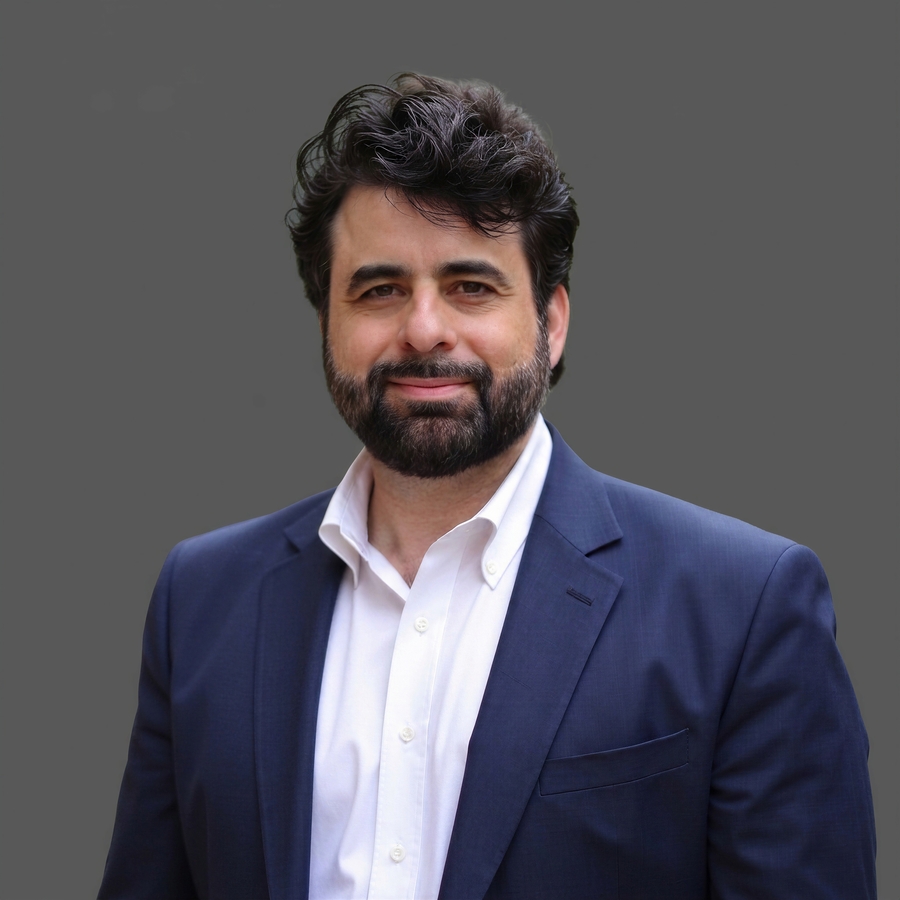

NEWBERG, OR, September 14, 2026 /24-7PressRelease/ -- Robert F. Melendy, PhD, has been recognized for achievement in electrical engineering.
Robert F. Melendy, PhD, is an Associate Professor of Electrical Engineering at George Fox University in Newberg, Oregon. In addition to his teaching responsibilities, Dr. Melendy conducts research at the intersection of Electrical Engineering and Neuroscience. Using the mathematics of symmetry and structure, he decodes how biological neurons work and how they can be replicated as engineered circuits. His recent work has culminated in two seminal publications: a paper published in March 2026 in the journal Membranes (https://www.mdpi.com/2077-0375/16/3/99) and another published in September 2026 in the journal Frontiers in Neuroscience (https://www.frontiersin.org/journals/neuroscience/articles/10.3389/fnins.2026.1896585/full). The Frontiers in Neuroscience paper rigorously verifies the model he introduced in his 2018 Journal of Electrical Bioimpedance article (https://reference-global.com/article/10.2478/joeb-2018-0015) and demonstrates that a neuromorphic circuit (i.e., an artificial neuron) can be engineered based on this model. Dr. Melendy considers these foundational achievements the most significant of his career, describing them as arriving in the 'fourth quarter' of his professional journey.
Dr. Melendy first joined George Fox University in 2006 as an Assistant Professor of Engineering, Physics, and Mathematics, a role he held until 2014. He subsequently served as Associate Professor of Electrical Engineering at Liberty University in Lynchburg, Virginia from 2014 to 2017, and at Oregon Institute of Technology from 2017 to 2023, deepening his expertise and advancing neuromorphic engineering through both instruction and research. In the fall of 2023 he returned to George Fox University, and it was there that his years of persistent research finally culminated in the seminal discoveries that now define the latter part of his career.
Throughout his career, Dr. Melendy has been recognized for his commitment to academic excellence and research innovation by several prestigious organizations. He is a senior member of the Institute of Electrical and Electronics Engineers (IEEE) and holds memberships in Eta Kappa Nu (the international honor society of IEEE), Pi Tau Sigma (the international honor society for Mechanical Engineering), and Sigma Xi: The Scientific Research Honor Society.
Dr. Melendy's unusually broad educational background spans Mechanical Engineering, Electrical Engineering, and Advanced Mathematics, providing a uniquely interdisciplinary foundation for his research. He earned a Doctor of Philosophy in Mathematics Education from the College of Science at Oregon State University in 2008. Notably, his PhD minor in Mathematics carried three times the credit hours of his PhD major, a testament to the extraordinary depth of mathematical training that would ultimately power his seminal discoveries. This degree was preceded by a Master of Science in Electrical Engineering from Oregon State University in 1998, a Master of Science in Mechanical Engineering in 1994, and a Bachelor of Science in Mechanical Engineering in 1992, all from Oregon State University.
It was during graduate school that Dr. Melendy first became interested in the intersection of Electrical Engineering and Neuroscience. This interest was kindled under the mentorship of Dr. Ronald R. Mohler, his Electrical Engineering thesis advisor at Oregon State University. Dr. Mohler's pioneering work on neural control and bilinear systems in biological applications planted the seeds of what would become a lifelong research passion. Although this passion was dormant for several years, it was reignited after attending a joint engineering and medical school conference in 2015. A pivotal moment occurred when he rediscovered an old graduate school textbook while cleaning his home office, recalling a concept from his studies that enabled him to solve a problem that had challenged him for more than a decade. This breakthrough directly led to the seminal publications that would ultimately prove the mathematical necessity of the artificial neuron.
Beyond his scholarly work, Dr. Melendy has demonstrated a deep and lifelong commitment to civic and humanitarian service. For six years he served as a volunteer chaplain with a death row ministry at Oregon State Penitentiary in Salem, Oregon, bringing pastoral care and human dignity to those on the margins of society.
Born in Brooklyn, Dr. Melendy comes from an academic family. His mother was highly educated and well-read, as was her brother, while his maternal grandparents were Italian immigrants who arrived in the United States in the early twentieth century. As part of the second generation on that side of his family to pursue academic work, he values persistence and the courage to return to first principles, qualities that proved decisive in the discoveries that now define his career.
Beyond his professional life, Dr. Melendy lives on a small farm property in Oregon with his wife Debbie, where hands-on DIY projects provide a welcome counterbalance to academic life, and where he shares his home with six dogs whose companionship he and Debbie treasure. Looking ahead, he aims to bring the human side of Neuromorphic Engineering to both public audiences and scientific peers, drawing inspiration from Carl Sagan's approach to science communication as he explores ways this work could inform treatment for neurodegenerative diseases such as Parkinson's disease and epilepsy. His most immediate goal is to develop a working circuit prototype based on his recent research findings, a tangible step toward the ultimate vision: a manufacturable artificial neuron.
# # #
Contact Information
Email: Email Us Here