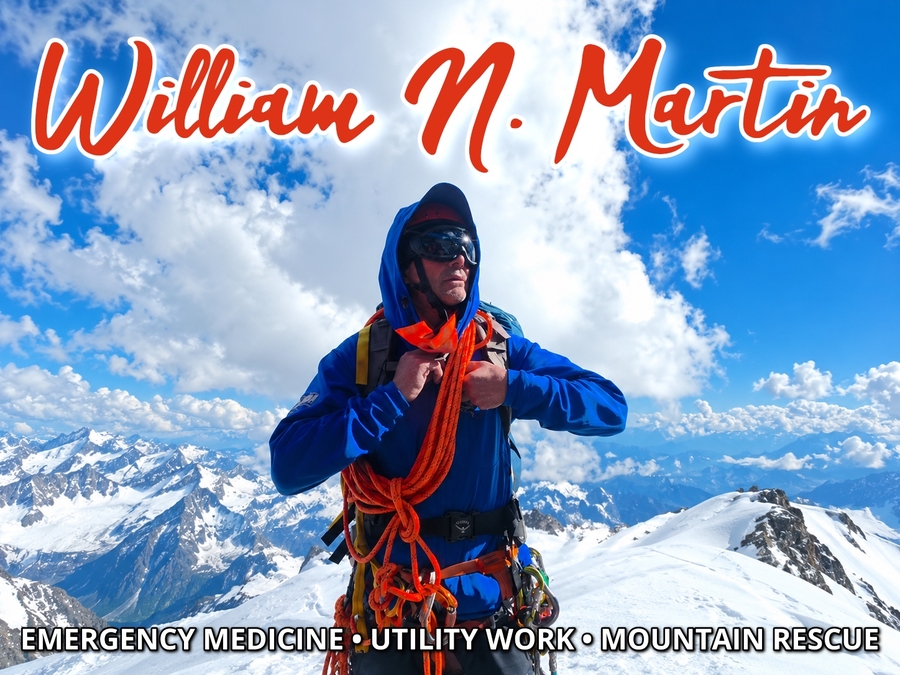

SARANAC LAKE, NY, October 02, 2026 /24-7PressRelease/ -- Organizations spend enormous amounts of time and money trying to improve outcomes. Leaders are taught to motivate people, increase accountability, improve performance and find new ways to get more from the people around them.
Martin believes a more fundamental question may come first:
What problem are we actually trying to solve?
If the goal is greater human potential, he argues, the answer may not begin with demanding more from the individual. It may begin with examining the conditions surrounding them.
William N. Martin believes much of that effort may begin with the wrong question.
"We strive for outcomes when we should be looking at conditions," Martin said.
It is a deceptively simple idea, but one Martin has developed over decades spent in environments where human performance had consequences far beyond quarterly numbers or productivity reports.
His background includes work as a utility lineman, flight nurse paramedic, ski patrol member and mountain rescuer. He is trained in both crevasse rescue aimed at glacier travel and avalanche rescue. Those experiences put him alongside people making decisions under pressure, sometimes when another person's life depended on what happened next.
One emergency involving an 11-year-old girl has remained with him.
The girl had suffered a traumatic amputation of her leg at the knee. When Martin entered the ambulance, he found capable emergency personnel working on her, but the intensity inside the vehicle was extremely high.
Martin did not tell anyone to calm down.
Instead, he began asking questions.
What was her blood pressure? What had already been done? Why was a second tourniquet being used? What were her vitals?
The questions were clinical. The manner in which they were asked was deliberate.
The atmosphere began to change.
"The people in that ambulance knew what they were doing," Martin said. "I didn't need to come in and tell them how to do their jobs. What I could do was change the condition we were operating in."
Outside the ambulance, another problem was unfolding.
The girl's mother was understandably overwhelmed. Her husband was unable to accompany her, and the mother faced a long drive to the trauma center while her daughter would be transported by helicopter.
Martin handed the mother his phone and asked her to call herself.
The request confused her at first. Martin explained that he wanted her telephone number so he could remain in contact during the flight. He would text her from the helicopter and call again when they reached the hospital.
He told her that her daughter was being cared for and that he could not yet know whether doctors would be able to save her leg. What he could give the mother was something else: a role.
Her job was to get to the hospital safely because her daughter would need her when she arrived.
The circumstances had not changed. Her daughter was still critically injured. But the mother now had something she could do.
Martin could not determine the medical outcome. What he could influence were some of the conditions surrounding it.
That distinction became important to the way he began thinking about human behavior well beyond emergency medicine. For Martin, the patient's support system is part of the calculus of the patient's outcome.
Martin questions the tendency to assume that poor performance automatically means a person lacks motivation, ability or commitment. Before trying to change the individual, he believes leaders, educators and even parents should first examine the conditions surrounding that person.
"What conditions have we allowed to persist?" Martin said. "Are we giving somebody the ability to think and make decisions, or are the conditions around them teaching them to simply wait for someone else to tell them what to do?"
The distinction matters because environments are rarely the product of one person or one decision. Some conditions are inherited. Others develop gradually. Some are influenced by circumstances outside anyone's immediate control.
For Martin, becoming aware of those conditions may be more useful than assigning blame for how they came to exist.
Martin often illustrates the idea with something considerably less dramatic than an emergency helicopter: two seeds.
He will place a sunflower seed and a corn seed in front of people and ask them to consider what each contains.
They are different in appearance and carry different genetic information. Given the opportunity, they will become entirely different plants.
Yet neither seed needs to be taught what it is capable of becoming.
What matters is whether it encounters the conditions necessary for that potential to be expressed.
"You put the seed in the appropriate soil. It needs water. It needs sunlight. There are conditions that allow what's already in that seed to emerge," Martin said. "I didn't create the potential in the seed. It was already there."
But throw those same seeds randomly out a window and their future becomes dependent on where they happen to land. The potential inside them has not changed. The conditions surrounding them have.
For Martin, that is where the analogy becomes useful in conversations about people.
An organization can recruit talented employees and still have an environment in which people become afraid to make decisions. A leader can ask people to take initiative while unintentionally rewarding conformity. Parents can want independent children while making every important decision for them.
None of those outcomes necessarily begins with bad intentions.
But demanding a different outcome without examining the surrounding conditions, Martin argues, misses part of the problem.
His interest is not in removing difficulty from people's lives. Much of Martin's own experience suggests the opposite. Human beings are adaptive, he says, and difficult circumstances can reveal extraordinary capability.
But there is a difference between conditions that allow people to adapt and conditions that gradually teach them to surrender their agency.
That distinction has become increasingly important to Martin as he thinks about younger generations and a future that will present problems their parents and grandparents cannot anticipate.
"I don't know what problems the next generation is going to have to solve because some of those problems haven't even been invented yet," Martin said. "So giving them all of my answers isn't the answer. They need to be able to think, adapt, connect with other people and make decisions."
For Martin, that changes the responsibility of leadership.
"Profit and performance are lagging indicators of the quality of our decisions," Martin said.
If that is true, leaders may need to spend less time demanding better outcomes and more time understanding the conditions under which those decisions are being made.
Sometimes the obstacle is the individual. Other times, Martin believes, the conditions surrounding that person deserve a closer look.
"We talk a lot about releasing human potential," Martin said. "I don't believe I can create somebody else's potential. What I can do is contribute to conditions that either allow it to emerge or help suppress it."
That leaves leaders with a question Martin believes is worth asking before demanding the next outcome:
What are we allowing to grow?
# # #
Contact Information
Gloria-Anne Bell
TSR News Group
New York, NY
USA
Telephone: 516.744.6010
Email: Email Us Here