
KNOXVILLE, TN, October 10, 2026 /24-7PressRelease/ -- 175 researchers outline the scientific challenges and emerging tools shaping the future of explosion mechanics.
For decades, explosion mechanics was the domain of explosives, shock waves and defense engineering. But as the field enters its seventh decade, its scientific scope has stretched far beyond conventional explosions—into new territory.
A comprehensive Explosion Mechanics Roadmap, published in Theoretical and Applied Mechanics Letters (TAML), brings together 175 researchers from 90 institutions to present a broad view of how matter, materials and engineering systems behave under extreme dynamic loading.
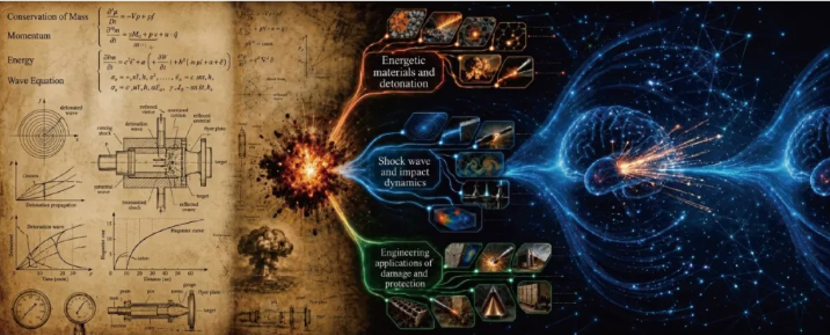
Spanning 65 sections, the roadmap reviews advances and challenges in energetic materials and detonation, shock waves and impact dynamics, damage and protection, and related engineering applications.
A science pushed to the edge
At its heart, explosion mechanics asks how high-power-density energy is transmitted through shock waves and other intense dynamic processes within extremely short times, triggering high-speed flow, large deformation and, ultimately, material failure.
This raises a bigger scientific question: How does a medium respond when energy loading, strain rates and deformation are pushed to their limits?
To find out, researchers must combine experiment, theory and computation, from advanced measurements that capture ultrafast events to models and simulations that describe highly nonlinear, multiscale behaviors.
Explosion mechanics is moving beyond solving specific engineering problems. It is becoming a broader science of matter and engineered systems under extreme dynamic conditions. That makes a field-wide roadmap especially timely: it can connect advances in experiment, theory and computation, identify shared scientific challenges, and give researchers a common reference point for the road ahead.
Artificial intelligence enters the picture
The roadmap also points to a broader shift in how mechanics research is conducted. It frames that transition in sweeping historical terms—from Galileo's experiment-and-mathematics paradigm to AI-empowered scientific research.
The authors see this paradigm shift as one of the field's major challenges. The real question is not whether data-driven methods can replace physical models, but how experimental evidence, mechanics-based understanding, numerical simulation and AI can work together to improve our understanding and prediction of complex, extreme processes.
Beyond traditional applications
The reach of explosion mechanics extends far beyond conventional explosion problems. Insights from shock waves, high-speed impact and dynamic material failure are increasingly relevant to aerospace engineering, advanced manufacturing and structural protection.
A companion Perspective in TAML brings that broader relevance into focus through resilient infrastructure. It shows how knowledge of extreme loading and structural failure can help not only resist severe events, but also maintain—and recover—engineering functionality.
From historical roots to future frontiers
Explosion mechanics has a distinctive history in China. Hsue-Shen Tsien (Qian Xuesen) introduced the term "explosion mechanics" in 1963, during the country's "Two Bombs and One Satellite" program. It grew into an interdisciplinary field spanning fluid mechanics, solid mechanics, physics and chemistry.
Six decades on, its scope has widened from individual explosion events to a broader scientific challenge: understanding and predicting how matter and engineered systems respond under extreme dynamic conditions.
One of the biggest challenges will be integrating mechanics-based understanding with emerging AI-enabled methods, especially for strongly nonlinear and multiscale problems. The real opportunity isn't to replace physical models with data-driven approaches. It's to bring experiments, simulation and AI together to sharpen both scientific understanding and predictive power.
The new roadmap gives the field a shared reference point for what comes next, bringing together current knowledge, open questions and emerging research tools in a single field-wide view.
References
DOI
10.1016/j.taml.2026.100714
Original Source URL
https://doi.org/10.1016/j.taml.2026.100714
About Journal
Theoretical and Applied Mechanics Letters (TAML)
Chuanlink Innovations, where revolutionary ideas meet their true potential. Our name, rooted in the essence of transmission and connection, reflects our commitment to fostering innovation and facilitating the journey of ideas from inception to realization.
Related Link:
http://chuanlink-innovations.com
# # #
Contact Information
George Hua
Chuanlink Innovations
Knoxville, Tennessee
USA
Telephone: 8656606278
Email: Email Us Here
Website: Visit Our Website