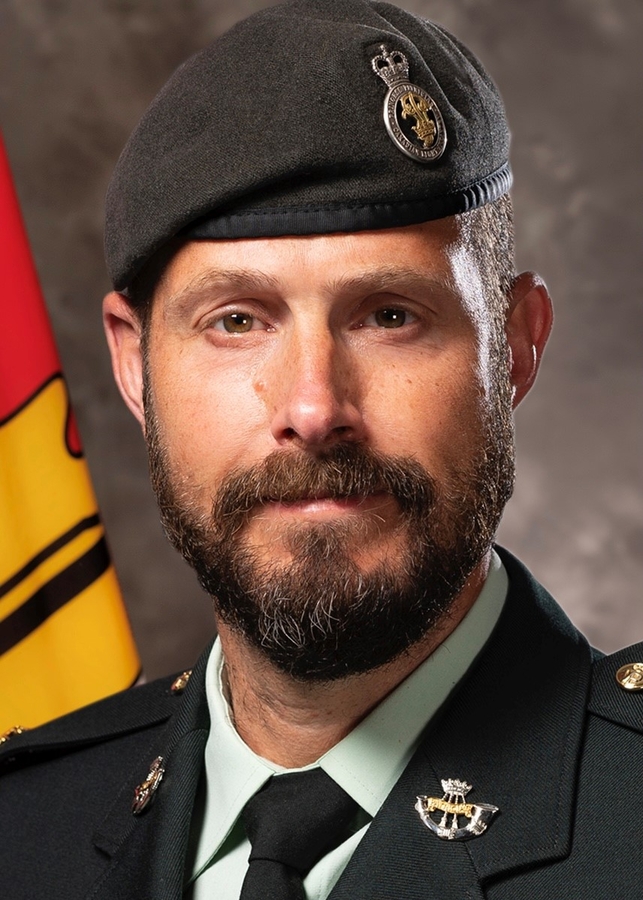

EDMONTON, AB, November 24, 2026 /24-7PressRelease/ -- Most military careers get described from the top down, starting with the rank and working backward. A more instructive version starts at the bottom, with the first job and the first lesson. In a profession that prizes rank, the order of the steps often says more than the title at the end of them.
Major Malcolm Grace, Officer Commanding the Transition Centre in Kingston, tells his story in that second order, and much of it was written in Alberta, where he studied and later served. He calls it a Zero to Hero path, and he asks that the phrase be read plainly, as a description of sequence and not a boast. Grace leads a unit that supports seriously ill and injured military members and builds retirement plans for personnel leaving the Canadian Armed Forces.
A Path Built From the Ground Up
Grace was born in Montreal and raised in Vancouver. At 18 he began work in a maximum security remand centre, a facility that holds people awaiting trial or sentencing. He stayed for eleven years, and he studied criminal justice at Langara College in Vancouver along the way. Eleven years is a long stretch in one workplace, and its shifts, procedures and rules became the building blocks he later used as a safety officer and an operations planner.
The work left a mark on how Grace thinks about people under pressure. "I started at 18 in a maximum security remand centre. Nobody hands you a career plan there, so you learn to show up, stay steady and treat the person in front of you with respect," Grace says. Those early habits carried into every later posting.
From Corrections to the Classroom
A change of direction took Grace to Edmonton, Alberta. At the University of Alberta he completed a Bachelor of Arts with a major in History and a minor in Classics, finishing in the mid-2000s. The program gave him a working method: read widely, weigh competing accounts and write clearly.
History and ancient philosophy remain among his interests. "My History and Classics degree taught me to read evidence and argue from it," Grace says. "I use that in an operations centre as much as I ever did in a lecture hall." Weighing sources that disagree, he explains, is the same skill an operations officer uses when two reports do not match.
A Commission and a Steady Climb
Within months of graduating, Grace enrolled in the Canadian Army as an infantry officer. He was badged to Princess Patricia's Canadian Light Infantry and posted to its 3rd Battalion in Edmonton. A deployment to Kandahar Province, Afghanistan followed, where he served as a Police Operational Mentoring Liaison Team Leader. The title points to mentoring and liaison, work that leans on teaching more than on direct command.
Later postings took him to the Canadian Manoeuvre Training Centre in Wainwright, Alberta, where he served as lead planner for the Canadian Patrol Concentration, an exercise with international participation. Promotion to Major came in the late 2010s. By then his work had moved from leading small groups toward planning and operations.
Grace describes the pattern without ceremony. "Infantry officers get put in unusual circumstances and are expected to lead," he says. "The job is to learn fast and look after your people while you do." The postings that followed tested that rule in very different settings.
Zero to Hero as a Working Idea
The phrase has stuck because it can be checked. Each step in Grace's record carries a place and a role, and none of them skips ahead. The record includes the Canadian Forces' Decoration, the General Campaign Star for South-West Asia, the Canadian Peacekeeping Service Medal and the medal of the Multinational Force and Observers.
Two commendations sit on his record as well, one from the chief of staff of the Multinational Force and Observers and one from a joint task force command he served under. Both recognize operational work done in rooms where few outsiders ever look.
"Zero to hero is not a boast. It is a way of saying that every posting, course and stretch of study counted for something later," Grace says. He treats the phrase as an accounting of what was built, not a claim about where he ranks.
Teaching and Operations Far From Home
At the Infantry School in Gagetown, New Brunswick, Grace commanded the Administration Company and mentored dozens of junior members. He also advised the school's Commandant on support matters, which meant coaching junior soldiers and advising a senior officer in the same week.
Teaching, in his telling, is a matter of temperament as much as technique. "I teach from a patient perspective, model the behaviour I expect, and use positive feedback. People repeat what gets noticed," Grace says. The approach carried into the next posting, which was far from any classroom.
In Egypt, Grace ran current operations for the Multinational Force and Observers, directing ground, air and maritime resources across the Sinai Peninsula on behalf of the Force Commander. He also served at Joint Task Force North in Yellowknife.
Command That Looks After People
The Transition Centre is a different kind of posting. Grace leads a small military staff and a somewhat larger group of civilian public servants, many of them former service members, in work that is delicate and personal. Military members and public servants work under different rules, so a leader who treats them identically risks losing one group or the other. Grace describes the posting as a very different approach from his usual style of command, and he asked for it.
"I asked for the Transition Centre because I wanted to help my brothers and sisters in uniform," Grace says. "Leading it takes patience, which is a different skill from leading in the field." The role asks for listening before deciding, a reversal of the usual command tempo.
What Comes Next
Grace's plans reach past the uniform. After retirement he intends to open a coaching site on leadership, lifestyle and fitness. In the meantime he keeps a daily routine of training, nutrition and meditation, and he keeps studying exercise science, ancient philosophy, history and Spanish.
"The phrase is about direction, not a summit," Grace says. "I am still studying, still training and still learning Spanish."
About Malcolm Grace, Major
Major Malcolm Grace is a Canadian Army infantry officer and the Officer Commanding the Transition Centre in Kingston, Ontario. He holds a Bachelor of Arts from the University of Alberta with a major in History and a minor in Classics. He is qualified as an Infantry Instructor and an After Action Review Instructor, and he has completed yoga instructor training.
His postings include the 3rd Battalion of Princess Patricia's Canadian Light Infantry, the Canadian Manoeuvre Training Centre in Wainwright, the Infantry School in Gagetown, the Multinational Force and Observers in Egypt and Joint Task Force North in Yellowknife. Outside the uniform he studies exercise science, ancient philosophy and history, and he trains in a routine of conditioning, nutrition and meditation. Follow his writing on the Malcolm Grace Alberta blog.
# # #
Contact Information
Malcolm Grace
Malcolm Grace
Edmonton, Alberta
Canada
Telephone: 6168164161
Email: Email Us Here
Website: Visit Our Website