 +1 888-880-9539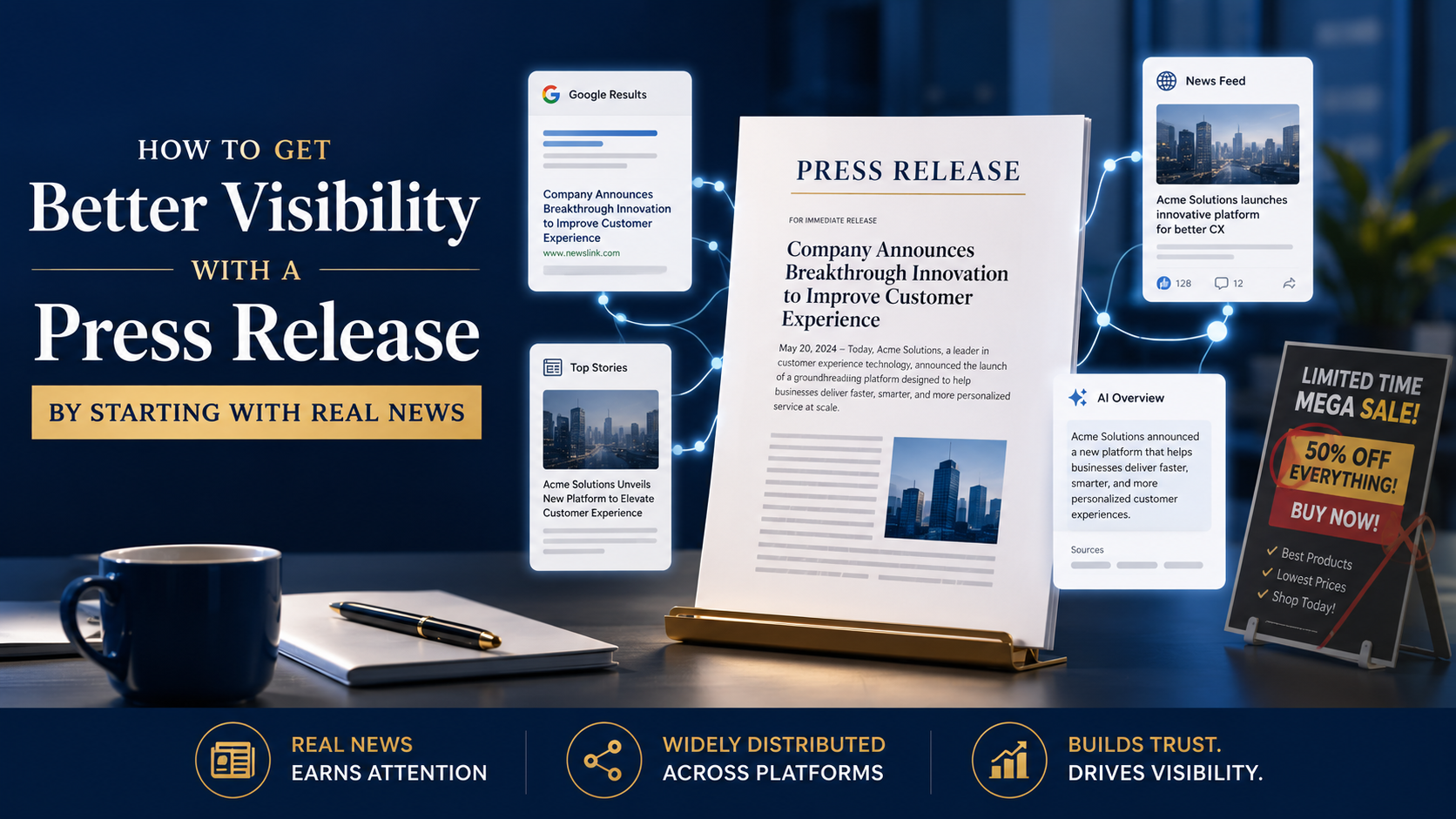
Many business owners submit press releases because they want visibility.
They want to be found online, appear in search results, build credibility, attract media attention, and now, increasingly, show up in AI-powered search results. Those are all valid goals. But the biggest mistake many businesses make is treating a press release like an advertisement, a blog article, or a generic advice piece. A press release can support visibility, but only when it is built around something real, timely, and newsworthy.
24-7 Press Release has covered this topic in similar articles before because we believe it is important for businesses to understand the value of creating credible, well-structured content that properly represents their company. As AI-powered search tools continue to improve, they are becoming better at recognizing the difference between clear, verifiable information and promotional hype. For more on this topic, read one of our recent articles: Why AI Search Is Rewarding Clear, Verifiable Press Releases Over Hype
A press release is not simply a place to say that a company is experienced, trusted, affordable, professional, or committed to customer service. It is also not the same as a tip article with a company name attached to it. For example, a headline such as “XYZ Flooring Encourages Los Angeles Homeowners to Plan Flooring Projects Around Durability, Moisture, Lifestyle and Indoor Comfort” may sound informative, but it does not clearly announce anything. It reads more like a soft advertisement or educational article than a news release. The company may have useful knowledge, but the release needs a stronger reason to exist.
The better approach is to start with the question: what actually happened? Did the company launch a new service, open a new location, publish a guide, release new data, expand into a new market, announce an event, form a partnership, win an award, reach a milestone, or respond to a timely trend? Those are the types of details that help turn promotional writing into legitimate news. A release should give readers a clear reason why the information matters now.
Using the flooring example, the company could create a stronger press release by connecting the advice to a real announcement. Instead of simply encouraging homeowners to think about flooring durability, the release might say, “XYZ Flooring Launches Los Angeles Flooring Planning Guide for Homeowners Managing Moisture, Durability and Indoor Comfort Concerns.” That headline still gives the company room to discuss useful homeowner considerations, but it now has a clearer news angle. The company has launched something. There is a location. There is an audience. There is a reason for the release.
This distinction matters even more as AI-powered search becomes part of how people find information. AI systems are designed to summarize and organize clear, factual content. A vague promotional release gives those systems very little to work with. A specific press release, on the other hand, gives clear signals: who is involved, what was announced, where it applies, why it matters, and what supporting details are available. That does not guarantee AI visibility, but it gives the content a better foundation.
Business owners should also understand that visibility does not come from stuffing a press release with keywords. It comes from clarity, structure, and credibility. A strong press release should answer the basic questions quickly. Who is the company? What is being announced? Where is it happening? When is it relevant? Why should the audience care? What quote, fact, milestone, program, report, or event supports the announcement? If those questions are hard to answer, the release may not be ready.
This is where many “expert tip” press releases fall short. A company may submit a release with a headline like “ABC Roofing Shares Tips for Homeowners Before Winter.” While that may be useful content, it is weak as a news release unless something specific is attached to it. A stronger version might be, “ABC Roofing Launches Winter Roof Inspection Campaign for Homeowners in Denver.” Now the release has a real action behind it. The company can still include winter roofing tips, but the news is the campaign, not just the advice.
For businesses submitting press releases, the goal should be to combine news value with useful context. A press release does not need to be dry or overly formal. It can educate readers, explain a trend, and provide helpful background. But the educational material should support the announcement, not replace it. The release should still be anchored in something concrete and follow proper press release writing protocol. Check out this article about proper press release writing structure: How to Write a Press Release: A Step-by-Step Guide for Businesses That Want Results
A simple test can help. Before submitting a press release, business owners should ask: would this still make sense if the company name were removed? If the answer is yes, it may be more of a generic article than a press release. Next, ask: did something happen that can be clearly stated in the headline or first paragraph? If the answer is no, the release likely needs a stronger news angle.
The best way to get visibility with a press release is to stop trying to disguise advertisements as news. Instead, start with a real announcement and build useful context around it. A strong press release is specific, timely, factual, and easy to understand. It tells readers what changed, why it matters, and who should care. That is what gives a press release a better chance of being accepted, read, shared, indexed, and understood by both people and AI-powered search tools.
In the end, a press release should not simply say, “We are a great company.” It should say, “Here is what happened, here is why it matters, and here is how it affects our audience.” That is the difference between promotion and news. It is also the difference between content that gets ignored and content that has a real opportunity to build visibility.
Where can I find more helpful information to write a press release? 24-7 Press Release Knowledge Base