 +1 888-880-9539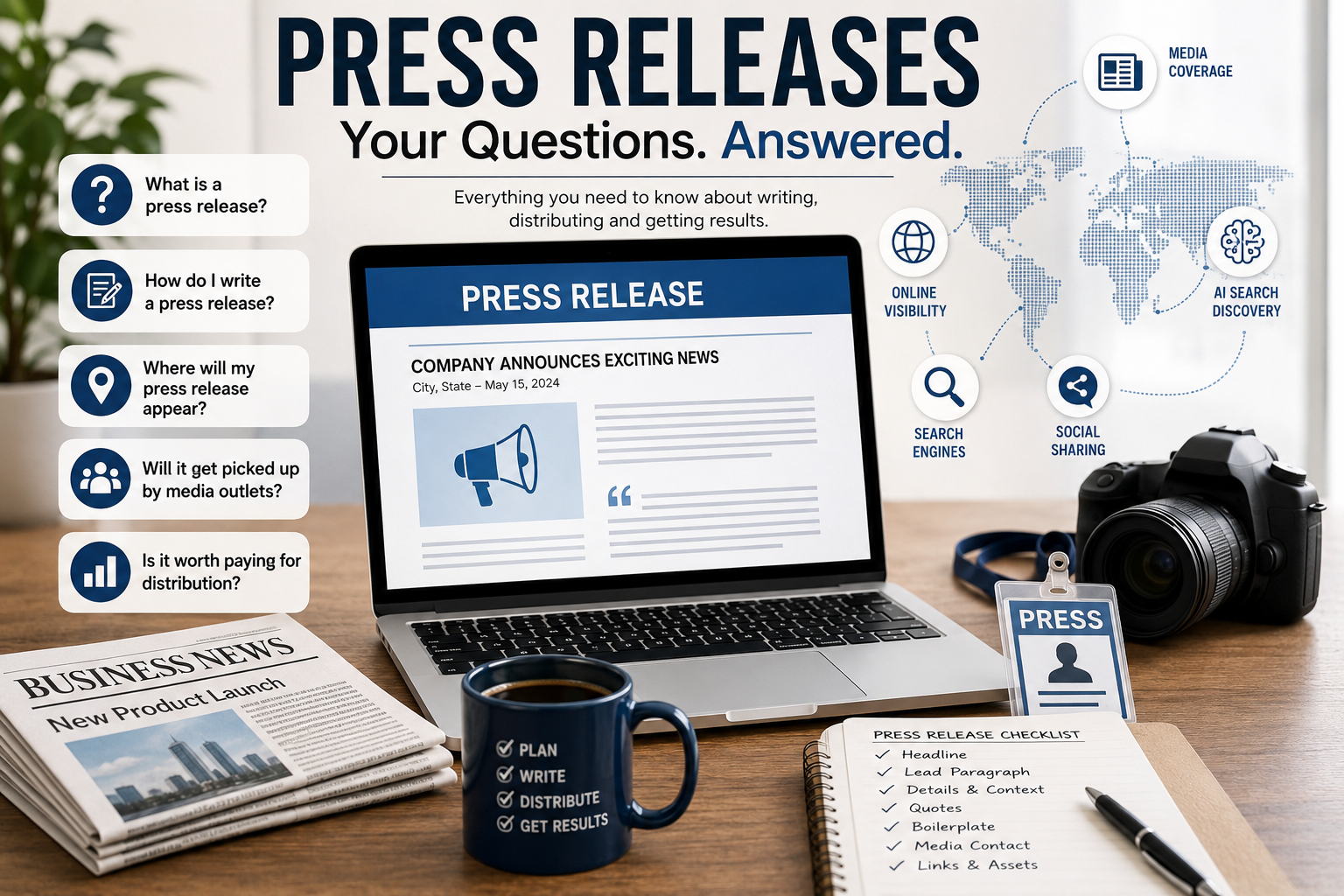
The concept of a press release for many small businesses sounds simple until it is time to actually write, submit, and distribute one. Then the questions begin. What should it include? How long should it be? Where will it appear? Will journalists see it? Is paid press release distribution worth it? These are some of the most common questions people ask online, including in marketing forums, Reddit discussions, public relations communities, and search results. The good news is that most of the confusion comes down to one thing: understanding what a press release is meant to do, and what it is not meant to guarantee.
What is a press release?
A press release is an official announcement written by a company, organization, author, professional, nonprofit, or public figure to share news with the media and the public. It is usually written in a clear news-style format and includes the most important facts first. According to PR Newswire, a press release provides basic information to journalists, who may use it as a starting point for a story. That does not mean every press release becomes a major news article, but it does mean the release gives your announcement a professional, searchable, and shareable format.
While the previously stated information remains generally accurate, our experience at 24-7 Press Release has shown that many news outlets are now publishing full press releases more frequently. In many cases, this appears to be the result of reduced newsroom staffing and ongoing financial cutbacks, which have left editors and journalists with less time to substantially rewrite submitted content than they may have had in the past.
A press release can announce many types of news, including a new product, company launch, book release, event, award, partnership, expansion, appointment, study, milestone, or community initiative. The key is that the announcement should have a real reason for being published. A press release should not read like an advertisement. It should explain what happened, why it matters, who is involved, and where readers can learn more.
How do I write a press release?
The best way to write a press release is to start with the news, not the promotion. Before writing, ask yourself: what is the actual announcement? If someone had only ten seconds to understand the story, what would they need to know? A strong press release usually begins with a clear headline, followed by a first paragraph that answers the basic who, what, when, where, why, and how.
The body of the release should add supporting details, context, and quotes. It should explain why the announcement matters, not just that it happened. For example, instead of only saying a company launched a new service, the release should explain what problem the service solves, who it helps, and what makes it timely or relevant. For a more detailed writing process, this guide on how to write a press release breaks the process down step by step for businesses that want stronger results.
What should be included in a press release?
A press release should include a headline, dateline, opening paragraph, body copy, quote, boilerplate, media contact information, and relevant links. The headline should summarize the announcement clearly. The opening paragraph should give readers the most important facts right away. The body should provide details, proof points, background, and context. A quote from a company leader, spokesperson, customer, author, or subject-matter expert can help make the release more human and credible.
Most releases should also include a boilerplate, which is a short “About” paragraph describing the organization. Media contact information is important because journalists, bloggers, podcast hosts, and other interested readers may need to follow up. If available, include a website link, product page, event page, media kit, or relevant supporting source. This guide to press release components also emphasizes that structure helps journalists scan the content quickly and find the facts they need.
How long should a press release be?
A press release should usually be long enough to explain the announcement clearly, but short enough to stay focused. In most cases, 400 to 700 words is a practical target. Some simple announcements may only need 300 to 500 words. More detailed announcements, such as major partnerships, research findings, company expansions, or legal/business updates, may need more room.
The mistake many people make is trying to include everything. A press release should not be a full website, brochure, biography, or sales page. It should focus on the announcement and support it with the most relevant information. If there are additional details, they can be linked instead of fully included. A concise release is often easier for journalists, customers, search engines, and AI answer engines to understand.
Are paid press release distribution services worth it?
Paid press release distribution services are absolutely worth it when you understand what you are buying. A distribution service can help publish, host, and syndicate your announcement across a network of media, news, search, and various news websites. It can give your release a public URL, help it appear in search results, provide reporting, and create a professional record of your announcement.
However, paid distribution should not be confused with guaranteed editorial coverage. Although a press release appearing on a news or syndication site is not the same as a journalist independently writing a feature story about your company, there is still good value. Distribution creates visibility and availability; earned media depends on newsworthiness, timing, relevance, journalist interest, and follow-up outreach. This is why a press release often works best as one part of a larger communications strategy, not the entire strategy. Many clients at 24-7 Press Release have been published in subsequent valuable publications, but no press release service should guarantee it.
What is the difference between press release distribution and media pitching?
Press release distribution means publishing and sending your announcement through a distribution network so it can appear online and become available to media outlets, search engines, databases, and readers. Media pitching is different. Pitching usually means contacting specific journalists, editors, producers, bloggers, or podcast hosts with a tailored story idea.
Both can be useful, but they serve different purposes. Distribution gives your announcement a formal public presence. Pitching is more personal and targeted. A strong strategy may use both: first publish a well-written release, then use that release as support when contacting relevant journalists. The release gives your pitch credibility because it shows the story is organized, sourced, and publicly available.
Where will my press release actually appear?
Where a press release appears depends on the distribution service, package, editorial guidelines, timing, and type of announcement. Some releases may appear on hundreds of websites through syndication. Others may appear on a smaller network, depending on category, region, or package level. A release may also be indexed by search engines, shared on social media, linked from a company website, or used in email outreach.
It is important to understand the difference between publication, syndication, indexing, and editorial coverage. Publication means the release has been posted and hosted. Syndication means it has been distributed to partner sites or feeds. Indexing means a search engine has discovered and included it in search results. Editorial coverage means a journalist or media outlet has chosen to write or produce their own story based on the news. For a deeper explanation of what happens after distribution, this article on how to write a press release that gets found in AI search, Google News, and traditional media is useful because it explains how releases can be written for AI search, Google News, and traditional media visibility.
Will my press release get picked up by major media outlets?
A press release can be seen by media outlets, but no ethical distribution service should promise guaranteed editorial coverage in a major media outlet. Journalists decide what they cover based on relevance, audience interest, timing, evidence, and news value. A release about a small local event may be very relevant to a community outlet but not to a national publication. A release about a major funding announcement, unusual trend, original research, or public-interest issue may have broader appeal.
The best way to improve your chances of pickup is to make the release genuinely useful. Include clear facts, credible quotes, strong context, and proof points. Avoid hype, vague claims, and exaggerated language. If your announcement includes data, customer impact, expert commentary, or a timely connection to a broader trend, it may be more attractive to media. This article on how to write a press release that builds trust explains how facts, quotes, boilerplates, and proof points can make a release more credible.
How much does a press release cost?
The cost of a press release can vary widely. Some companies write and publish releases themselves. Others hire freelancers, public relations agencies, or distribution services. Distribution pricing can range from budget-friendly options to several hundred or even several thousand dollars, depending on the provider, geographic reach, word count, multimedia options, targeting, and reporting. At 24-7 Press Release, our press release distribution packages start at $49 and go up to $479. More about our distribution packages may be found here: Press release pricing plans
For example, large wire services often charge more because they may offer broader networks, investor relations options, regulatory disclosure tools, or specialized targeting. Smaller businesses, startups, authors, and local organizations may prefer more affordable services that still provide online publication, syndication, search visibility, and reporting. One PR resource notes that cost can depend on factors such as distribution reach, add-ons, and the type of visibility a business wants.
When should I send a press release?
The best time to send a press release depends on the announcement. If the release is tied to an event, launch, opening, or deadline, it should be sent early enough for people to act on it. For an event, that may mean days or weeks in advance. For a product launch, it may mean coordinating the release with the launch date, website updates, social media, and email campaigns. For awards, milestones, or evergreen announcements, timing may be more flexible.
Many businesses prefer sending releases earlier in the week and during business hours, but timing alone will not make a weak story successful. The more important question is whether the release is ready, accurate, timely, and connected to a real announcement. Another PR sources explains that timing depends on the type of news, the audience, and whether you are sending a release through a distribution service or pitching a journalist directly.
Are press releases still useful for SEO and AI search?
Press releases can still support search visibility, but they should not be treated as a shortcut for ranking. Years ago, some companies used press releases mainly for backlinks and keyword stuffing. That approach is outdated. Today, the better value comes from publishing clear, factual, well-structured announcements that search engines, journalists, customers, and AI systems can understand.
A modern press release can help create a credible public record of your news. It can include your company name, key people, product names, locations, dates, facts, quotes, and links to relevant pages. This structured information can help search engines and AI answer engines understand who you are and what you announced. The release should be written for humans first, but clarity, structure, and factual consistency also help machines interpret the content.
What makes a press release newsworthy?
A press release is newsworthy when it gives people a reason to care now. A new product may be newsworthy if it solves a timely problem or introduces something meaningfully different. A company milestone may be newsworthy if it shows growth, community impact, innovation, or industry relevance. A new hire may be newsworthy if the person is well known, the role is significant, or the appointment signals a strategic change.
Newsworthiness often comes from timing, impact, proximity, conflict, novelty, human interest, data, or authority. A release does not need to be world-changing, but it should have a clear angle. Before submitting, ask: why would a journalist, customer, investor, partner, or community member care about this announcement today? If the answer is not obvious, the release may need a sharper focus.
What is the biggest mistake people make with press releases?
The biggest mistake is writing a press release like an advertisement instead of a news announcement. Phrases like “best-in-class,” “revolutionary,” “game-changing,” and “world-leading” often weaken a release if they are not backed by proof. Journalists and readers are more likely to trust specific facts than broad claims.
A better approach is to show credibility through details. Instead of saying a company is growing rapidly, mention the new location, number of employees, customer milestone, funding amount, partnership, or measurable result. Instead of saying a product is innovative, explain what it does differently. Instead of saying an organization is trusted, include a relevant award, certification, client result, expert quote, or third-party source. The more specific the release is, the more useful it becomes.
What should I expect after submitting a press release?
After submitting a press release, you should expect the release to go through review, approval, distribution, publication, and reporting, depending on the service you use. You may receive a live link, distribution report, pickup report, or analytics. Your release may appear on partner sites, be available to search engines, and become something you can share on your website, social media, email newsletter, investor updates, or sales materials.
What you should not automatically expect is instant fame, guaranteed sales, viral traffic, or a front-page media story. A press release is a visibility and credibility tool. It gives your announcement a professional format and helps make it discoverable. The best results usually happen when the release is part of a larger plan that includes a strong website, social media, direct outreach, email marketing, customer communication, and follow-up pitching.
Final thoughts: What should a press release really do?
A press release should make your news easier to understand, easier to find, easier to verify, and easier to share. It should answer the questions people are already asking: what happened, why does it matter, who is involved, where can I learn more, and why should I trust it? When written properly, a press release can support media outreach, online visibility, AI search discovery, customer trust, and long-term brand credibility.
The most successful press releases are not the ones filled with the most hype. They are the ones that clearly explain a real announcement with useful facts, credible quotes, and a strong reason for readers to care. Whether you are launching a product, announcing a partnership, promoting an event, sharing a milestone, or building your public record, a well-written press release remains one of the most practical tools for getting your news into the world.